
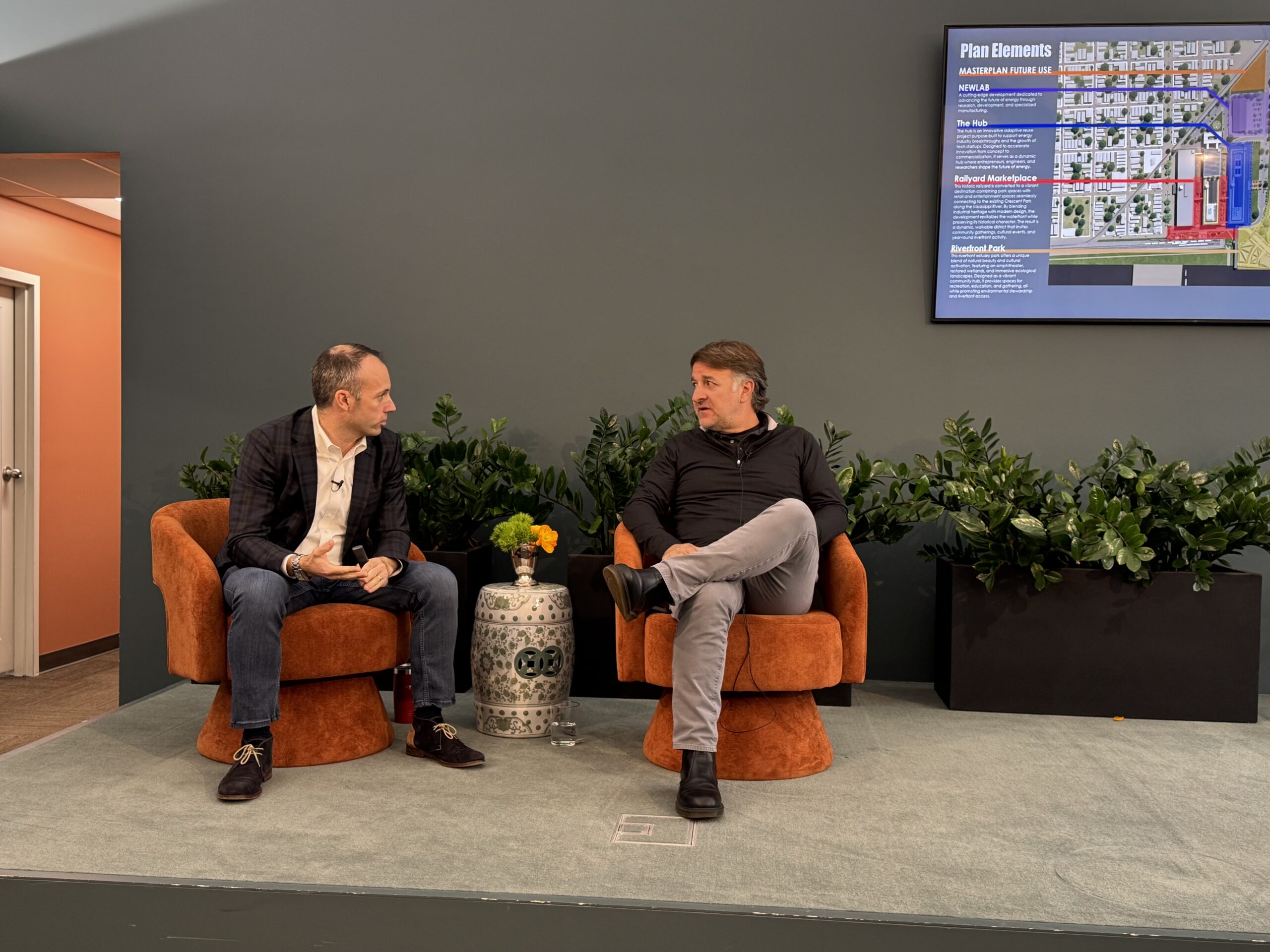
Developer Brian Gibbs on converting the former Naval Support Activity base in the Bywater into the largest Low Income Housing Tax Credit project in Louisiana history, and what it could mean for a neighborhood that has been waiting a long time.
For decades, three half-million-square-foot industrial buildings sat fenced off on the Bywater riverfront, assembled tanks during World War I, housed a thousand naval workers after that, and then slowly became one of the most visible symbols of post-Katrina stagnation in the city. The gates are finally coming down.
Brian Gibbs, developer and principal of Brian Gibbs Development, LLC, stepped into a project that another developer had spent years trying to unlock, and that was heading back to the city the day a $20 million state grant came through. What followed was the most complex financing stack ever assembled for affordable housing in Louisiana: $197 million, 294 units, federal and state tax credits, a HUD loan, city and state grants, and a California partner who added a rooftop pool. Construction started the day after closing.
The former Naval Support Activity (NSA) base in the Bywater is a 23-acre campus of three buildings, each roughly 600 feet long and 150 feet deep, a half million square feet per structure. Here is where the project stands.
It ended up being the largest Low Income Housing Tax Credit project in the history of the state of Louisiana. It’s $197 million this first phase, it’s 294 units. There’s historic tax credits, federal and state low income tax credits. The city’s coughed up money.Brian Gibbs, Developer & Principal, Brian Gibbs Development, LLC
The project’s origin story involves a death, a car accident, and an unlikely inheritance. Joe Yeager (hotelier, contractor, and real estate operator) had held the 99-year lease on the NSA site from the city for years, working to unlock the financing needed to make the numbers work. He had been waiting on a state gap-funding award when he was struck by a car on the North Shore in the summer of 2024.
Yeager died on or around June 25, 2024. On July 3, eight days later, the state announced its CDBG awards, and his estate was on the list for $20 million. His estate contacted Gibbs, who had been advising on the HUD loan application, and asked him to take the project over. The alternative was returning the keys to the city. Gibbs said yes, having never previously completed a LIHTC deal.
The first two buildings are under construction. The third, the one closest to the Industrial Canal, is a different problem. The city contributed $6 million to stabilize its exterior: windows, paint, and a building envelope, essentially a movie-set shell while a long-term plan takes shape. Inside, it needs environmental remediation.
Louisiana Economic Development awarded the project Fast Sites dollars: $7 million to clean out the building’s interior. Gibbs says it was the only project in New Orleans to receive a Fast Sites award in that round. The working vision for the space is a jobs-creation hub that graduates companies out of New Lab into the larger structure, with ground-floor retail, art galleries, a vo-tech school, and destination tenants curated to draw the neighborhood in the way Magazine Street draws people to meander.
The model Gibbs keeps returning to is Industry City in New York, a campus where the draw is the aggregation of things to do, not any single anchor. He is also in conversations about a grocery store and has had an inquiry from Waymo. The lease from the city runs for 99 years at $150,000 a year for the entire campus.
As a developer, I’m like a victim of the food chain, so to speak, like I’m the low man on the totem pole. I can’t force the incomes of people to go higher so they can pay more rent or buy a bigger house. But this is our opportunity to get move up the food chain and create jobs.Brian Gibbs, Developer & Principal, Brian Gibbs Development, LLC
Since 1918, the entire NSA campus has been fenced off from the surrounding neighborhood. Gibbs intends to change that completely. The site sits at what locals call “the End of the World” (the point where the Industrial Canal meets the Mississippi River), and he describes it as feeling like Audubon Park’s fly, just on the other end of the city.
He has met with Audubon’s Mike Sawaya and Ron Foreman about programming the riverfront edge as a low-touch park: native plants, a spine running along the canal, parking on both sides, and a pedestrian connection to Crescent Park, which is roughly 500 yards away. An economic development district would generate sales tax revenue to sustain the park without requiring the zoo or a nonprofit to absorb operating losses. The 880-car parking structure, with roughly 400 to 500 spaces reserved for residents and the balance open to the public, would anchor access for visitors arriving by car, while bike and pedestrian paths serve those coming from the neighborhood.
The term “affordable housing” carries a lot of baggage. Gibbs is direct about what this project actually delivers. All 294 units in the first phase are income-restricted, not a mix with market-rate units on top. The income range runs from 30% to 80% of Area Median Income (AMI), using income averaging across the project. At 80% AMI in New Orleans, the qualifying income is roughly $44,000 a year for an individual household.
Rents are structured so that tenants pay approximately 30% of their income toward housing. The affordability commitment runs for 40 years, as do the property tax abatements the city and state have provided. Lincoln Avenue Communities pushed significantly higher finish standards than the original project contemplated (hotel-quality lobby, rooftop swimming pool and cabana) specifically to attract working residents who have options. Their comparable project, the Tivoli at the former Lee Circle, filled in three months and has a three-year waiting list. That is the benchmark Gibbs is building toward.
You got to make the product so nice that people want to live there. And that’s how, like, that’s where the teachers and folks like that get in there, and it’s actually helps them as they’re moving along.Brian Gibbs, Developer & Principal, Brian Gibbs Development, LLC
The NSA Bywater project does not exist in isolation. Across town, the River District, the stretch running from the power plant at Market Street through the convention center, has just topped out its first new office building in decades. Shell is moving 700 employees into roughly 150,000 square feet there, with an $80 million core-and-shell cost and a $30 million tenant buildout. The Gulf of America deep-water group is relocating its headquarters to that building, led by Colette Hurst, a New Orleans native who was just named head of Shell USA, the first time that role will be based in this city.
Gibbs is a co-developer on the River District project alongside Laura Sella and the broader development team. The two projects (one at the upriver edge of downtown, one at the downriver edge of the Bywater) represent the largest simultaneous bets on New Orleans’ urban core in a generation.
Brian Gibbs closed a $197 million deal he had no business being in (by his own admission, he had never done a LIHTC project before) and broke ground the next day. The NSA Bywater campus will add 294 high-finish affordable units, a clean energy innovation hub, 20 newly public riverfront acres, and an 880-space parking structure to a neighborhood that has been land-locked by a fenced industrial ruin since 1918. The financing is done, Broadmoor is on site, and the target is December 2027. What happens in the third building (half a million square feet, remediated and ready) is the next decision that will define what the Bywater becomes.
About this series. KW New Orleans hosts regular conversations with the leaders shaping our city: developers, architects, investors, and operators building the New Orleans of tomorrow. These are the conversations that happen in the rooms most people don’t get invited into.
Be in the Room Where It Happens
KW New Orleans brings together the sharpest minds in real estate, development, and hospitality. If you’re ready to work alongside people building the city’s future, we’d love to talk.
Connect With Our TeamExplore the Neighborhood