
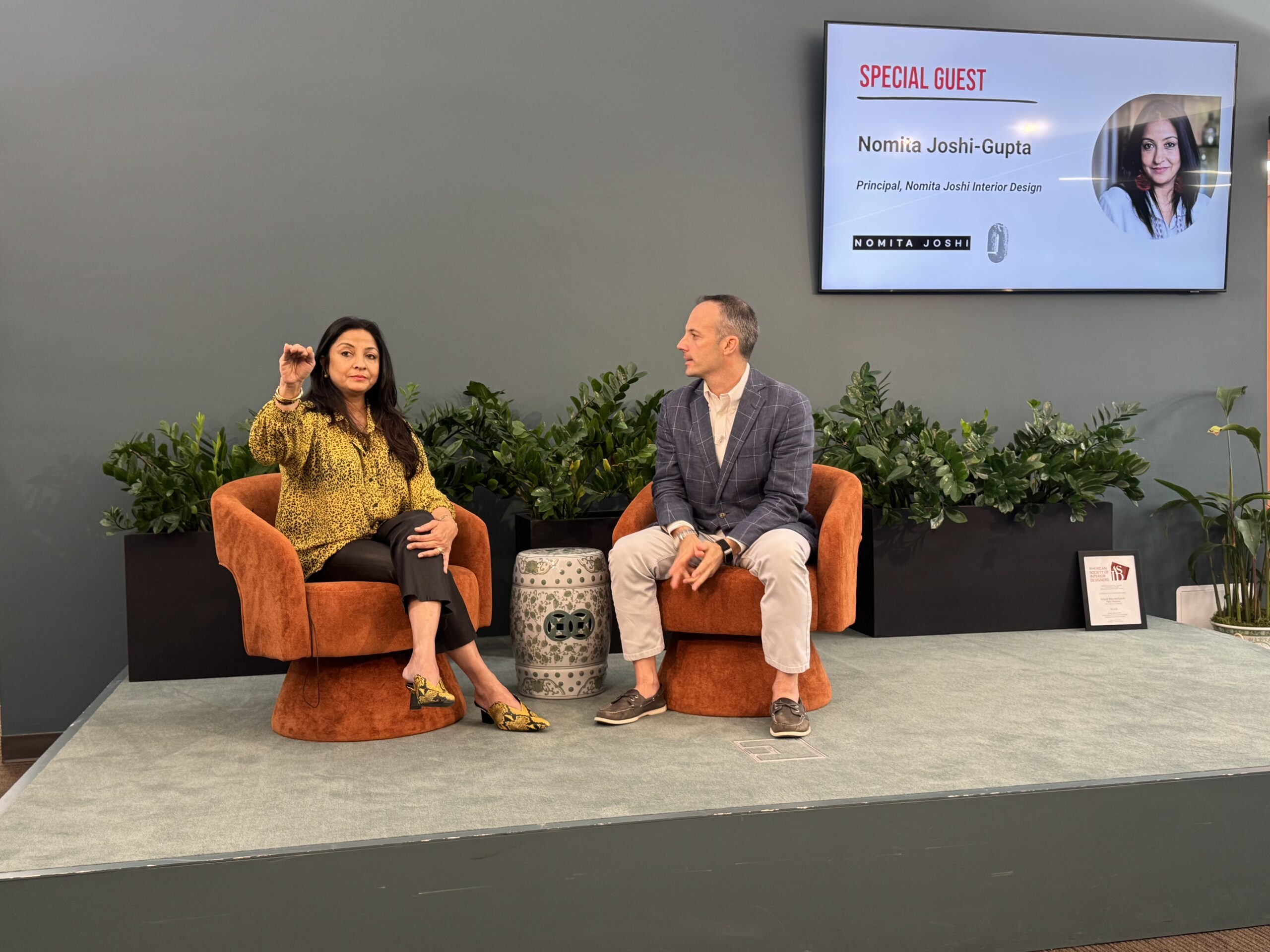
Nomita Joshi-Gupta, Principal of Nomita Joshi Interior Design, on how compression and expansion sell homes, why color is therapy, and the design philosophy behind the KW New Orleans office transformation.
The office you walk your clients into is doing sales work before you say a word. That’s not a metaphor; it’s architecture. And the team at KW New Orleans learned it firsthand when they handed the keys to a mid-century modernist building full of cubicles to an interior designer who understood both the building’s bones and the brokerage’s soul.
Nomita Joshi-Gupta joined the KW New Orleans weekly meeting to walk agents through the decisions behind the office’s renovation, and why nearly every principle she applied to this space translates directly to how agents should think about the homes they sell.
Watch the Conversation
When Nomita first walked into the KW New Orleans building on River Road, she saw something other designers missed: the building wasn’t a problem to fix; it was a vocabulary to translate. Here is what that approach looked like in practice.
You wanted to transform it into a place where people felt welcome. Your clients felt like you were coming to maybe like a boutique hotel, or like a living room, or also a place which had cultural identity from many places, but not necessarily rooted in one, because New Orleans is kind of like a culture of many.
Nomita Joshi-Gupta, Principal, Nomita Joshi Interior Design
The wall behind the main meeting space, the one everyone notices first, was not the result of a single inspired decision. It went through multiple full iterations before the final version existed. That process is itself the lesson.
The original vision was a stylized house form with a slot window, architectural without being obvious. The platform beside it was built, torn down, and rebuilt in a different location. At one point there were round steps. Through all of it, Nomita’s guiding principle was to suggest the idea of home without illustrating it. The mid-century lattice that finally resolved the wall drew from an image the clients had brought back from Colorado: an open-close indoor-outdoor feeling that Lauren Doussan ultimately realized by hand, weaving the entire structure herself with a newborn in a carrier on the floor. Nomita looked at it and said: that’s it. The American Society of Interior Designers South Central chapter later awarded the project a silver award in the small commercial category.
Nomita makes a clean distinction between color as aesthetic choice and color as psychological environment, and argues that most people default to white precisely because it protects them from exposure.
When working with clients on color, she starts with what they’re drawn to and, more importantly, what they actively dislike. Color palettes are then built to guide movement through a home, functioning the same way compression and expansion do spatially: each color is experienced in relationship to the one beside it, not in isolation. For smaller New Orleans doubles where architectural compression is hard to achieve structurally, color and wallpaper become the primary tools for creating that same sense of coziness or openness.
Her advice to agents whose clients are preparing to sell a boldly colored home: resist the impulse to whitewash everything. Edit instead. Remove visual clutter, create coherence, and let the intentionality of the choices do the selling. The home with a legible design story moves faster than the one scrubbed into neutrality for a hypothetical buyer who may not exist.
I was watching a video the other day about some designer who said, don’t design your home for someone else. Design it for yourself. Design it for yourself. And then the buyers will come. They’ll buy it.
Nomita Joshi-Gupta, Principal, Nomita Joshi Interior Design
One of Nomita’s most direct challenges to the agents in the room: every house has a story, and it’s the agent’s job to know it and tell it.
When she approaches a new project, she builds a muse and a narrative before she touches a material: who is the person walking through this space? What does this house want to be? She applied that same lens to 1914 Esplanade Avenue, a home on Bayou Road that her firm designed and that is now on the Preservation Resource Center’s Spring Tour (May 9–10). The house is the last documented work of architect Henry Howard, built in 1914, and known as the Tête House, notable for a dramatic staircase built to a specific scale for its original occupant. The clients pushed for bold color throughout, and Nomita pushed back harder. The result will be open top to bottom for tour visitors.
For agents, the application is immediate: being able to reference a home like this one (to say I walked through one of the most colorful houses on Bayou Road last spring, and here’s what was possible) is the difference between describing a neighborhood and selling a dream. Robert Cannon, a noted New Orleans artist whose home is on the cover of the PRC print, is also featured in the tour.
Every plant in the KW New Orleans office is real, and that was not an accident.
Nomita points to Mexico City, one of the most densely populated cities on earth, as a model: nearly every establishment there integrates living plants at a scale that feels like walking into a greenhouse. The effect is calm, not chaos. Living plants provide a texture and luminosity that no object or artificial alternative can produce, and they create a relationship between the occupant and the natural world that quietly shifts how a space feels to be inside of it. In an office people come to every day, or a home someone is trying to imagine themselves living in, that matters.
Every home is kind of like a mirror of that person. You know what they’re like? I’m here as a designer to put that person’s vision together. But the end of it, it’s a mirror to them. Their lifestyle and their soul a little bit.
Nomita Joshi-Gupta, Principal, Nomita Joshi Interior Design
The KW New Orleans office is home court advantage, and now agents know exactly why it works and how to talk about it.
Every conference room, every corridor transition, every fixture was argued over, built twice, and chosen deliberately. Being able to articulate that to a client (to walk them through a space and explain the compression before the kitchen, the reason the carpet stayed, why the ceiling troughs glow at night) is the same skill that sells homes. Design literacy is a competitive edge. Knowing a project like 1914 Esplanade, knowing a designer like Nomita, knowing the story of the Tête House: these are the details that separate agents who describe properties from agents who make people want to live inside of them.
Nomita Joshi-Gupta turned a cubicle farm into an award-winning workspace by refusing to be literal about what an office, or a home, is supposed to look like. She reads buildings the way good agents should read neighborhoods: for what’s already there, what story it wants to tell, and who belongs inside it. Her framework of compression and expansion, color as therapy, and design as a mirror of the soul isn’t abstract theory; it’s a practical tool for anyone who walks clients through spaces for a living. As bold color continues to move New Orleans homes faster than neutral palettes, and as the Preservation Resource Center Spring Tour opens the Tête House to the public this May, agents who understand the language of intentional design will have something to say that their competition doesn’t.
About this series. KW New Orleans hosts regular conversations with the leaders shaping our city: developers, architects, investors, and operators building the New Orleans of tomorrow. These are the conversations that happen in the rooms most people don’t get invited into.
Be in the Room Where It Happens
KW New Orleans brings together the sharpest minds in real estate, development, and design. If you’re ready to work alongside people building the city’s future, we’d love to talk.