
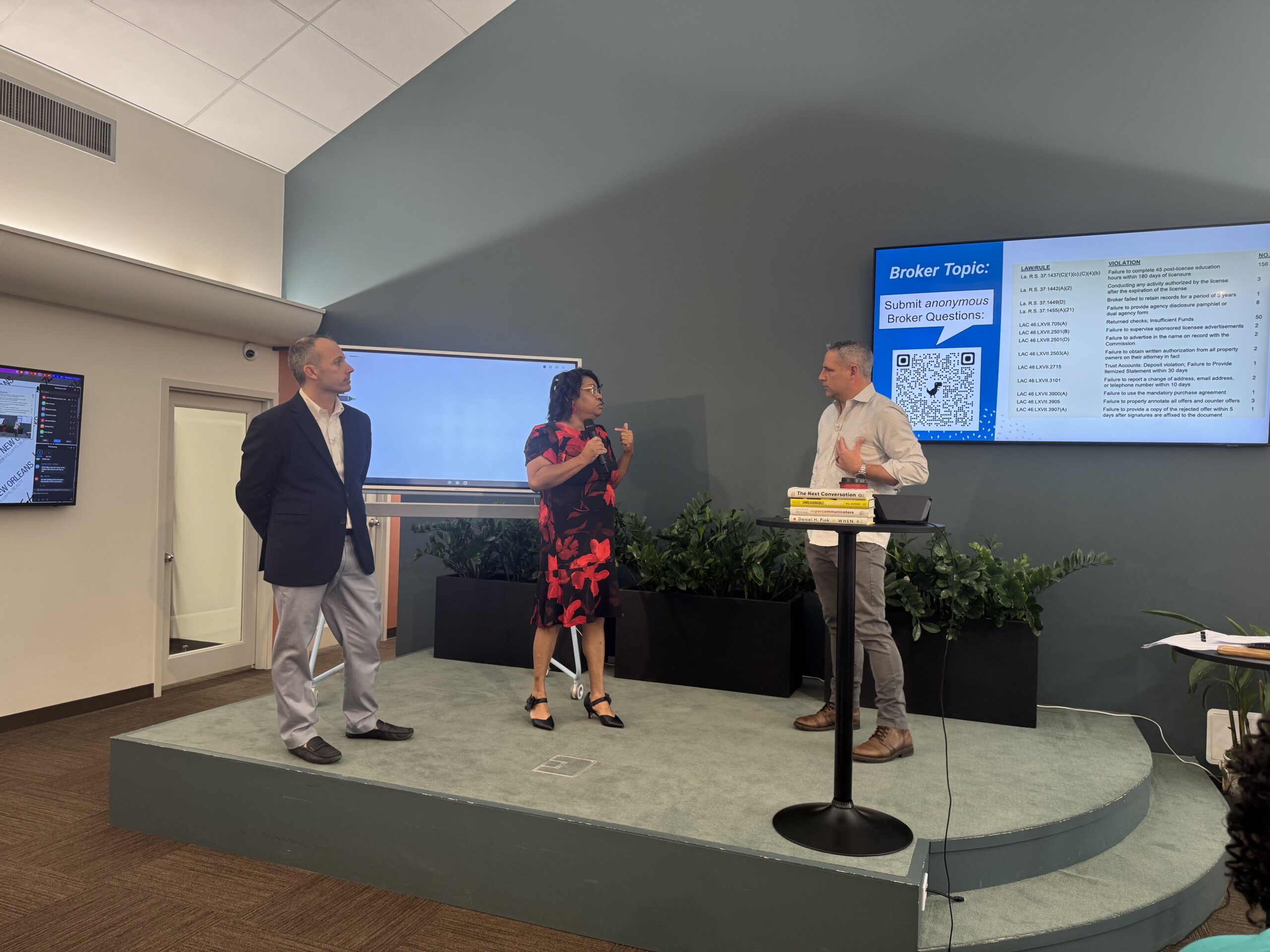
The KW New Orleans leadership team breaks down the LREC Q1 violation report, and what 50 bounced escrow checks reveal about who you should trust with your client’s deposit.
When the Louisiana Real Estate Commission newsletter lands in your inbox, most agents skim the president’s letter and move on. The violation summary buried at the back, the one listing what actually went wrong across the state last quarter, is where the real education lives.
The KW New Orleans leadership team (Cody Caudill, Jeffrey Doussan, and Nichole Donald) turned that violation report into a teaching moment during a recent team session, working through what each line item means for agents in the field and the clients depending on them.
The LREC Q1 violation report surfaced a cluster of compliance failures that reflect real pressure points in the current market. Each one has a direct consequence for working agents.
It’s very important that you’re in business with a brokerage that is, I won’t say legitimate, but can afford and runs their financials in a way that you know it’s secure.
Nichole Donald, Coach & Co-Broker, KW New Orleans
The conversation grew pointed when the team addressed a scenario that is reportedly happening right now: listing-side brokerages demanding that the buyer’s earnest money deposit be held at their office, with no alternative offered.
Under Louisiana law, the buyer, not the listing brokerage, has the right to direct where their deposit is held. A brokerage cannot unilaterally require that funds flow to their escrow account as a condition of the transaction. If a listing side pushes back, the team’s advice is clear: put your client’s preference in writing and, if necessary, reference the LREC for clarification.
The preferred alternative is a reputable title company. That preference isn’t just procedural; it’s financial protection. As the Q1 report demonstrates, some brokerages are holding deposits they cannot cover. A bounced check on an earnest money deposit mid-transaction can unravel a deal and expose both buyer and agent to real losses.
You do not want it to go to that brokerage. You want it to go to a title company. And again, that’s another issue: you want to make sure you’re in business with a good title company.
Nichole Donald, Coach & Co-Broker, KW New Orleans
One exchange in the session cut to a question agents regularly sidestep: what are your obligations when agency was never formally established?
The scenario (an out-of-town seller, no signed listing agreement, and an offer arriving from a family member of the property’s occupant) surfaced an obligation agents often don’t think through in advance. Without an agency relationship in place, the duty to present a rejected offer (or document its rejection) is legally ambiguous. The LREC lists “failure to provide copy of rejected offer” as a violation category precisely because the obligation exists in most circumstances, and agents are penalized when they assume the absence of a listing agreement eliminates it entirely.
The team’s practical guidance: establish agency in writing before you engage with any offer, on any property. Paperwork created after the fact rarely holds up in a complaint proceeding.
When we get this every quarter, take a look at it, because it’s eye opening.
Nichole Donald, Coach & Co-Broker, KW New Orleans
The LREC publishes its violation summary quarterly inside its standard newsletter distribution, the same email most agents delete after reading the headline item. Nichole Donald’s position on appeal panels means she encounters these cases before they become statistics. Her instruction to the team is simple: read the violations section every time it comes out.
The value isn’t punitive awareness; it’s anticipation. The violations that repeat quarter after quarter are the ones that catch experienced agents off guard because they involve judgment calls, not ignorance. Knowing that “failure to obtain written authorization from all property owners” appeared in Q1 prompts a different checklist conversation the next time a listing has multiple owners on the deed.
Fifty returned escrow checks in a single quarter is not a market anomaly; it’s a structural warning. The KW New Orleans leadership team is telling agents to treat deposit placement as a financial due-diligence decision, not a default courtesy to the listing side. Verify that whichever party holds escrow (brokerage or title company) can actually cover it. Establish agency in writing before offers arrive. Use the mandatory purchase agreement. And read the LREC violation report every quarter: Nichole Donald sits on the appeal panels producing those numbers, and the patterns she’s watching now are the compliance gaps that will surface in your transactions next.
About this series. KW New Orleans hosts regular conversations with the leaders shaping our city: developers, architects, investors, and operators building the New Orleans of tomorrow. These are the conversations that happen in the rooms most people don’t get invited into.
Be in the Room Where It Happens
KW New Orleans brings together the sharpest minds in real estate, development, and hospitality. If you’re ready to work alongside people building the city’s future, we’d love to talk.