
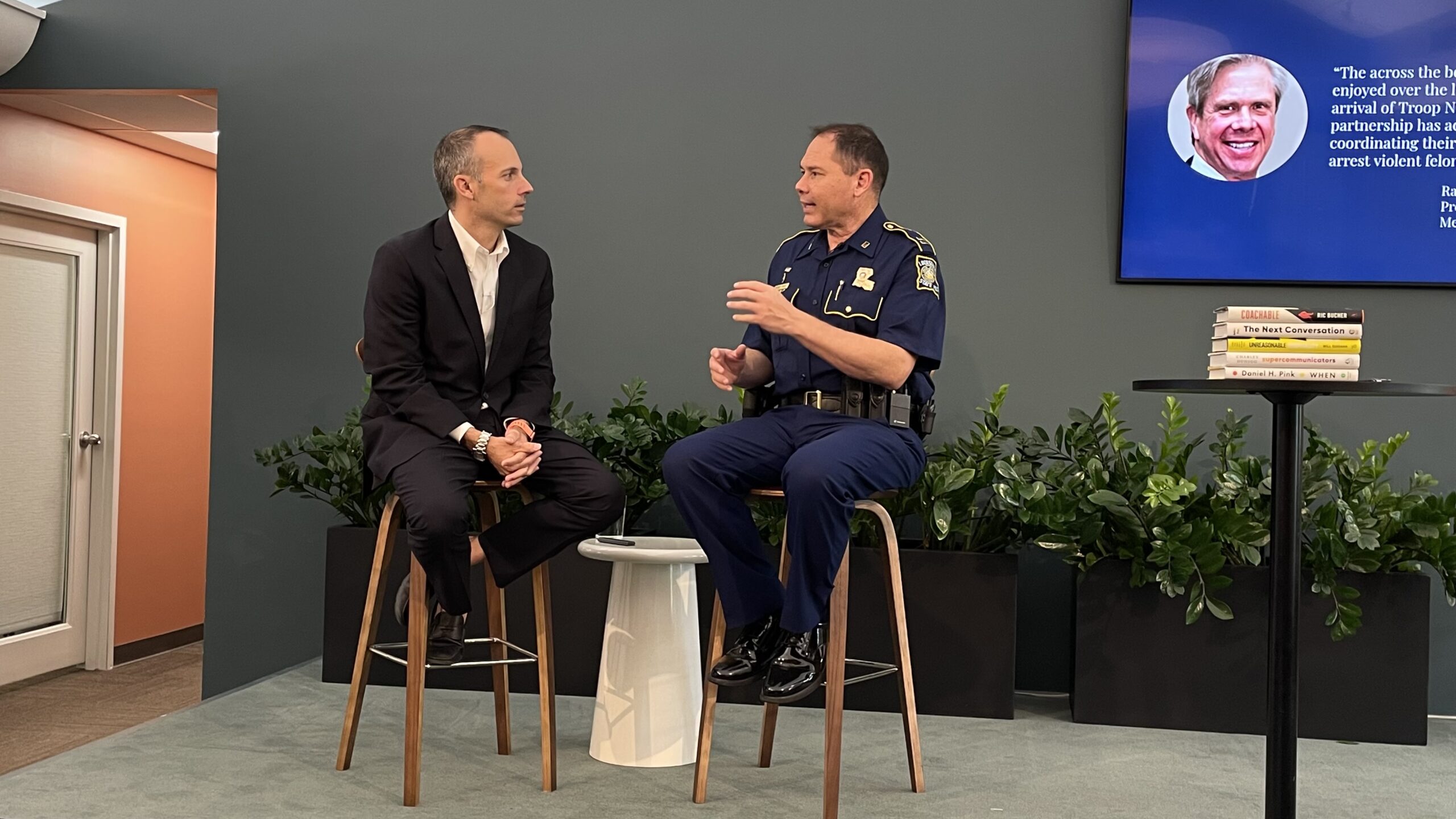
Commander Rodney Hyatt of the Louisiana State Police Troop NOLA on cutting carjackings by nearly 90%, building collective efficacy block by block, and why New Orleans could be on pace for fewer than 100 homicides this year.
Why It Matters
For years, the single biggest drag on New Orleans real estate wasn’t interest rates or inventory; it was the feeling that the city wasn’t safe. That feeling shapes everything: whether families stay, whether buyers commit, whether developers bet on a neighborhood. Change the safety picture and you change the investment thesis for the entire city.
Commander Rodney Hyatt leads Louisiana State Police Troop NOLA, a permanent, citywide troop created by Governor Jeff Landry, unlike anything that existed before. In conversation with KW New Orleans Operating Principal Jeffrey Doussan, Hyatt laid out exactly how a theory-driven, ego-free coalition of law enforcement agencies has produced crime reductions that are reshaping how people think about living, buying, and investing in New Orleans.
The State of Play
When Troop NOLA launched, it inherited a city averaging roughly 220 homicides a year in the years following COVID, according to data cited by the Metropolitan Crime Commission. The mandate from Governor Landry was blunt and offered no roadmap: make New Orleans the safest city in the nation. Here is what Hyatt built.
The ultimate goal of Troop NOLA is not necessarily to reduce crime. We focused on building collective efficacy in the community, which means that you have to have the community care about their community so much that they police it and they change it.
Commander Rodney Hyatt, Troop NOLA, Louisiana State Police
The Numbers Behind the Shift
Raw crime data from the Metropolitan Crime Commission tells a story that would have seemed implausible five years ago. Carjackings, which sat at 241 in 2020, had fallen to 31 at the time of this conversation. Homicides have dropped by roughly half from their post-COVID peak. According to Hyatt, 2024 was the year the acceleration really took hold, with a 46% decline from prior benchmarks.
Sustaining double-digit percentage drops compounds in difficulty as the baseline falls; Hyatt acknowledges that openly. But the trajectory is notable enough that New Orleans was on pace, as of this interview, to record fewer than 100 homicides for the year. For context, the city was once cited as the murder capital of the country and was regularly surpassing 300 annual homicides in earlier peak years.
For anyone thinking about buying or investing in New Orleans real estate, those numbers matter beyond the headline. Neighborhoods that felt untouchable five years ago are now drawing serious developer attention. New Orleans East, long underserved and over-stigmatized, is one example Hyatt called out directly, noting new ownership at the Willows apartment complex as the kind of private-sector confidence that follows when safety improves.
How They Actually Patrol
One of the most visible things about Troop NOLA is also one of the most deliberate: the cars travel in packs. Five or six state police units moving together through a neighborhood is not a coincidence or a shortage of coverage elsewhere.
Hyatt describes it as creating omnipresence: a cluster of vehicles triggers social media chatter, spreads awareness faster than any press release, and serves as a force multiplier for a unit that doesn’t publicly disclose its size. The National Guard rides along as an additional force multiplier during major operations.
The pursuit tactics are another story entirely. NOPD, under a federal consent decree, operated under significant restrictions on vehicle pursuits for years. Troop NOLA was not bound the same way, and Hyatt’s team developed urban adaptations of tactical intervention techniques (pit maneuvers and vehicle-boxing approaches) designed for tight city streets rather than rural highways. The standard training, Hyatt explains, doesn’t account for parked cars on both sides of a narrow street. His team rewrote those protocols. In nearly two years of citywide operations, Troop NOLA has recorded zero fatal injuries from these interventions.
Amazing what you can get done when you don’t have any egos in the room, and I think that’s the most important thing, that it doesn’t matter about credit, it doesn’t matter about any of that. It matters about what we can accomplish when we work together.
Commander Rodney Hyatt, Troop NOLA, Louisiana State Police
Prosecution, Jurisdiction, and the DA Question
One of the more unusual structural decisions behind Troop NOLA’s success happened at a press conference at the Superdome: Orleans Parish District Attorney Jason Williams agreed that anyone arrested by Troop NOLA would be prosecuted not by his office, but by the Louisiana Attorney General. It was a voluntary surrender of jurisdiction, rare in law enforcement, and it mattered enormously.
With Troop NOLA generating 22% of the Orleans Parish court docket, dumping that caseload onto an already strained DA’s office would have created a bottleneck that could unravel everything downstream. The arrangement freed Williams’ office to focus on its existing caseload and programs like its padlock initiative. Now the FBI federalization adds another lane: U.S. Attorney Dave Courcelle can screen Troop NOLA cases and absorb those that rise to federal prosecution, while Louisiana Attorney General Liz Murrill handles state-level Troop NOLA cases. NOPD arrests continue through the DA’s office as before.
The result is a three-lane prosecution pipeline (federal, state, and local) built specifically so that enforcement capacity doesn’t outrun prosecutorial capacity. That alignment is what keeps the system from collapsing under its own weight. For those interested in how neighborhood-level change happens in New Orleans, this legal infrastructure is as important as the patrol strategy.
Events, Terrorism Prevention, and the Technology Layer
The Bourbon Street attack on New Year’s Day 2025 reset how every agency in the city thinks about mass events. Hyatt was direct: no system can guarantee prevention of every attack. What has changed is the response architecture and, increasingly, the intelligence reach.
During the 2026 festival season, which Hyatt noted produced record crowds at French Quarter Fest and Jazz Fest, the city operated what he calls the French Quarter Enhanced Security Zone: no large bags permitted on Bourbon Street, National Guard presence at major entry points, physical barrier systems at crowd-dense locations. The same Crime Prevention Through Environmental Design (CPTED) principles that Hyatt applied to neighborhood policing apply to event security: design the environment to make harm harder.
One concrete example: at the Bayou Classic, an event that had historically produced shootings every year, 2025 marked the first year with zero. NOPD’s Canal Street closure protocol, which eliminates the vehicle circulation patterns that enable drive-by shootings in dense crowds, has now produced zero violence incidents every time it has been deployed, including at high-attendance concerts.
The intelligence layer extends further. Project NOLA, a nonprofit camera network operating in New Orleans and beyond, flagged a credible threat ahead of Jazz Fest: a man reportedly driving toward the city with stated intent to shoot festival attendees. Through the Joint Terrorism Task Force, he was intercepted in Florida before reaching Louisiana. He was found with a weapon and admitted his destination. The system, unglamorous as it is (cameras, tip lines, interagency data-sharing), stopped something the public never had to hear about at the scene. As Hyatt noted, Project NOLA’s camera network now operates in multiple states, a sign that what works here travels.
Technology is also accelerating. Jefferson Parish‘s drone program, which Hyatt called one of the most impressive things he’s seen, is the model New Orleans is moving toward. Facial recognition capabilities at the state level, combined with the FBI’s more advanced toolset now accessible through federalization, are expected to tighten targeting further as the program moves from broad crime reduction into what one FBI agent described as getting past the low-hanging fruit.
We can make it safe and we can do our part. Then I think the developments come. I think that’s what happens.
Commander Rodney Hyatt, Troop NOLA, Louisiana State Police
Civil Liberties and the Limits of Enforcement
Hyatt doesn’t deflect the harder question. Over-policing, sweeping up ordinary people in broad enforcement nets, has never produced lasting crime reductions anywhere. It produces the opposite: eroded community trust, an us-versus-them dynamic, and the collapse of the collective efficacy that Hyatt says is his actual goal.
His answer is specificity. Troop NOLA stops are built around identifiable stolen vehicle indicators (missing plates, mismatched plates, plate-less cars), not pretextual equipment violations. When a stop reveals someone who simply couldn’t afford to renew their registration, Hyatt says a verbal warning and a send-off is the standard outcome. The target is a felon in possession of a firearm, full stop. Recovered weapons go to the crime lab, get entered into NIBIN, and frequently tie back to prior shootings, connecting dots across cases that would otherwise stay cold.
He also addressed what happens during a routine traffic stop in plain terms: attitude drives discretion. Troopers are trained in verbal judo, a structured de-escalation protocol, but they carry the weight of every fatality scene they’ve worked. Compliance, an apology for whatever triggered the stop, and patience are the practical advice he gives his own children. Louisiana troopers, for officer safety reasons, will ask drivers to step to the rear of the vehicle, a protocol that differs from other states and is worth knowing. Those navigating questions about living and investing in New Orleans often want to understand the city’s safety landscape firsthand; conversations like this one are part of that picture.
What This Means for New Orleans Real Estate
Safety is the invisible variable in every real estate decision made in this city. It sits underneath interest rates, underneath inventory, underneath neighborhood comparables. When it improves, everything else can work, and the data Hyatt presented suggests it is improving at a rate that is starting to unlock neighborhoods that stalled.
New Orleans East is the clearest case Hyatt named. He cited new private ownership at the Willows apartment complex as an early signal, and noted that his troopers spend significant time in the East precisely because that’s where the crime stats still demand presence. The logic he laid out is direct: safety creates the conditions for development, and development reinforces safety. That cycle, once it starts moving in the right direction, tends to accelerate. The same pattern has played out in other parts of the city, and those watching emerging New Orleans neighborhoods would do well to track where Troop NOLA is concentrating.
Record festival attendance in 2026, a tourism sector regaining confidence, and a homicide pace that could land below 100 for the first time in recent memory: these are the signals that show up in real estate fundamentals before they show up in price data. The city is building something. Whether it holds depends on the infrastructure Hyatt described: a prosecution pipeline that doesn’t collapse, a technology layer that keeps improving, a community that starts to believe the change is permanent. The master’s degree from the Naval Postgraduate School running Troop NOLA thinks it will. And FBI agents from around the country are now coming to New Orleans to learn how it was done.
Commander Hyatt didn’t walk in with a simple enforcement plan; he walked in with criminal justice theory, a three-lane prosecution pipeline, a marketing degree that trained him to think about persuasion, and a direct mandate from a governor willing to buy damaged Tahoes. The result: carjackings down nearly 90% from their 2020 peak, homicides potentially falling below 100 for the first time in recent memory, and a model that FBI agents are traveling to study. The next phase (FBI federalization, expanded drone surveillance, and hyper-targeted enforcement against the remaining high-frequency offenders) is already in motion. For New Orleans real estate, the implication is concrete: the neighborhoods that stalled because of safety are now in play, and the infrastructure Hyatt built is designed to hold those gains long after any individual administration changes.
About this series. KW New Orleans hosts regular conversations with the leaders shaping our city: developers, architects, investors, and operators building the New Orleans of tomorrow. These are the conversations that happen in the rooms most people don’t get invited into.
KW New Orleans brings together the sharpest minds in real estate, development, and public safety. If you’re ready to work alongside people building the city’s future, we’d love to talk.