
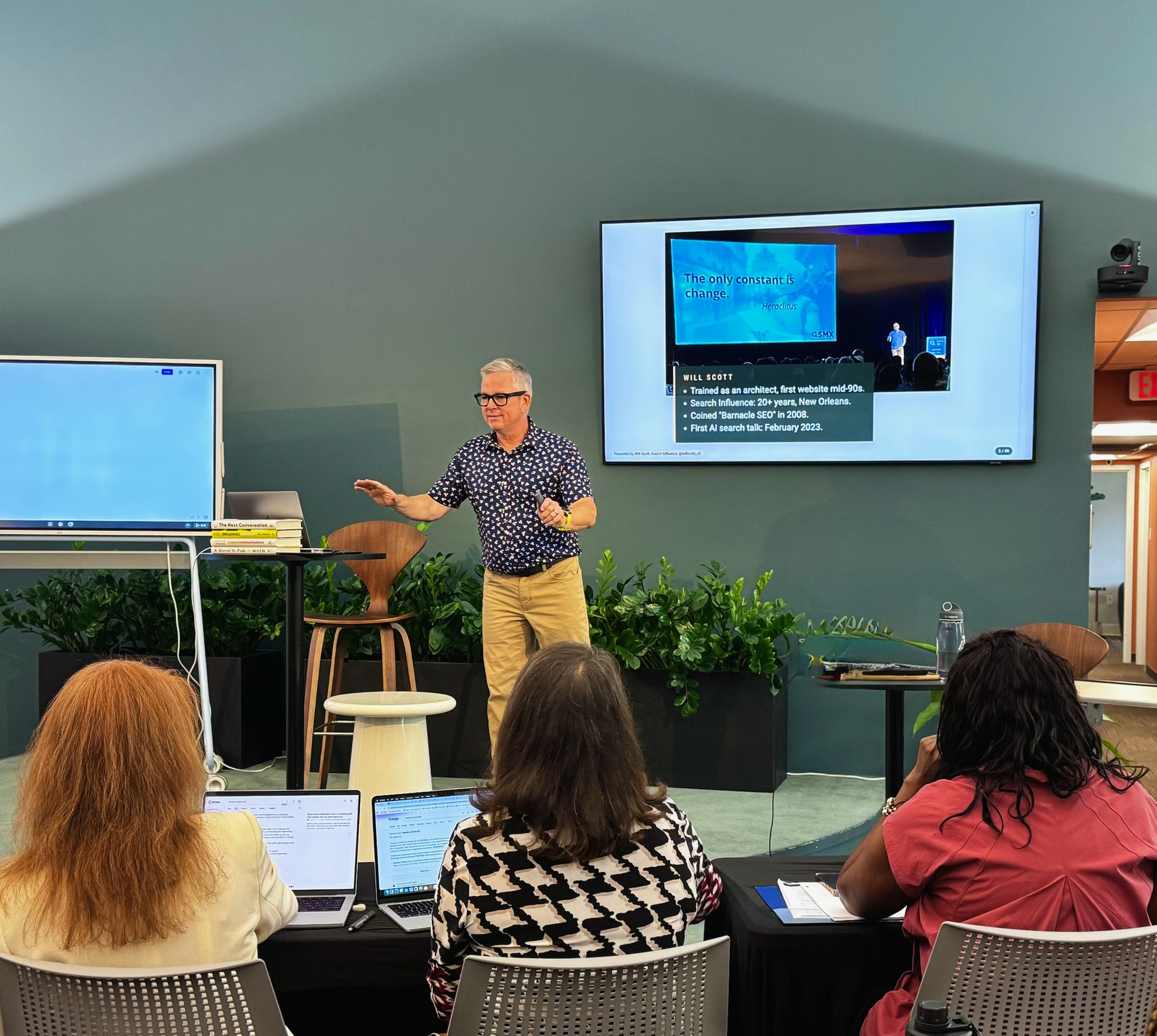
Will Scott, co-founder of Search Influence, on what it actually takes for a New Orleans real estate agent to show up when AI systems answer the questions your clients are already asking.
Why It Matters
The search bar your clients used five years ago no longer works the way it did. Google’s top results are now AI-generated answers. ChatGPT, Perplexity, and Claude are fielding real estate questions daily. And the agents who show up in those answers aren’t necessarily the ones who posted the most. They’re the ones who left the clearest, most specific trail of who they are, what they do, and for whom.
That shift is exactly what brought Will Scott into the room with KW New Orleans agents in June 2026. Co-founder of Search Influence, the New Orleans-based digital marketing firm he’s built over 20 years, Scott has watched every major transition in how people find information online, from the first blue-link era to the current moment where AI systems arbitrate what gets seen and what disappears. He came not to sell a service, but to hand agents a framework for surviving and winning in the new environment. The session was part of a broader initiative at KW New Orleans to build AI-powered marketing infrastructure directly into agents’ daily workflows, a project Scott called unlike anything he’d been asked to do by any other brokerage in the city.
The State of Play
Scott opened with a single practical question: what makes local expertise visible enough for AI systems to understand and cite when someone asks for help? The answer requires understanding how dramatically the search environment has changed, and how fast.
It’s over, right? This is no longer the way people are going to be getting information, and even when they are getting their information mediated by Google, as we just talked about, the answers are gonna look like answers, they’re not gonna look like 10 blue links and a job to do.
Will Scott, Co-Founder & CEO, Search Influence
The Moment Scott Knew Everything Had Changed
On a flight from New Orleans to Denver in December 2022, three weeks after ChatGPT launched, Scott had his laptop open and typed a question into the new tool: what was the beef between Vin Diesel and The Rock? He got a clean, complete answer. Then he opened Google and asked the same question. Ten blue links. A job to do.
That contrast, trivial as the question was, told him everything. After 20 years of building businesses on top of Google’s search architecture, he was watching the underlying logic change in real time. The format of the answer had changed. And with it, the entire calculus of what it meant to be found.
The practical consequence he laid out for agents: where traditional search might surface ten results, AI answers typically surface three. If you’re not in the top few, you don’t exist for that query. The field narrowed. That makes the specificity of your content and your presence across multiple platforms, more important than it has ever been. It also means that the dynamics reshaping how buyers discover listings in New Orleans are no longer just about portal dominance. They’re about which agent leaves the clearest signal for the machines doing the answering.
Semantic Triples and the Specificity Imperative
The concept Scott returned to repeatedly was what he called the semantic triple: a simple, declarative structure that tells AI systems exactly who you are, what you do, and for whom. Think “agent helps first-time buyers weigh renovation risk in Mid-City condos” rather than “experienced local real estate professional.”
Generic content, he argued, has always been invisible to humans who care. Now it’s doubly invisible: AI systems can’t extract a citable claim from flowery prose. They can extract a claim from a sentence that pegs a result to a location, a time, and a client type. “Due to market conditions in New Orleans in March of 2026, we were only able to get 89% of the listing price” is useful to a machine. “The market was tough but we got it done” is not.
The same logic applies to ambiguity. Scott used Apple as his example: without context, the word means nothing. “I just got ripped off at the Apple Store” resolves that ambiguity instantly. Agents face the same problem: describing yourself as a “local expert” gives a machine nothing to work with. Saying you help physicians relocating to New Orleans close complex transactions, having helped several through LCMC Health and Tulane Medical Center referrals, gives the machine something it can hold onto and cite.
One agent in the room, who works primarily with sellers, worried that her client base was too scattered geographically to claim a neighborhood. Scott reframed the question: the “where” doesn’t have to be a ZIP code. It can be a client type. Sellers helping aging parents downsize. Out-of-town heirs who inherited a property. Listings that failed to sell the first time. Those are semantically related clusters, and they’re specific enough for a machine to recognize a pattern and start associating your name with it.
If you want to be everything to everybody, you’re going to be nothing, nobody, right, and especially in this world, where you have to have a specific answer.
Will Scott, Co-Founder & CEO, Search Influence
What Barbara Corcoran Figured Out Before Google Existed
Scott anchored the specificity argument with a story from the Inc. 500 conference, where he heard Barbara Corcoran describe the origin of the Corcoran Report. At the time she created it, she had roughly 18 sales to her name. She mailed it to reporters at the New York Times, who cited it, instantly establishing her as a market authority on New York City apartment sales. She wasn’t yet. But she spoke with specificity, and specificity is what editors and now AI systems recognize as expertise.
The lesson translated directly. An agent who has helped three physicians buy property in New Orleans can legitimately say she helps physicians find their New Orleans home. That framing, repeated consistently across platforms, starts building the association in what Scott called “the knowledge graph in the sky”: the web of entity relationships that AI systems draw on when constructing an answer. The Corcoran Report didn’t require years of market dominance to land on CNBC. It required a clear, repeatable, specific claim staked early and often.
Scott was direct about the threshold for claiming a niche: you don’t need to be the undisputed authority. You need to be the one talking most clearly and consistently about it. That’s a meaningful distinction for agents who feel they lack the credentials to claim a specialty, and it’s a window that closes as more agents start thinking this way. Agents who want to build that presence with structure can start with the KW New Orleans Accelerate Series, the five-week AI marketing intensive this session was part of.
The AI Maturity Curve: What “Autopilot” Actually Looks Like
One question from an agent cut to the practical heart of the session: how much time does this actually take, once the pieces are in place? Scott’s answer started with a model of AI maturity that runs from asking questions, to directing tasks, to automating processes, to what he called the autopilot stage.
His own newsletter, The Visibility Report, runs on that autopilot model. Every Monday morning, an agent he’s built inside Claude scans sources, assembles a preview of the newsletter, drafts a LinkedIn post, and prepares versions for Twitter, Instagram, Threads, and Blue Sky. Scott reviews it, adjusts what he doesn’t like, approves it, and the system then uses browser automation to publish across all channels. What looks like a multi-platform publishing operation is, in his telling, a Monday afternoon review session.
The caveat he returned to several times: the system only gets that good through training. Early outputs will be wrong. The agent will say “I don’t like that,” and the machine will adjust. Over enough iterations, it starts to know your voice, your boundaries, the things you’d never say. He named his primary assistant Bob. That level of familiarity, knowing when Bob’s output is lazy and when to push back, is what separates an agent who gets real value from AI from one who gets generic content they’re embarrassed to post.
KW New Orleans built a Claude skill specifically for agents in the Accelerate Series, connecting to Canva for image creation, Metricool for cross-platform scheduling, and individual agent websites for content sourcing. The goal: push content across all online platforms so that a new listing, a recent sale, or a market update can move from raw input to scheduled posts in a single session. More on the tools and training available to agents lives in the KW New Orleans learning center.
You have to turn your local expertise, right, which you all have, into an AI-visible trail. More posting is not the goal, right. The goal is to make sure that when you are posting, you’re leaving a really clear public trail of who you are, what you do, and for whom, where.
Will Scott, Co-Founder & CEO, Search Influence
The Johnny Appleseed Principle and Why Hashtags Are Over
Given that 71% of cited sources differ across AI platforms, Scott’s tactical advice was simple: be everywhere. He called it the Johnny Appleseed approach: cast content as widely as possible, because you can’t predict which platform a given AI system will favor for a given query.
That means the old concern about duplicate content (the fear that posting the same listing description to multiple channels would confuse search engines) is effectively obsolete. Each platform is being read by different systems looking for different signals. Posting the same core content across your website, YouTube, Instagram, and Google Business Profile isn’t redundant. It’s the strategy.
YouTube deserves particular attention. Scott noted it’s more likely to be cited in AI answers than Instagram, which matters because real estate agents tend to be heavily overweighted toward Instagram. Video descriptions on YouTube are also far longer than most agents use them for. That unused space is an opportunity to load in the specific details (address, buyer type, price range, neighborhood context) that help AI systems understand what the content is actually about.
On hashtags: Scott’s view was unambiguous. The time agents spend constructing hashtag strings for Instagram is wasted. Search on Instagram is now AI-driven, not hashtag-driven. That space is better spent on 50 more words of explicit, specific content. For YouTube, he recommended using the platform’s built-in tag fields rather than embedding hashtags in descriptions. The logic throughout was consistent: spend your effort on content that carries real information, not on metadata conventions that served a different era of search. Anyone looking to understand how these principles connect to the current New Orleans real estate market will find the implications direct.
The Feedback Loop That Makes AI Actually Useful
Scott closed with what he called the highest level of AI maturity: the feedback loop. Not just using AI tools, but actively training them over time to produce outputs that reflect your voice, your standards, and your specific expertise.
The analogy he used was a new assistant. You wouldn’t expect someone on their first week to sound exactly like you. You’d spend time showing them what good looks like, correcting the things that are off, building shared language. AI works the same way, except the training compounds. Every correction makes the next output better. Every preference you establish becomes a standing rule. The agent who has been having that ongoing conversation with their AI system for six months will produce content that looks nothing like what a first-time user generates.
For agents at KW New Orleans, the infrastructure built by the team (the Claude skill, the Metricool connection, and the individual agent websites) is the starting point. The compounding happens through use. Scott’s parting encouragement was the same thing he tells his own team: you don’t need to know how the technology works. You need to know what you want it to do. Tell it clearly, correct it when it’s wrong, and give it enough time to learn you. Agents considering what that investment looks like in practice are welcome to reach out to the KW New Orleans team directly.
Will Scott gave KW New Orleans agents a clear-eyed account of a moment most of the industry hasn’t caught up to yet: the era of ten blue links is over, and presence on any single platform no longer guarantees visibility. The agents who will be cited by ChatGPT, Google AI Mode, and Perplexity when a buyer or seller asks for help in New Orleans are the ones who have staked specific, repeatable claims tied to real client types, real neighborhoods, and real outcomes, across the widest possible range of channels. Specificity is not a constraint on your market. It’s the mechanism by which the machines learn to send you business. The window to establish those associations before competitors do is open now, and it won’t stay that way.
Frequently Asked Questions
What is AI visibility for real estate agents in New Orleans?
AI visibility means showing up when tools like ChatGPT, Perplexity, and Google AI Overviews answer real estate questions on behalf of buyers and sellers. In New Orleans, agents who are cited by AI systems are those who have published specific, consistent content tied to a real client type, a real neighborhood, and real transaction outcomes. Volume of posts is not the determining factor. Specificity and cross-platform presence are.
What did Will Scott teach at KW New Orleans in June 2026?
Will Scott, co-founder and CEO of Search Influence, taught a full-day session at KW New Orleans in June 2026 as part of the Accelerate Series. He covered how AI citation patterns work, why traditional SEO rankings no longer guarantee AI visibility, and how agents can use semantic triples, cross-platform publishing, and AI workflow automation to get cited by AI search systems when buyers and sellers ask for help in New Orleans.
How do AI systems like ChatGPT decide which real estate agents to recommend?
AI systems draw on a knowledge graph built from publicly available content across multiple platforms. They favor sources that make clear, specific, verifiable claims tied to a location, a client type, and a demonstrated outcome. Roughly 71% of URLs cited for any given real estate query differ depending on which AI system answers it, which means no single platform guarantees visibility. Agents who publish specific, consistent content across their website, YouTube, Google Business Profile, and social platforms are most likely to be cited.
What is the Accelerate Series at KW New Orleans?
The Accelerate Series is a five-week AI marketing intensive run by KW New Orleans for real estate agents. Each Monday session runs from 9am to 3pm at 8601 Leake Avenue in New Orleans. The program covers business strategy, AI workflows, SEO and social content, website builds, and market positioning. Will Scott of Search Influence taught the search and AI visibility session in June 2026. The program is open to all NOMAR agents and business owners.
What is a semantic triple in real estate content marketing?
A semantic triple is a clear, declarative statement that identifies who an agent is, what they do, and for whom. For example: “Agent helps first-time buyers weigh renovation risk in Mid-City condos” is a semantic triple. “Experienced local real estate professional” is not. AI systems can extract and cite a semantic triple because it contains a subject, a predicate, and a specific object. Generic descriptions give AI systems nothing to hold onto or cite.
How is KW New Orleans using Claude AI for real estate agent marketing?
KW New Orleans built a Claude skill specifically for agents in the Accelerate Series. The skill connects to Canva for image creation, Metricool for cross-platform scheduling, and individual agent websites for content sourcing. The goal is to push content across all online platforms so that a new listing, a recent sale, or a market update moves from raw input to scheduled posts in a single session, giving New Orleans real estate agents an AI-powered content engine built on their own voice and expertise.
About the Accelerate Series. Accelerate is a five-week AI marketing intensive KW New Orleans runs for real estate agents. Each session brings in an expert instructor to build real skills, real tools, and a real content engine. Learn more and join the next cohort at kwneworleans.com/accelerate.
KW New Orleans brings together the sharpest minds in real estate, marketing, and technology. If you’re ready to work alongside people building the city’s future, we’d love to talk.