
Keller Williams Realty New Orleans

How Every Agent Must Change Their Digital Marketing in the AI Era

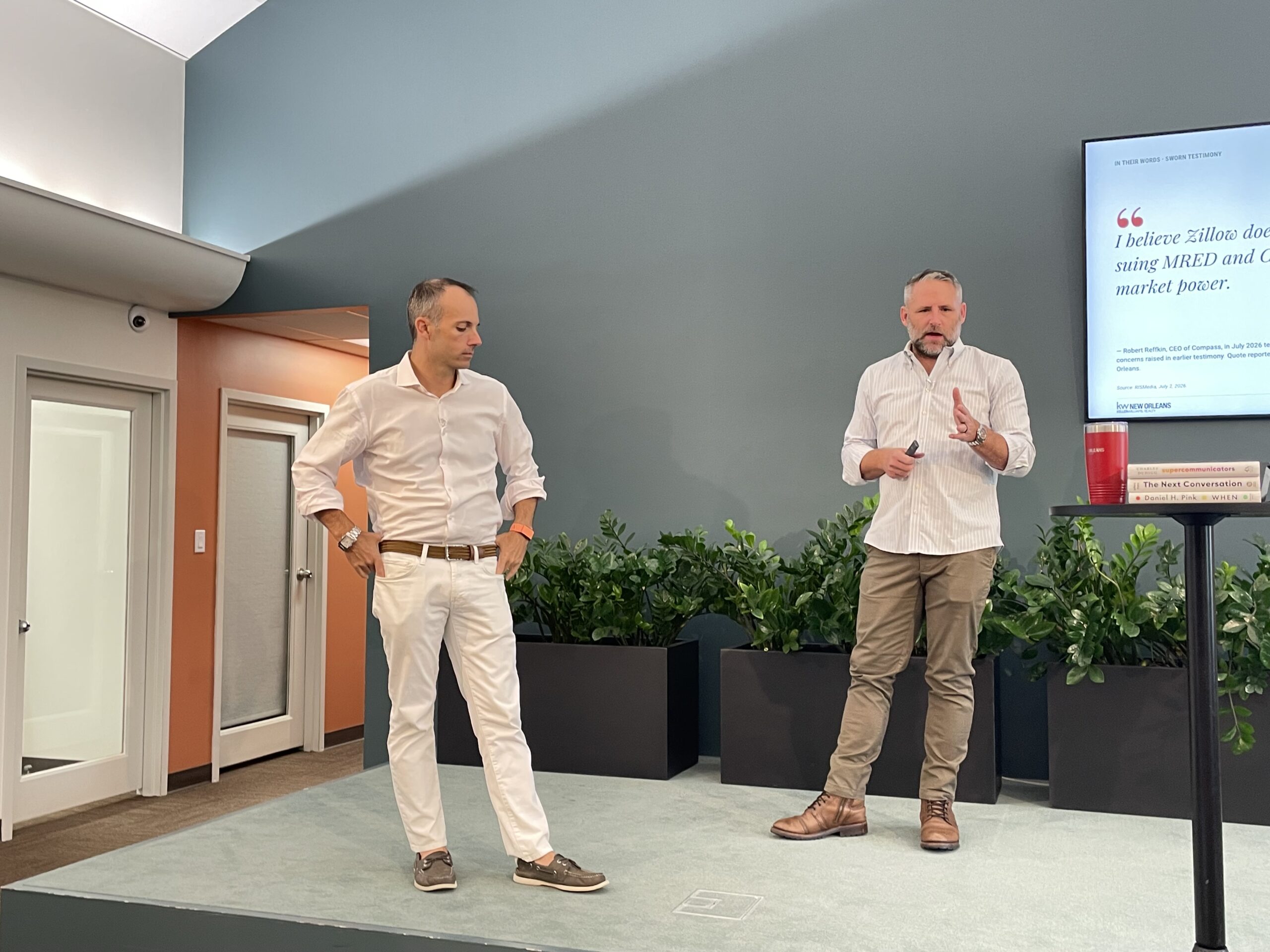
Cody Caudill and Jeffrey Doussan on AI-era digital marketing for real estate agents at KW New Orleans

Agent Strategy & Market Insights

Cody Caudill and Jeffrey Doussan, Team Leader and Operating Principal at KW New Orleans, on why every agent’s digital marketing approach is already behind — and the exact six-step system to fix it this week.

The Short Answer

The AI era has permanently changed what it takes for a real estate agent to be visible and trusted online. Agents who publish consistent, platform-specific content — using AI tools to generate copy, distribute video, and monitor engagement — are building the kind of searchable, citeable personal brand that a national brokerage portal cannot manufacture for them. In the Mid City, Garden District, and across the greater New Orleans metro, the agents with depth of published content are becoming the market’s go-to experts — not because they are better agents, but because they are more findable ones.

The real estate industry is consolidating at a pace most agents are not watching closely enough. Compass completed its January 2026 acquisition of Anywhere Real Estate (formerly Realogy). Rocket Companies acquired Redfin. National portals are fighting over who controls listing distribution. While the brokerage giants wage those battles, individual agents face a quieter but equally consequential question: when a potential client searches for a real estate expert in their neighborhood, do they find you — or someone else?

The answer, increasingly, is determined not by how many transactions you have closed but by how much verifiable, searchable expertise you have published. Cody Caudill and Jeffrey Doussan, Team Leader and Operating Principal at KW New Orleans, laid out a six-step framework for building that presence — and backed it up with mid-year market data showing why the New Orleans market right now rewards agents who move fast.

Cody Caudill & Jeffrey Doussan
Team Leader & Operating Principal — KW New Orleans
Cody Caudill came up through production — building a book of business the old-fashioned way before stepping into leadership. The pivot point was noticing that the agents who grew fastest were not necessarily the most talented; they were the most visible. That observation now drives how KW New Orleans trains its agents to think about content, personal brand, and AI. Jeffrey Doussan brings a financial markets lens to real estate that is unusual in a local brokerage context — he tracks REIT stocks, S&P multiples, and brokerage equity performance the way most team leaders track pending pipelines. Together, they run one of the fastest-growing offices in the New Orleans metro by unit count, with the lowest days on market among the top ten brokerages in the city. Doussan’s view: the brokerage war is a sideshow. The real game is whether your agents are building personal brands that outlast any merger.

Before getting into agent strategy, Caudill and Doussan walked through the macro context — because the brokerage consolidation wave and the New Orleans market data are directly related to why individual agent brand-building has never been more urgent.

01
Brokerage consolidation is reshaping national real estate. Compass closed its acquisition of Anywhere Real Estate in January 2026, Rocket Companies acquired Redfin, and The Real Brokerage has agreed to acquire RE/MAX in an $880 million deal expected to close in the second half of 2026 — three major consolidations reshaping the industry. Per Doussan, the driving logic is not brand superiority but cost-basis reduction and agent headcount. Compass stock rose approximately 89% in the 12 months following its acquisition push, per Doussan’s cited figures, before pulling back as earnings reports arrived. eXp Realty is down roughly 30% over the same period, according to Doussan.

02
Zillow vs. Compass is a fight over who controls listing distribution. In July 2026, a preliminary injunction hearing unfolded in an antitrust lawsuit brought by Zillow against Compass and Midwest Real Estate Data (MRED), the Chicago-area MLS. At issue: Compass CEO Robert Reffkin’s push to let sellers test the market through Compass’s pre-MLS marketing phases. Zillow’s standards ban listings that are publicly marketed before being made broadly available through the MLS. the outcome of this dispute could reshape how listing distribution works nationally.

03
New Orleans inventory is compressing fast. Orleans Parish has moved from roughly 11 months of housing supply approximately 18 months ago to about 7 months in mid-2026, according to MLS data cited by Caudill. Days on market have roughly halved since January. Several specific New Orleans submarkets — including parts of Uptown — are sitting under four months of supply, a figure the team flagged as seller’s market territory.

04
Million-dollar-plus properties are outpacing the broader market. According to KW New Orleans’s analysis of MLS data, the city’s overall closed volume is up even as unit count shows modest seasonal softness — because the luxury tier is appreciating at a double-digit rate while entry-level and mid-market segments are growing in the single digits. The S&P Cotality Case-Shiller national index (recently renamed from CoreLogic) showed only 0.8% annual home price growth in April 2026 and 1.1% in May, which when adjusted for inflation represents a real-dollar decline — but Caudill and Doussan argue New Orleans is clearly bucking that national softness.

This is the ball game right now. We are like dead set… this is that moment to plant your flag in the ground, and it’s going to matter for the next five years.

— Jeffrey Doussan, Operating Principal, KW New Orleans

The single clearest lesson from the national consolidation story is that clients do not follow brokerage logos — they follow people. When Compass absorbed Anywhere’s agent count, what it bought was not brand loyalty; it bought a roster. The agents who will thrive through another decade of consolidation are the ones whose names mean something in their specific markets, independent of what sign hangs outside the office door.

That reality used to be a cold comfort — building a personal brand required a budget, a social media manager, and hours of production time most agents could not spare. Claude, Substack, AI-powered cross-posting tools, and a well-built content system have changed that math. What took a corporate marketing team of 20 people is now achievable by a single agent who commits roughly one hour a day. The gap between agents who build that system now and those who wait is compounding daily — in search visibility, in AI citation results, and in the simple arithmetic of how many pieces of valuable content a prospective client can find when they look you up.

One KW New Orleans agent, Cameron — who previously ran digital marketing for a publicly traded company, overseeing Google retargeting and multi-channel campaigns — described what he’s watching his own business do since building this content system: clicks growing four times over in a single week, and incremental improvements arriving every day after. His verdict is blunt: what agents are being shown how to do in 2026 is exactly what Fortune 500 marketing departments are spending millions of dollars to accomplish.

It’s right up there with the things that the biggest companies are doing in the world right now.

— Cameron, Agent & Former Corporate Digital Marketing Director, KW New Orleans

Caudill laid out a specific, sequenced six-step action plan — not a philosophy, not a long-term roadmap, but a week’s worth of concrete hours that move an agent from invisible to in-motion. The framework is built around two parallel goals: productivity (doing your job faster) and lead generation (getting found by more clients). The tools that accomplish both at once are the ones worth prioritizing.

01
Establish your platform accounts and connect them to a cross-posting aggregator. Gary Vaynerchuk has been emphatic that agents need a presence on seven or more platforms. That sounds paralyzing until you realize the goal is not to manually post on seven platforms — it is to publish once and distribute everywhere through a tool like a social media aggregator. Step one is simply making sure those accounts exist and are connected to a centralized publishing system.

02
Stand up your newsletter and link it to your website. A Substack or equivalent newsletter serves two purposes: it builds a direct-to-client communication channel that no algorithm controls, and it creates indexed content that search engines and AI systems can cite. Make sure the newsletter is linked from your website — and that any analytics tracking code from your cross-posting tool is also installed on your website so you can see what is actually working.

03
Publish your first blog post. Content creation has genuinely never been easier. Block one hour — Monday morning is Caudill’s suggestion, when the instinct is to avoid calls — and use an AI tool to help you build something worth reading. Use market data from RPR (Realtors Property Resource) or local MLS sources as the backbone. The goal for week one is simply publishing — not perfection.

04
Record a video and run it through the distribution system. Video is the highest-engagement content format on nearly every platform. If you are already producing video, the leverage point is getting it out everywhere automatically rather than posting manually to one or two places. An AI tool can generate platform-specific captions for the same video — because what works as a LinkedIn post is very different from what works on Instagram.

05
Validate that it is working. AI skills can now scrub all of your social platforms, read every comment, track every lead signal, and report back to you — tasks that would have required a dedicated person monitoring a dashboard all day. Once your content system is live, configure this kind of monitoring so you are not guessing whether any of it is landing.

06
Schedule the system to run without you. The difference between a content system and a content chore is automation. Once your AI tools are configured to pull market data, generate platform-specific posts, and monitor engagement, schedule them to run on a cadence — twice a day for lead monitoring, weekly for content creation — so the machine keeps moving even when you are in appointments.

Here is what a national brokerage platform cannot do: it cannot write a post that sounds like you. It cannot reference the specific block in Bywater where you sold three houses last year. It cannot capture the opinion you have about where the Marigny market is heading. Generic content — even AI-generated generic content — does not build trust. Specific content does.

The customization layer is what separates an agent who dabbles in AI from one who builds a real competitive moat with it. An AI content tool that has been trained on your writing style, your market perspective, your client communication patterns, and your preferred platform formats will produce output that feels like you wrote it — because in the ways that matter, you did. You built the style guide. You set the preferences. You gave the tool your voice. The tool just scales it.

Caudill made the point plainly: the goal of sending a client a JP Morgan market report, a YouTube video, or a blog post from this week’s meeting is not to check a marketing box. It is to give people on the fence a reason to think about you — naturally, without a “just circling back” email that hands away all your negotiating position. The content does the follow-up. You show up for the conversation.

When you just have like so much content that you actually like produce and you’re proud of and you create it and you can point clients to, and like, there’s good depth to it. You actually start, like, being that expert that you say you are.

— Cody Caudill, Team Leader, KW New Orleans

For agents, the content opportunity and the market opportunity are pointing in the same direction at the same time. Inventory compression, shrinking days on market, and luxury-led price appreciation all create motivated sellers who need a push — and motivated buyers who need guidance. The agents publishing that guidance consistently are the ones getting the calls.

KW New Orleans’s own numbers underline the market’s pace. The office closed more units in June 2026 than in any prior month on record, according to Doussan’s presentation. It holds the lowest days on market of any top-ten brokerage in the city for the year — not a single month, the full year to date. Pending sales, a forward indicator, stayed flat rather than falling off after the July 4th holiday weekend, which Doussan described as unusual and encouraging. See how our KW New Orleans agents are putting these market conditions to work for their clients.

The market data that agents have access to — through MLS pulls, RPR, and the kind of brokerage-level analysis Doussan presents monthly — is the same data that makes for compelling content. An agent who can turn a pending sales chart into a 400-word blog post explaining what it means for a homeowner thinking about listing in Lakeview is doing something no algorithm can replicate: translating data into a local, human, specific answer that a real person was actually wondering about.


How should real estate agents use AI for digital marketing right now?
Real estate agents should establish accounts on seven or more social platforms, connect them through a cross-posting tool, publish at least one blog or piece of content per week, and create video that can be distributed automatically across platforms. AI tools like Claude can help generate platform-specific copy, repurpose market data, and even schedule a lead-scrubbing check of every platform twice a day — tasks that used to require a team of 20 people.

What is the New Orleans real estate market doing in July 2026?
The New Orleans real estate market in July 2026 is showing signs of a meaningful recovery. Inventory has dropped from roughly 11 months of supply to about 7 months in Orleans Parish, days on market have nearly halved since January, and million-dollar-plus properties are leading growth with double-digit appreciation while the broader market grows at a single-digit rate.

What happened with the Compass and Zillow lawsuit over the Chicago MLS?
In May 2026, Zillow sued Compass and Midwest Real Estate Data (MRED), the Chicago-area MLS, alleging they conspired to cut off Zillow’s access to Chicago-area listing feeds. A judge ordered the feeds restored while the case proceeds, and after a preliminary injunction hearing ran July 1–3, 2026, the presiding judge took the motions under advisement; observers expect a ruling could take weeks or months. Zillow’s listing standards ban homes publicly marketed before being made broadly available through the MLS — the policy at the center of the dispute.

Why does a real estate agent’s personal brand matter more than their brokerage’s brand?
Clients make buying and selling decisions based on trust in an individual agent, not a national brokerage logo. AI-powered content tools allow individual agents to publish a high volume of localized, personalized content that a national platform cannot replicate — building the kind of specific expertise and visibility that earns referrals and repeat business.

How can a real estate agent start building an AI-powered content system in one week?
In one week, an agent can: establish accounts on major social platforms and connect them to a cross-posting aggregator; set up a newsletter or blog and link it to their website; publish a first blog post; record and distribute a video through the platform system; and configure an AI skill to scrub leads and monitor engagement across all platforms on a daily or weekly schedule. Each step takes roughly one hour.

The Bottom Line

The brokerage consolidation happening at the national level — Compass absorbing agent rosters, Rocket buying Redfin’s search traffic, portals fighting over listing control — is a reminder that no one is building your personal brand but you. In a New Orleans market where inventory is compressing, days on market have halved since January, and luxury properties are appreciating at double-digit rates, the agents who are publishing consistent, specific, local content are the ones getting inbound calls without making outbound ones. The six-step system Caudill and Doussan laid out is not a long-term initiative — it is six hours of work spread across this week. The agents who do it now are five years ahead of the ones who wait to see how this all shakes out.


About this series. KW New Orleans hosts regular conversations with the leaders shaping our city — developers, architects, investors, and operators building the New Orleans of tomorrow. These are the conversations that happen in the rooms most people don’t get invited into.

Join the Conversation
Build Something That Lasts

KW New Orleans is building agents who own their markets — not just their transactions. If you’re ready to work in an office where the leadership team tracks stock multiples, builds AI content systems, and gives you the tools to compete at the level of a 20-person marketing department, we’d love to talk.

Connect With Our Team

AI Digital Marketing
Real Estate Agent Strategy
New Orleans Market 2026
Personal Brand
Content Marketing
Brokerage Consolidation
Zillow Compass Lawsuit

Disclaimer: This article is provided for general informational purposes only and reflects a summary of a public conversation. It is not legal advice, public safety guidance, or a guarantee of outcomes. Laws, policies, and crime trends can change, and individual situations vary. For questions about legal matters, consult a licensed attorney. For real estate questions, consult a licensed real estate broker, and verify any neighborhood-specific concerns through appropriate official sources.