
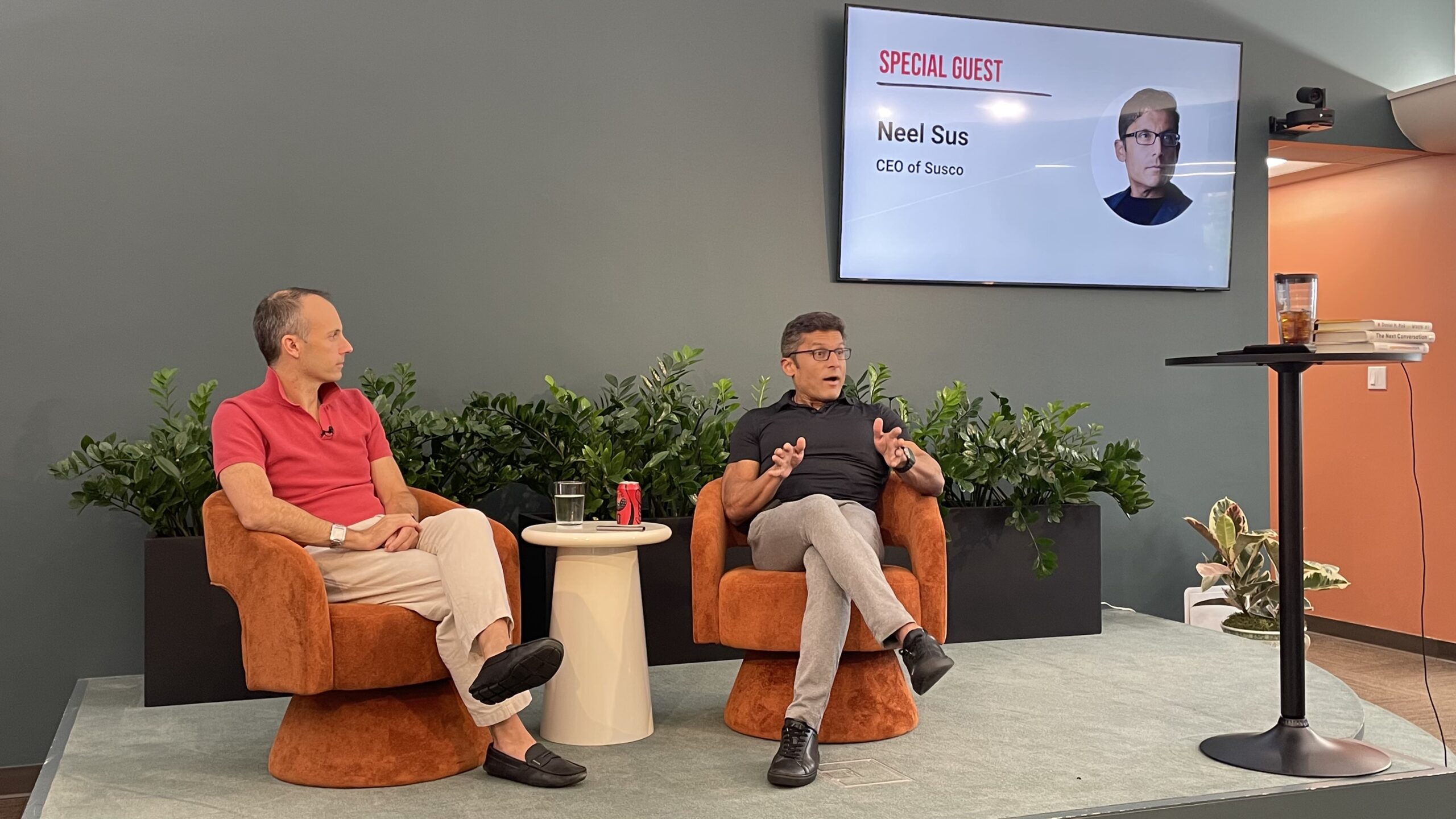
Neel Sus, CEO of Susco, on AI’s threat-and-opportunity paradox, why chasing efficiency with AI is a trap, and the decade-long personal transformation that taught him everything he knows about sustainable change.
AI is simultaneously compressing the value of things businesses already sell and opening markets for things they could never afford to build before. For real estate professionals and software firms alike, the companies that survive this shift will be the ones that use AI to grow what they bring in, not just to shrink what they spend. The “how” is no longer the hard part; knowing where you want to go is.
Why It Matters
Every industry conversation about AI eventually arrives at the same fork in the road: cut costs, or find new ground? The answer most businesses default to (get leaner, reduce headcount, improve margins) is also the one most likely to hollow out a company over time. Neel Sus has been living inside that tension for the past two years, and he came to KW New Orleans with something more useful than a prediction: a framework for thinking through the choice.
Sus is the CEO of Susco, a New Orleans-based software firm of roughly 30 people that builds custom business systems and holds a nationally recognized practice in insurance and claims management software. He sat down with KW New Orleans Operating Principal Jeffrey Doussan for a wide-ranging conversation that moved from enterprise software disruption to vibe coding to transcendental meditation, and made a strong case that the through-line connecting all of it is clarity of purpose.
The State of Play
The AI disruption hitting software firms is structurally similar to what real estate has been absorbing for the past several years: margin compression at the bottom, concentration at the top, and a window of genuine opportunity for anyone willing to reframe what they sell. Sus broke the current moment into four dynamics.
Where can you provide value that’s not being eaten by AI?
Neel Sus, CEO, Susco
What This Means for Real Estate Professionals
The conversation kept returning to a shift in how professionals think about effort. Doussan described an agent at KW New Orleans who had never written a line of code in her life and vibe coded a fully functional transaction management system, because nothing available on the market did exactly what she needed. That story is becoming common, and it points to something Sus thinks is underappreciated: the “how” is no longer the limiting constraint.
The shift matters for anyone working with clients in a relationship-intensive business. If you can describe your current situation and your goal clearly, AI can map the path between them. You no longer need to know the middle steps. For a real estate professional, that might mean automating postcard outreach to every resident in a specific building, resurrecting cold contacts from a decade-old CRM, or building a follow-up sequence that surfaces the right client at the right moment, none of which required a developer to implement a year ago.
Sus offered a specific example that resonated with the room: scanning a commercial contact database for people who have recently changed employers. That task, once impossibly tedious to do manually across years of history, can now be automated entirely. The result is a fresh prospect list pulled from relationships that already exist, requiring nothing more than identifying the signal and acting on it. For agents serious about growing their book of business, the database they already have is probably their most underworked asset.
Things you couldn’t even do, you wouldn’t do. It just wasn’t worth it per unit time to do it manually.
Neel Sus, CEO, Susco
The Efficiency Trap
Sus is direct about the danger of using AI purely as a cost-cutting tool. When an audience member asked how he was adapting his own business, he went somewhere unexpected: a warning about the seduction of operational efficiency.
If all a business does is make its operations more efficient through AI, there is exactly one way to realize those gains: reduce payroll. Sus rejects that path, not for sentimental reasons, but because it contradicts why he built Susco in the first place. His alternative is to use AI to drive top-line revenue growth: more leads in the door, faster closes, higher volume. When the top line grows, efficiency gains translate into capacity rather than cuts.
For real estate brokerages, the same logic applies. The technology that reduces time spent on transaction paperwork or marketing production is only valuable if the time freed up goes toward client relationships, prospecting, and deals, not toward shrinking the team. The goal Sus describes is using AI to do things that were previously impossible, not just to do existing things more cheaply. That framing is the one worth bringing back to any team conversation about technology adoption.
The Personal Transformation
Sus has lost and regained significant weight three times in his adult life: in college, before his wedding, and again around 2010. Each time, the trigger was external and the results didn’t hold. The fourth attempt, beginning in 2016, was different in kind, not just degree.
The turning point was a staircase in his wife’s family home in India. He was 39, smoking heavily, and his knees hurt on the way up. He thought about his father at 40 (composed, together, not a “hot mess”) and decided the problem wasn’t behavioral. It was deeper. He applied the same approach that had worked when he started Susco without a business background: find mentors, join peer groups, read everything. Through the Entrepreneurs’ Organization, he worked on what he calls his limiting beliefs. He found transcendental meditation. And he built what he describes as a very clear “anti-vision” (a precise mental picture of the future he was working against) alongside a vision of what his life could look like instead.
He frames the durability of that change as a coping mechanism problem, not a willpower problem. Everyone needs to meet their needs for comfort and connection. The question is whether you meet those needs through habits that compound positively or negatively. Sus replaced food and cigarettes with meditation and hard conversations. The mechanism is the same; the direction changed.
Transcendental Meditation: What It Is and Why It Works Differently
Transcendental meditation (TM) is a form of mantra-based meditation (a practice with roots in Hindu tradition) that works differently from the mindfulness or focus-based meditation most Western audiences have encountered. Where mindfulness asks you to hold your attention on your breath or a single object, TM involves silently repeating a meaningless sound that functions as mental white noise, allowing the mind to settle without forcing it.
Research on regular TM practice has linked it to meaningful reductions in stress and anxiety with consistent practice. Sus cites the effect on stress response as the reason it worked where focus-based meditation hadn’t: when he tried to focus on his breath, he ended up focused on payroll. The mantra gave his mind somewhere to go.
He recommends learning through the official program at tm.org rather than free online tutorials, not because the information isn’t available elsewhere, but because the structured four-day learning sequence (now partly on Zoom) provides the accountability that makes the practice stick. He has funded TM training for employees, family members, and fellow entrepreneurs. His observation: the people who pay for formal instruction continue practicing at a significantly higher rate than those who try to learn it for free.
I had a very clear anti-vision and kind of a clear vision of what life could be instead.
Neel Sus, CEO, Susco
The Horseshoe Maker Problem
Sus saves his sharpest thinking for the question of what happens to people whose expertise AI absorbs. He talks to his own staff about it directly. His framing: a developer whose job shifts from writing code to reviewing AI-generated code didn’t sign up to be a proofreader. That is a real loss. The question isn’t whether to acknowledge it; it’s what to do next.
His analogy is the horseshoe maker watching the automobile arrive. The car didn’t ask permission. You can adapt to tires or you can not work. Those are the options. But the adaptation is more than tactical. It requires going back to the root question of why you loved the work in the first place. If a developer loved programming because of the creativity and problem-solving, can that same satisfaction be found in reviewing, directing, and refining AI-generated output? Sometimes yes. Sometimes the honest answer is no, and that’s a different conversation.
The same question faces real estate professionals. If what you loved was the autonomy, the relationship-building, and the moment a client gets their keys, AI doesn’t threaten that. If what you were selling was friction management and paperwork processing, the margin on that is already gone. Knowing which one you are doing is worth more than any specific technology adoption plan. For agents thinking through this at a career level, the KW New Orleans team is navigating the same questions in real time.
Common Questions
Neel Sus built Susco on the insight that bad software makes people miserable, and then watched AI arrive to complicate everything he had built. His response is not to defend the old model but to follow the same logic that started the company: find where the pain is, build something that fixes it, and make sure the people doing the work understand why it matters. He is doubling down on sales growth rather than headcount cuts, funding TM practice for his team, and actively hunting the new customer categories that only exist because AI dropped the price of entry. For real estate professionals, his core argument translates directly: your CRM is a prospect list waiting to be read, efficiency without revenue growth is just a slower decline, and the agents who know exactly why they love this work are the ones who will still be doing it when the next disruption arrives.
About this series. KW New Orleans hosts regular conversations with the leaders shaping our city: developers, architects, investors, and operators building the New Orleans of tomorrow. These are the conversations that happen in the rooms most people don’t get invited into.
KW New Orleans brings together the sharpest minds in real estate, development, and technology. If you’re ready to work alongside people building the city’s future, we’d love to talk.