
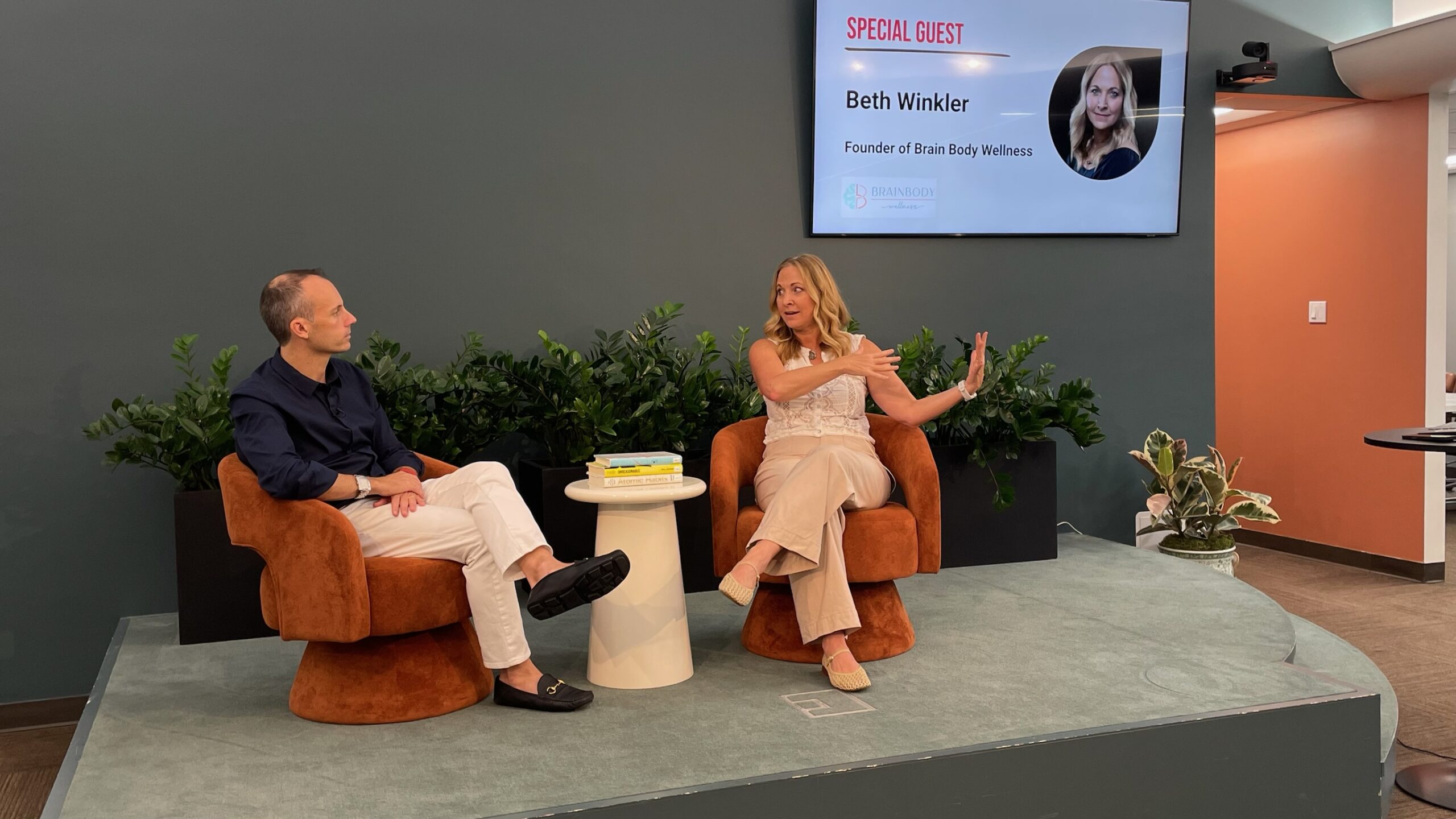
Beth Winkler, founder of Brain Body Wellness and co-founder of Magnolia Physical Therapy, on what chronic pain actually is, how the brain decides whether to make you hurt, and three tools you can use before your next meeting.
Chronic pain is not simply a product of damaged tissue — it is an output of the brain and nervous system, which decide 100% of the time whether to produce a pain experience and how intense to make it. Pain reprocessing therapy and nervous system regulation techniques, including breathwork and targeted meditation, can retrain those neural patterns so the brain stops generating symptoms that outlast the original injury. Physical therapist and Brain Body Wellness founder Beth Winkler used these tools to heal her own post-concussion syndrome after years of conventional treatment fell short — and now teaches them to clients dealing with everything from back pain to long COVID.
Why Chronic Pain Is a Nervous System Problem, Not Just a Tissue Problem
Most people in high-pressure environments — real estate agents, business owners, shift workers, parents managing multiple crises at once — spend the majority of their waking hours in a sympathetic nervous system state: the body’s fight-or-flight mode. The stress itself is not the only problem. What compounds it is never counterbalancing it. According to Winkler, a nervous system chronically stuck in that gear becomes overprotective, hypersensitive, and eventually starts generating physical symptoms that have nothing to do with structural damage.
Beth Winkler brought this conversation to KW New Orleans not as a theoretical wellness pitch but as someone who built a 21-year physical therapy practice from scratch, survived two of the worst disruptions a small business can face, and then discovered that the very pain she couldn’t treat in herself pointed toward a completely different model of healing. She is the co-founder of Magnolia Physical Therapy and now runs Brain Body Wellness, where she works with clients whose chronic symptoms have resisted every conventional approach they’ve tried.
How the Brain Creates Pain: 4 Principles from Modern Neuroscience
Understanding Winkler’s approach requires letting go of a basic assumption most people carry into a doctor’s office: that pain lives where it hurts. The current neuroscience tells a more complicated story.
The brain is the deciding factor 100% of the time, whether it’s an acute injury or whether it’s something that you’ve had for a year to 20 years.
— Beth Winkler, Founder, Brain Body Wellness
How Pain Reprocessing Therapy Works
Pain reprocessing therapy is a clinical intervention developed to retrain the brain’s interpretation of pain signals. Winkler did not develop it herself — she was trained in it after her own healing experience sent her into a certification sprint — but it has become the cornerstone of her work with chronic pain clients.
The core technique involves guiding a client to focus on a painful sensation and deliberately connect a neutral emotion to it — specifically curiosity or non-judgment. Not gratitude, Winkler is careful to say, because that asks too much of the brain too fast. Curiosity is close enough to neutral that the brain registers it differently from fear or shame, which both read as additional threat and turn the volume up further.
Why does this work? Because fear, shame, and anger associated with a physical sensation are themselves signals the brain reads as evidence of danger. When those emotional associations are loosened, the perceived threat level drops — and so does the pain output. Winkler uses a simple diagnostic to confirm when this neuroplastic pattern is at work: if a client can reduce, move, or eliminate their symptom just by changing what they are thinking about it during a session, that is strong evidence the brain is generating it, not the tissue. That moment — the client’s aha — often becomes the turning point in treatment.
Treatment courses under this model are shorter than most clients expect. Winkler describes many straightforward cases resolving in three to five visits. Complex cases — the ones where neural pathways have been reinforced for years, or where clients have tried every conventional route and landed with her as a last resort — take longer. But the goal in every case is the same: give the client the tools so they do not need her anymore.
It puts a lot of power and really empowers the client to do this work on their own. So I’m giving them these tools for not just their injury, but for the rest of their life.
— Beth Winkler, Founder, Brain Body Wellness
The Three Pillars of Daily Nervous System Regulation
Winkler is direct about something most wellness practitioners soft-pedal: the bucket is always filling. Stress, difficult relationships, demanding work, unprocessed grief — life does not stop supplying inputs. The practice is not a cure you do once. It is maintenance, in the same way that cardiovascular exercise is maintenance for the heart.
She organizes her approach around three pillars. The first is breathwork. During the KW New Orleans session, she walked the room through the physiological sigh — a technique supported by research at Stanford University — which involves a deep inhale, a brief hold, a second smaller sip of air, then a slow exhale for a count of eight. That extended exhale is the active ingredient: it activates the parasympathetic nervous system faster than almost any other voluntary action. Winkler did it in her car before walking into the presentation.
The second pillar is movement — not necessarily structured exercise but any form of physical activity that feels good: yoga, walking, whatever creates a sense of ease in the body. Winkler also incorporates visual and vestibular exercises (inner-ear work) that she describes as reducing the threat signals the nervous system is processing in the background.
The third pillar is meditation or visualization, which for chronic pain clients often means the pain reprocessing protocol described above. For everyone else, it might be a guided body-scan practice that simply develops the skill of noticing how the body feels — a skill most high-functioning, always-on people have systematically abandoned. Connecting an emotion to a physical sensation, Winkler points out, is something therapists have been asking clients to do for decades. The difference here is that the direction runs the other way: start with the physical sensation, then attach the emotion.
Conditions Nervous System Regulation Can Help: Dysautonomia, POTS, Long COVID, and More
The audience at KW New Orleans surfaced a range of conditions that Winkler addressed one by one, and her answers expanded the scope of the conversation well beyond back pain.
Dysautonomia and POTS (postural orthostatic tachycardia syndrome, a condition defined by an abnormal increase in heart rate of at least 30 beats per minute when moving from lying down to standing, without a significant drop in blood pressure) are both rooted in autonomic nervous system dysfunction. According to Dysautonomia International, these conditions affect millions of people and are frequently dismissed or misdiagnosed. Winkler does not promise a cure, but she is clear that nervous system regulation can meaningfully reduce symptoms in autonomic disorders — because the autonomic nervous system is exactly what she is working on.
Long COVID and chronic fatigue fall into the same category. Winkler groups them with dysautonomia as conditions where the nervous system has been dysregulated by a significant physiological event and has not found its way back. The boom-and-bust pattern she describes — feeling well enough to do everything, then crashing into bed the following day — is a hallmark of chronic fatigue and signals a nervous system that cannot calibrate exertion safely. The retraining approach, she says, involves going up toward the symptom gradually, building evidence for the brain that the activity is safe, then backing off before the crash happens.
Depression also came up in the room, with one attendee observing that depression and chronic pain often feed each other. Winkler confirmed the mechanism: depression, chronic pain, anxiety, and IBS can all be outputs of the same overprotective brain-nervous-system system. They are not separate diagnoses sitting in separate boxes. They share infrastructure.
One practical tool several attendees asked about was heart rate variability (HRV) — a biometric measured by wearables like the WHOOP strap that tracks how well-regulated the autonomic nervous system is on a given day. Higher HRV generally indicates a more resilient, parasympathetically active system. Winkler monitors her own HRV on a Garmin device and uses it as behavioral feedback — she has noticed, for instance, that alcohol reliably tanks her next-day reading. Her caution: people who are already perfectionists should be careful not to turn their HRV score into another thing to be anxious about.
They call neuroplasticity the science of hope.
— Beth Winkler, Founder, Brain Body Wellness
The Emotional Side of Chronic Pain Recovery
Winkler does not treat the emotional dimension of pain as a secondary concern or a referral to someone else’s lane. She considers it primary — and the hardest sell in her practice.
Her own training pulled from both physical therapy and mental health professional education, and she uses both. The core skill she teaches is processing an emotion rather than suppressing it. Most people, she observes, have spent a lifetime pushing difficult feelings away — particularly shame and guilt — which does not neutralize them. It relocates them. The nervous system, she says, gets angry when emotions are consistently ignored, and that anger shows up somewhere in the body.
The practice she describes is counterintuitively simple: when a feeling arises, locate it in the body, name it without judgment, let it be there. This is not the same as wallowing. It is the opposite — emotions that are allowed to complete their cycle tend to move through the system faster than the ones being actively resisted. The book This Naked Mind by Annie Grace, which several people in the room referenced, makes a parallel argument about alcohol: that suppressing emotional pain with a substance prevents the underlying patterns from clearing, and those patterns eventually surface as physical symptoms.
The most direct summary of this came not from Winkler but from an attendee: “We speak to ourselves on a daily basis,” he said, “and until you start talking to yourself better in these situations, that’s the hurdle.” Winkler agreed, and added the piece most self-help frameworks miss: you cannot simply decide to feel safe. You have to show your nervous system that you are, through repeated, embodied experience. The tools — breath, movement, meditation — are how you show it.
Frequently Asked Questions About Pain Reprocessing Therapy
Beth Winkler opened a physical therapy clinic one month before Katrina, lost her home in Broadmoor, and rebuilt — twice, counting COVID. The chronic pain she could not resolve in herself using every tool her profession had given her turned out to point toward a different model entirely: one where the brain is not just a passenger in the pain experience but the driver. She now gets people out of symptoms in three to five visits by teaching them to show their nervous system that they are safe, rather than simply telling it. For the high-functioning, always-on professionals in the room — the ones whose wearables read stress scores in the teens on a normal Tuesday — the takeaway was not that they need to slow down. It was that the nervous system loves a counterbalance, and building one does not require an hour of meditation. It requires a two-breath technique, a dinner with a friend, and the willingness to feel what’s already there.
About this series. KW New Orleans hosts regular conversations with the leaders shaping our city — developers, architects, investors, operators, and now the practitioners helping the people who build things actually sustain themselves. These are the conversations that happen in the rooms most people don’t get invited into.
KW New Orleans brings together the sharpest minds in real estate, business, and the wider New Orleans community. If you’re ready to work alongside people who take their craft seriously — we’d love to talk.