
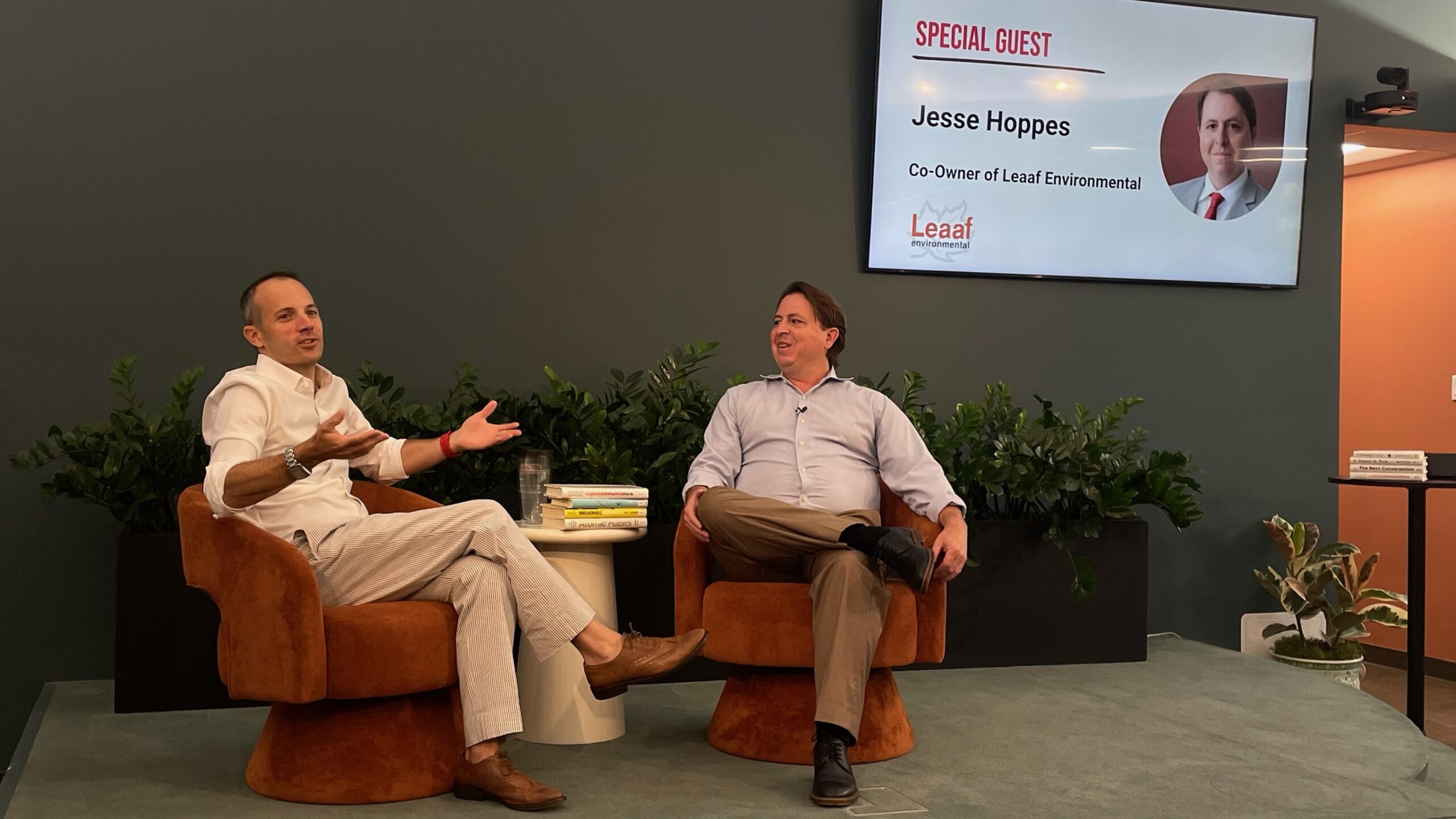
Jesse Hoppes, co-owner of Leaaf Environmental, on Phase 1 assessments, asbestos, dry cleaner sites, and the environmental questions every commercial agent needs to ask before the deal closes.
A Phase 1 environmental assessment is a standardized due-diligence process, governed by the ASTM International E1527 standard, in which a qualified environmental professional reviews property history, inspects the site, and searches regulatory databases to determine whether hazardous chemicals or petroleum products have likely contaminated the ground. Completing a Phase 1 (and keeping its interviews, records searches, site inspection, and environmental professional declaration current within 180 days of closing) gives buyers a legal defense against being held responsible for contamination that predates their ownership. Skipping it, even when a bank doesn’t require one, leaves buyers exposed to liability that can dwarf the cost of the report itself.
Why It Matters
Commercial real estate agents talk about Phase 1 reports the same way they talk about appraisals: a box to check when the bank asks for one. But the people who actually run those reports see something different: a snapshot of everything that happened on a piece of ground before your client ever signed a contract, and a legal shield that either exists or it doesn’t.
Jesse Hoppes has spent his career on the science side of that equation. As co-owner of Leaaf Environmental, a 25-to-30-person firm with offices in Gretna and Baton Rouge and work spanning Louisiana and Mississippi, he’s the person agents call when a deal gets complicated underground. He joined KW New Orleans Operating Principal Jeffrey Doussan for a deep session on what environmental due diligence actually involves, what it costs, and what happens when an agent skips it.
The State of Play
Environmental due diligence in commercial real estate isn’t one thing. It’s a stack of different concerns (below-ground contamination, above-ground hazardous materials, building-specific issues like asbestos), each governed by different rules, different timelines, and different consequences if ignored. Here’s the framework every agent working commercial deals needs to carry.
It’s a process you follow. And what they’ve done is overall they’ve made the laws to where the EPA or the DEQ won’t hold you liable for the contamination if you follow this process and you don’t find anything.
Jesse Hoppes, Co-Owner, Leaaf Environmental
The Liability Shield Explained
The single most important thing to understand about a Phase 1 is what it actually does legally. It is not absolution. It is a shield: a documented defense that, if followed correctly and completed on time, prevents the state and federal government from naming the current owner as the responsible party for contamination that predates their purchase.
That distinction matters for sellers and buyers alike. An old Phase 1 from a prior owner or a prior lease transaction does not transfer that protection. Each new buyer needs their own report, completed within 180 days of their closing, to earn the shield. A Phase 1 done three years ago for a bank’s collateral review doesn’t protect the person signing the deed today.
The Louisiana Department of Environmental Quality and the U.S. Environmental Protection Agency can still pursue anyone else in the chain of title, but a properly completed, timely Phase 1 takes the current buyer off that list. Find contamination after closing that demonstrably predates the Phase 1? You’re protected. Skip the Phase 1 entirely? You own whatever’s in that ground.
For agents, the practical implication is straightforward. Even when a bank doesn’t require a Phase 1 (some lenders exempt lower-value transactions or apply internal screening first), flagging the liability question to your client in writing is part of fiduciary duty. As Doussan put it during the session: document it in an email, let the client make an informed adult decision, and move on.
What the Bank Actually Does
Commercial lenders aren’t monolithic on environmental review. The process varies considerably by institution size, deal value, and how much in-house environmental expertise the bank carries.
Larger institutions (Hoppes named Hancock Whitney and others in the regional market) typically have internal environmental specialists who run a preliminary electronic review before deciding whether a full Phase 1 is warranted. Below certain loan thresholds, they may clear a deal internally and never order a Phase 1 at all. Smaller community banks often push that decision further toward outside consultants. Either way, environmental firms like Leaaf operate from bank-maintained approved-vendor lists, similar to how appraisers are selected; the buyer pays the cost, usually surfacing in final loan documents.
Leaaf has developed a tiered service specifically for banks: packages ranging from a quick historical screening all the way up to a full Phase 1, priced by the complexity and potential risk of a given property. Several regional banks, including Gulf Coast Bank, now use Leaaf as their de facto internal environmental review team, according to Hoppes. The model solves a real problem: loan officers and underwriters are good at credit risk, not soil chemistry.
The biggest problems usually come with cash transactions and new buyers that aren’t used to dealing with commercial properties. They go buy stuff with cash, they never do any of their due diligence, and that’s where the problems come. And then it’s like they’re in construction. Then all of a sudden they hit stuff.
Jesse Hoppes, Co-Owner, Leaaf Environmental
Reading the History: Sanborn Maps and What They Reveal
A significant portion of what goes into a Phase 1 is archival research. Environmental professionals aren’t just checking current databases; they’re reconstructing what a property and its neighbors looked like across a century or more of use.
The most powerful tool in that archive is the Sanborn fire insurance map collection: detailed, block-by-block surveys produced from the late 1800s through roughly the 1950s, originally drawn so insurers could assess fire risk in American cities. For environmental work, they’re invaluable: Sanborn maps show building footprints, construction materials, occupant types, and, critically, the specific industrial features insurers most feared: boiler rooms, fuel tanks, dry cleaning operations, storage tanks. A 2,000-gallon diesel tank marked on a 1909 map of a New Orleans block is exactly the kind of detail that triggers a closer look in a Phase 1 review.
Access is free. Louisiana residents can reach the Sanborn collection through their Orleans Parish or Jefferson Parish library cards. The maps are also digitized and searchable through the Library of Congress. City directories (historical phone books organized by address rather than name) layer on top of that, year by year, showing what business occupied every address in a given period. Paired with historical aerial photography (Google Earth’s archive remains useful for industrial sites going back to the 1990s) and DEQ’s regulatory database, these tools let an experienced environmental professional piece together a property’s full industrial biography before anyone touches a shovel. New Orleans, with its dense urban history, has some of the richest Sanborn records in the country.
The takeaway for agents isn’t to become forensic historians. It’s to know these resources exist, understand why a Phase 1 takes three to four weeks to do properly, and recognize when a property’s history warrants a closer look before recommending your client skip the report. For agents who want to go deeper, the KW New Orleans Learning Center has additional resources on commercial due diligence.
The Dry Cleaner Problem, and Other Red Flags
Some property types carry environmental risk so well-documented that the market has already priced it in. Dry cleaner sites are the clearest example.
Historical dry cleaning operations used perchloroethylene (PERC), a chlorinated solvent, as their primary cleaning agent. For decades, the standard industry practice was to dispose of used solvent directly into the ground. PERC is classified by the EPA as a likely human carcinogen, it passes through clay soils more readily than petroleum products, and unlike gasoline (which floats near the water table), PERC sinks until it finds an impermeable layer and then migrates laterally. It’s more expensive to remediate than petroleum, and there is no Louisiana state fund equivalent to the underground storage tank program to help cover costs. Banks know this. Old dry cleaner sites are effectively unbankable as collateral, which is why they often appear attractively priced; the discount reflects the contamination burden the seller hasn’t solved.
Gas stations present a different but more common scenario. Louisiana maintains an underground storage tank cleanup fund (funded by a per-gallon fee collected at the pump) that acts as a kind of insurance policy for active stations with leaking tanks. Hoppes’s team manages 10 to 20 active cleanup sites under that program at any given time. The relevant point for commercial buyers: an adjacent gas station, especially one operating with older steel tank infrastructure, can contaminate a neighboring property. Phase 1 scope extends to surrounding parcels, not just the subject property.
Then there are the less obvious categories. Nuclear pharmacies, facilities that produce radioactive compounds for cancer diagnostics and treatment, operate quietly in commercial buildings with no visible signage. Doussan described a transaction involving a building that had housed a small nuclear reactor for pharmaceutical production; the team brought in a certified health physicist with a Geiger counter to survey every square foot before proceeding. Asking prior tenants the right questions matters. So does knowing which questions those are.
Just because there’s environmental doesn’t mean it’s a dead deal. … There’s a lot of workarounds and things you can do.
Jesse Hoppes, Co-Owner, Leaaf Environmental
When Contamination Is Found: Brownfields and the Path Forward
A Phase 1 that surfaces likely contamination is not automatically a deal-killer. How you proceed depends on the type and severity of the problem, the intended use of the property, and, increasingly, whether public funding can close the gap between cleanup cost and transaction economics.
Leaaf Environmental is, by Hoppes’s description, the leading brownfields remediation firm in Louisiana. Brownfields are properties where confirmed or suspected contamination complicates redevelopment: sites that won’t move through a conventional transaction because the cleanup liability exceeds what a private buyer can absorb. The EPA Brownfields program channels federal grant money to regional planning commissions and municipalities to address exactly these sites. The City of New Orleans has received Brownfields funding; so have regional planning entities across Louisiana. That money exists specifically to make deals work on properties that otherwise wouldn’t.
For agents, the practical move when contamination surfaces is not to panic and pull the client out; it’s to bring in an environmental attorney alongside the consultant, understand what remediation actually costs for the specific contaminant involved, and then explore whether the deal can be restructured around a price adjustment, a remediation escrow, or a public funding application. Environmental issues become negotiating tools as often as they become deal-breakers. One agent at the session described using a prior owner’s Phase 1 findings as leverage to negotiate a lower purchase price after the report scared off competing buyers.
Louisiana DEQ staff are more accessible than most people assume. The agency’s website lists direct contacts by program area (petroleum, asbestos, hazardous waste), and those contacts field calls from agents and buyers, explain the status of specific sites, and can describe what funding is available and what remediation priority a given property carries. The institutional knowledge sitting inside DEQ is often the fastest path to understanding what a contaminated deal actually requires. Agents working commercial properties in Louisiana and Mississippi can also browse available listings through KW New Orleans property search to identify sites worth a closer environmental look before bringing a client to the table.
Common Questions
Jesse Hoppes draws a hard line between what a Phase 1 covers (below-ground contamination from hazardous chemicals and petroleum products) and everything else (asbestos, lead, mold, nuclear residue), which requires entirely separate inspections. He makes an equally hard case that cash buyers skipping environmental due diligence are the most common source of mid-construction disasters in commercial real estate. The liability shield a Phase 1 provides is time-limited, buyer-specific, and irreplaceable: a report from a prior owner protects the prior owner, not the current buyer. For agents working commercial transactions in Louisiana and Mississippi, the job isn’t to diagnose environmental problems; it’s to know when to flag them, who to call, and how to keep a deal alive when the ground turns complicated. Brownfields funding, public remediation programs, and sharp environmental counsel mean contaminated properties can still close. They just require a different kind of deal-making.
About this series. KW New Orleans hosts regular conversations with the leaders shaping our city: developers, architects, investors, and operators building the New Orleans of tomorrow. These are the conversations that happen in the rooms most people don’t get invited into.
KW New Orleans brings together the sharpest minds in real estate, development, and hospitality. If you’re ready to work alongside people building the city’s future, we’d love to talk.