
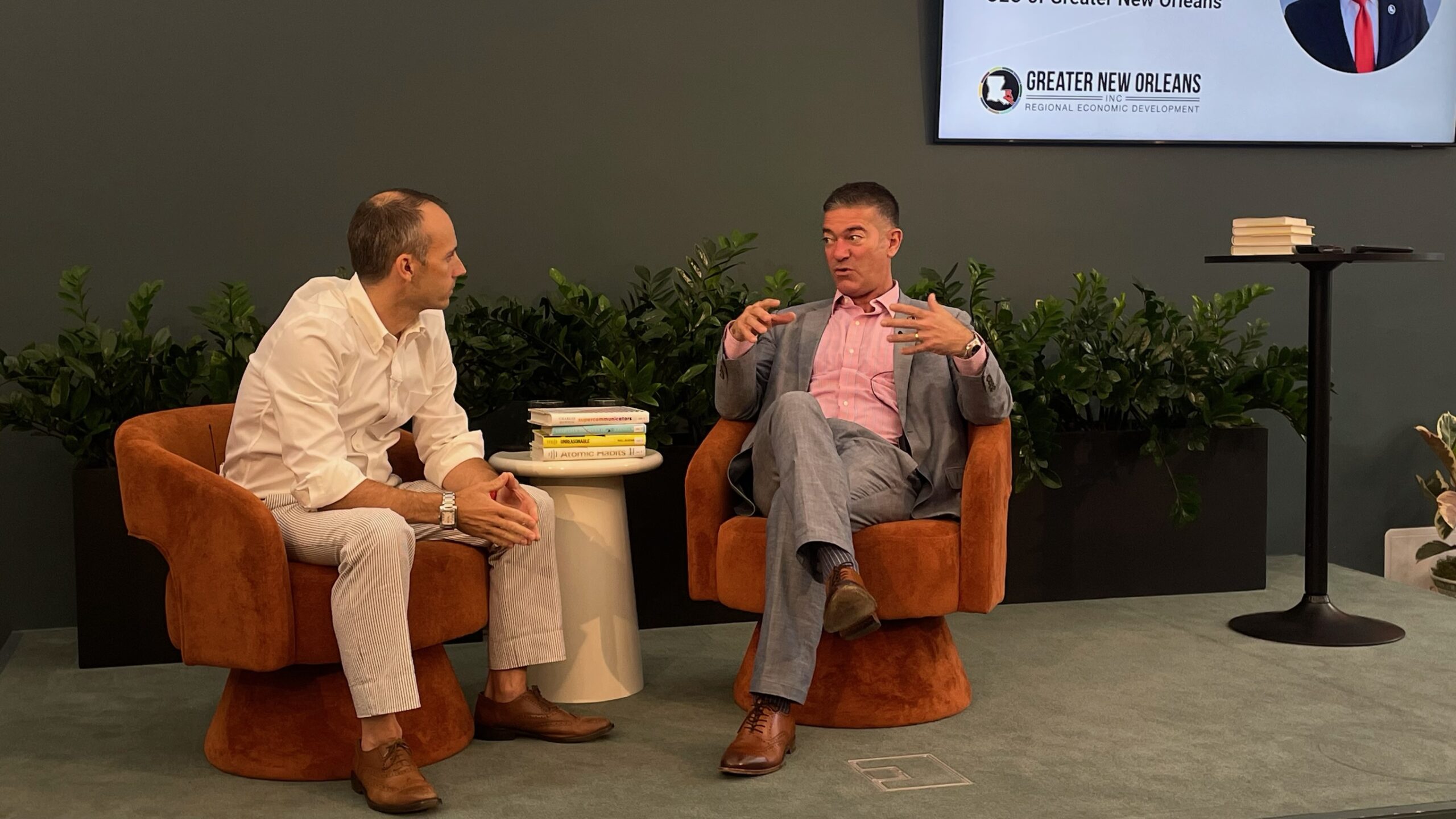
Michael Hecht, outgoing CEO of Greater New Orleans, Inc., on four engines of regional growth, a historic crime reversal, the population strategy that defines winning, and what still stands in the way.
Greater New Orleans is at an inflection point driven by four converging industries (energy, defense, aerospace, and maritime trade) that are bringing high-wage jobs and, for the first time in decades, actually bending the region’s population curve upward. Greater New Orleans, Inc. (GNO Inc.), the region’s economic development organization, has set a clear benchmark: grow the ten-parish metro population by 5% over five years. If that happens, Hecht argues, everything else (the tax base, the schools, the housing affordability, the retail) becomes solvable. If it doesn’t, the city’s structural problems compound.
Why It Matters
Every month, more U-Haul trucks leave Louisiana than enter it. That single data point has become a kind of blunt instrument in conversations about the region’s future, a gut-check metric that cuts through every optimistic press release. Which is exactly why the counterargument Hecht is now making deserves serious attention: for the second consecutive year, according to Hecht, Louisiana has actually added population. The curve is bending.
Michael Hecht, who spent nearly two decades as president and CEO of GNO Inc. and will transition to a new role in 2027, sat down with KW New Orleans Operating Principal Jeffrey Doussan in August 2026 for an unfiltered briefing on the regional economy. This wasn’t a press conference. It was the kind of conversation that happens after the cameras are supposed to be off: candid on politics, specific on projects, and direct about what the city is still getting wrong.
The State of Play
The macro picture Hecht laid out isn’t cheerleading. It’s structural. Four global trends have converged on Louisiana in a way that’s producing real jobs, real capital, and, slowly, real population.
Population growth is the way we go back on offense.
Michael Hecht, President & CEO, Greater New Orleans, Inc.
Five by Five: The One Metric That Matters
GNO Inc.’s population strategy is deliberately simple: grow the ten-parish Greater New Orleans metro from approximately 1.41 million residents to 1.55 million over five years. That’s a 5% increase. Not per year, total. Hecht is blunt about why he’s chosen population as the organizing metric over the traditional economic development measures of capital investment and jobs created.
“If you don’t grow population, you’re not adding the resources you need to keep growing population,” he told the room. It’s a compounding problem in both directions. A shrinking city loses tax base, which degrades services, which makes the city less attractive, which accelerates the exodus. A growing city generates the sales tax, the property tax, the rate-payer base that funds the infrastructure people actually want to live around. The U-Haul flow reversal he’s aiming for isn’t cosmetic; it’s the only sustainable path to everything else on the civic wish list. Urban geographer Richard Campanella of Tulane put it in terms Hecht likes to repeat: cities exist in dynamic equilibrium, like a bicycle. They’re either moving and stable, or they stop moving and they fall over.
The four pillars supporting that population target are economic opportunity (the industries described above), quality of life (led by crime reduction and parks investment), affordability (insurance costs, home prices, rental rates), and brand, the perception problem that makes people imagine New Orleans as a place to visit for Jazz Fest, not a place to build a career. GNO Inc. is now working on branding campaigns at both the state and city level, with a mayor Hecht trusts to be on camera.
The Crime Story Nobody Expected
Four years ago, New Orleans led the country in per-capita murders. Carjackings were happening in every neighborhood. Stunt driving shut down intersections. By any honest accounting, the city had a public safety crisis that was driving people out and keeping investment away.
The reversal has been, by Hecht’s telling, historic. Murders and violent crime are down more than 70% from their peak, a turnaround he describes as potentially the biggest in American history for a city. Jefferson Parish, which shares the metro, recorded only three or four homicides in all of 2026 as of this interview. Hecht credited coordinated civic pressure (including the NOLA Coalition, a public safety advocacy effort) and a sustained focus from law enforcement and the mayor’s office. He pushed back sharply on media coverage that, in his view, underplays the transformation. A recent critical article about first-responder drones particularly frustrated him. Jefferson Parish has deployed drones that reach any location in the parish within 90 seconds of a 911 call at a cost of roughly $2.5 million for the whole system, a force-multiplier Hecht argued New Orleans should adopt immediately.
Louisiana schools are also improving, according to Hecht, faster than any other state, moving from near the bottom of national rankings upward by multiple positions, with New Orleans schools among the fastest-improving in the country by some measures. He’s careful not to oversell: “Louisiana schools are still not great,” he said. But the direction matters almost as much as the absolute position.
If you had told me four years ago when we were in the depthless thing and there was carjackings all over all over the city, every neighborhood… that today we would have the biggest turnaround in public safety, maybe in American history, I would have been like, “Yeah, okay, let’s just try to cut it in half.”
Michael Hecht, President & CEO, Greater New Orleans, Inc.
Downtown’s Physical Transformation
The projects reshaping New Orleans’ built environment are not speculative anymore. Several of the city’s most significant redevelopments are either permitted, under construction, or in active planning, and they’re concentrated in ways that could produce genuine neighborhood change rather than isolated wins.
The redevelopment of Charity Hospital into a mixed-use anchor tied to Tulane University is Hecht’s headline for downtown. The River District, a planned new neighborhood on the riverfront, has received approvals on a significant initial residential phase. And the former Naval Support Activity (NSA) site in Bywater (which Hecht described, with characteristic bluntness, as previously functioning as “a drug and despair distribution center”) is being converted into several hundred units of mixed-income housing. The back portion of that site will become a new campus for Newlab, a technology incubator Hecht called the best in the country, with a focus on energy and maritime innovation. Newlab New Orleans is slated to open in January, according to Hecht.
On Canal Street, Hecht sees an asset that has never had a dedicated owner, no one whose job it is to walk it every single day and fix what’s broken. He invoked his New York background: business improvement districts succeed on three things and three things only. “Clean, safe, beautiful,” he said. “Everything else does not matter.” A new point person, Sayde Finkel, is now taking on that mandate as part of the city’s effort to bring Canal Street back into commerce. One persistent problem: the 100 blocks at Canal’s intersection with the French Quarter have historically fallen into an ownership gap, technically under the Downtown Development District’s jurisdiction but functionally owned by no one.
Affordability & Housing: Where GNO Inc. Is Wading In
For most of its history, GNO Inc. focused on large-scale economic development: corporate attraction, infrastructure, workforce. Housing affordability was someone else’s lane. That’s changing.
Hecht acknowledged that homeowners insurance, flood insurance, and auto insurance costs have been a meaningful deterrent to both buyers and renters. He noted that 2026 marked the first year since 2016 with no insurance rate increases, a data point he believes is contributing to a bump in home sales activity, alongside sellers who have finally adjusted their price expectations after three years of resistance. Neither factor alone explains the market shift; it’s the combination that’s moving the needle.
On the supply side, GNO Inc. is now engaging with zoning, terrain it has historically left to municipalities. The challenge Hecht and Doussan put plainly: new construction in the region skews heavily toward large-lot suburban development, particularly on the North Shore, where land is available and build costs are lower. The economics of fitting a neighborhood-scale retail or residential project into a city block in the Lower Garden District are roughly as expensive as building from scratch in a suburban corridor, which pushes developers toward the path of least resistance. Bringing density (and the mixed-use neighborhood fabric that makes urban blocks functional) back into the city requires confronting zoning codes that haven’t kept up with the city’s economic ambitions.
More residential supply in and around the urban core would, over time, push rental prices down. That matters for the population strategy: the city cannot attract and retain a young professional workforce if a one-bedroom apartment costs more than a mortgage would in any other mid-sized city in the South. The new apartment developments Hecht referenced, projects near the waterfront and in the Bywater corridor, are part of that supply response. But searching available homes and properties across Greater New Orleans still reveals a market with limited move-in-ready options at entry-level price points, which is why GNO Inc.’s willingness to engage on zoning is significant.
Keeping Young Talent in the City
Every year, Tulane University and Loyola University New Orleans graduate thousands of students who chose New Orleans because they love it, and then leave because they feel they have to. Hecht has thought carefully about why, and he doesn’t let the city off the hook with a simple answer.
Historically, Tulane has had one of the highest percentages of out-of-state students of any university in the country, and one of the highest departure rates after graduation. Hecht frames this as “educational colonization”: the city bears the cost and energy of four years of student life and then exports the talent to Houston, Atlanta, Nashville, and New York. The fix is both structural and reputational. Structurally, the energy, defense, maritime, and aerospace sectors now generating jobs at average salaries above $90,000 (per Hecht’s account of LED’s announced projects) give young graduates a real economic case for staying. Reputationally, universities and employers haven’t done enough to make those opportunities visible to graduating students before they sign offers elsewhere.
There’s also a cost-of-living argument that goes underutilized: the purchasing power of a New Orleans salary, relative to what that income buys in terms of housing, food, culture, and quality of life, compares favorably to almost any major coastal city. That’s not a consolation prize; it’s a genuine differentiator that gets lost when the only comparison made is the headline salary number.
I am hinging the next version of GNO Inc.’s reputation on fixing this at the regional level.
Michael Hecht, President & CEO, Greater New Orleans, Inc.
The Politics: What’s Working, What’s Not
Hecht gave Mayor Helena Moreno unusually direct praise, the kind a civic leader rarely offers a sitting politician on camera. She is, in his telling, the rare elected official who became more grounded after taking office rather than less. She has publicly claimed ownership of the city’s most politically dangerous problems: population decline, infrastructure, the Sewerage & Water Board, New Orleans East. Her team, he said, operates with “a great happy warrior attitude.”
The friction with Louisiana Attorney General Liz Murrill is a different story. Hecht declined to get deeply into the substance, describing it as “way above our pay grade” in terms of personality and politics. His operating position: ignore the spectacle, keep working on the projects, and trust that the structural relationships between city and state, which have to function regardless of who’s fighting on Twitter, will hold. The city’s financial position is a harder problem to set aside: cash reserves have been severely depleted, and Hecht acknowledged it plainly. His cautiously optimistic read is that the fiscal pressure may force structural decisions (on the judiciary, on government consolidation, on spending priorities) that political goodwill alone never would have compelled.
The judiciary piece is specific. The consolidation of Orleans Parish criminal and civil courts, eliminating a structural anomaly that New Orleans maintained while the rest of Louisiana did not, has forced judges who might otherwise have served unchallenged to compete against each other. Hecht’s view: that’s not automatically a bad outcome. The Metropolitan Crime Commission’s public reporting on judicial caseload data (which judge clears cases, at what pace, with what backlog) has made that accountability visible in a way it never was before.
Common Questions
Michael Hecht spent nearly two decades building the case that New Orleans is a serious place to invest, build a company, and raise a family. He leaves the day-to-day CEO role at a moment when that case is finally, materially stronger: crime is down by historic margins, four industry sectors are adding high-wage jobs simultaneously, the NSA site in Bywater is becoming a tech hub, and a mayor is publicly claiming ownership of the city’s hardest problems. The unfinished work is specific: keep enough young graduates from leaving, unclog the zoning codes that prevent urban density, close the gap between Canal Street’s physical potential and its current condition, and move the population number from 1.41 million toward 1.55 million before the momentum of this moment dissipates. GNO Inc. is now betting its next chapter on that last metric being the only one that actually counts.
About this series. KW New Orleans hosts regular conversations with the leaders shaping our city: developers, architects, investors, and operators building the New Orleans of tomorrow. These are the conversations that happen in the rooms most people don’t get invited into.
KW New Orleans brings together the sharpest minds in real estate, development, and economic growth. If you’re ready to work alongside people building the city’s future, we’d love to talk.