
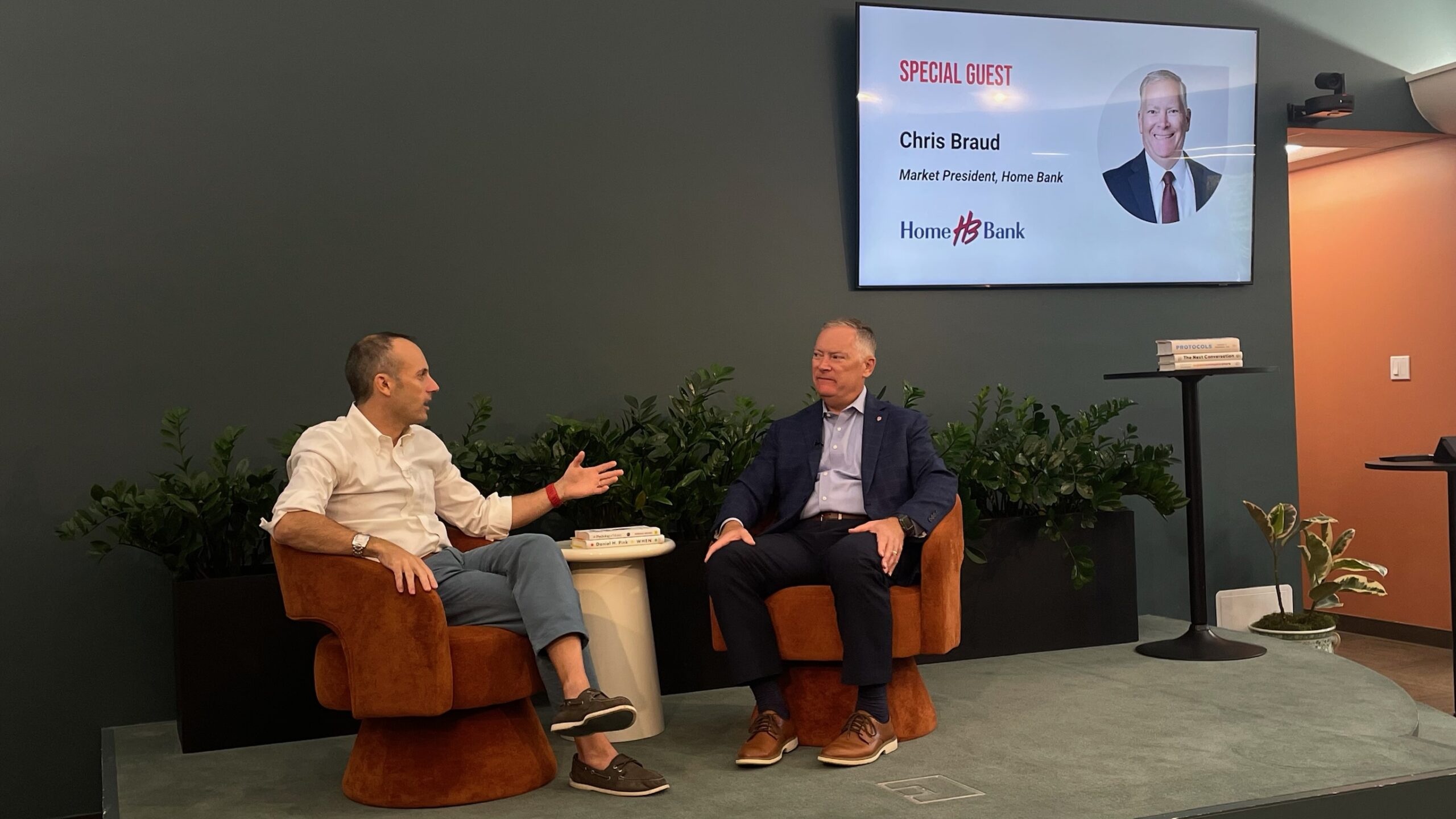
Chris Braud, New Orleans Market President at Home Bank, on how commercial real estate loans actually work, why personal guarantees are nearly universal, and where the real opportunity sits in New Orleans right now.
Commercial real estate loans are not interchangeable the way residential mortgages are. Every deal is underwritten on its own merits: the property’s income, its leases, the borrower’s personal guarantee, and the bank’s judgment about risk it will hold on its own books for years. In New Orleans, that work falls mostly to community and regional banks, and understanding how they think is the first step toward closing a deal.
Why It Matters
Most real estate professionals spend their careers doing residential transactions. Then a client calls with a commercial deal and the rules feel completely different, because they are. The federal infrastructure that makes residential mortgages liquid and predictable, Fannie Mae and Freddie Mac, does not exist for most commercial property. The bank that makes the loan keeps it, which changes everything about how that bank thinks.
Chris Braud, New Orleans Market President at Home Bank, joined Jeffrey Doussan and the KW New Orleans team for a candid, question-driven session on commercial lending. Home Bank, N.A. is a Lafayette-based community bank that traces its roots to 1908; its parent company, Home Bancorp, is publicly traded under the ticker HBCP. Braud leads the bank’s New Orleans market. What follows is the substance of that conversation, organized for agents who want to serve commercial clients without embarrassing themselves or their clients.
The State of Play
Before you can help a commercial client, you need to understand four structural realities that separate commercial lending from everything you already know about residential mortgages.
On a commercial loan… particularly in real estate, we’re looking for the property to perform on its own, so we’re looking at the leases in place. What’s the debt service coverage? Historicals are great. If it’s a new build, you know, we’re looking at, you know, kind of projections and what those leases are going to be.
Chris Braud, New Orleans Market President, Home Bank
Loan Structure: What to Expect
Commercial loan terms are shorter than most residential clients expect, and that is intentional. Because the bank holds the loan and cannot predict where interest rates will be in a decade, it reprices the note at regular intervals to manage that risk.
The most common structure Braud described is a 5-year term with a 20-year amortization. The monthly payment is calculated as if the loan runs 20 years, but the remaining balance (the balloon) comes due after five. At that point the bank re-underwrites: updated appraisal, current financials, a look at how the property has been maintained. If everything checks out, it renews for another five-year term on the remaining 15-year amortization schedule, and so on until the loan is retired. “We’re more than happy to renew it,” Braud said. Renewal is the expected outcome.
Down payment expectations, per Braud: roughly 25% for investment property, and around 20% for owner-occupied. The SBA 504 loan program can bring that down for qualifying owner-occupied deals. In the typical structure Braud described, the bank takes about 50% of the financing and an SBA-backed debenture covers about 40%. Under 13 CFR 120.910, the borrower must contribute at least 10% of the project cost, or 15% for a business that has operated two years or less or for a limited- or single-purpose building (20% if both apply). The SBA portion carries a long-term fixed rate, with 20- and 25-year terms available for real estate, which is unusually stable for commercial credit. Doussan’s tip: ask for the all-in rate, because fees get layered onto the quoted rate and change the actual cost of the loan.
One other structural difference worth flagging for clients who come from the residential world: commercial loans almost never have escrow accounts for taxes and insurance. The borrower manages those obligations directly. That matters because failing to pay property taxes or letting insurance lapse puts the renewal at risk.
The Personal Guarantee and the Non-Recourse Myth
This is the topic where clients most often arrive with dangerous misconceptions, sometimes armed with terminology they found online.
Non-recourse debt means the lender’s only remedy in a default is to take the property. No personal guarantee, no personal liability. It sounds appealing, and clients occasionally show up insisting they can get it. Doussan’s rule of thumb from the session: at $20 million and below, there is no shot. Braud agreed that banks typically will not go non-recourse on that kind of loan. The bank is holding the loan, so beyond the property’s own performance, it looks for strong guarantor support.
Non-recourse terms do exist in the institutional market, particularly through Fannie Mae and Freddie Mac programs for larger multifamily complexes. Doussan added that a borrower with the credentials to qualify for a loan of around $100 million can get non-recourse terms. For nearly every other deal in New Orleans, the guarantor is part of the underwrite. “We really don’t want the property back,” Braud said. “We just want to get repaid.” The personal guarantee is the mechanism that makes that possible.
When a client says they have access to non-recourse debt, Doussan’s advice is simple: “Let’s go meet that person.” If someone is talking to you about non-recourse debt, he said, “they are either uber wealthy or uber naive, and you’ve got to decide which one they are in that conversation at that moment.”
We don’t want the property back. That’s the last thing we want.
Chris Braud, New Orleans Market President, Home Bank
The Relationship Bank Advantage
Community banks run on a different model from the big national banks, and that difference shapes how a commercial borrower should approach one.
Braud described Home Bank as a relationship bank, a phrase with a specific commercial meaning: the bank wants the full business relationship, not a single loan transaction. Deposits matter because banks lend out what they take in. “Money is inventory for banks,” he said. A client who moves their operating accounts, payroll, and treasury activity to a community bank is also providing that bank with a live picture of their business health, which makes the bank more confident and the borrower more competitive for credit. Pricing reflects the depth of the relationship. A transactional borrower with no deposits at the bank is likely to pay more than one who has been a full client for years.
That makes the first question for a commercial client simple: who do you already bank with? If the answer is a community or regional bank, Doussan said, that is probably good news, because that bank wants to lend to them more than anybody else. If the answer is a national money-center bank like Chase, the client should be ready to move their whole business relationship (checking and operations) to whichever bank makes the loan. Braud confirmed that is the expectation, so set it early.
Braud said Home Bank will go up to $20 million to $25 million for one borrower, though it would rather not put that much into a single project. For bigger deals, it takes the lead and brings in other banks through participations. Doussan described a $60 million multifamily deal a client brought to Home Bank: Home Bank was set to take $20 million as the lead, with two other banks (one of them Hancock Whitney) at $20 million each, and the client dealt only with Home Bank. That kind of lead-and-participate structure lets community banks stay relevant on large transactions without concentrating too much risk on a single relationship.
Environmental Due Diligence: The Step Agents Often Miss
Commercial transactions carry an environmental layer that has no equivalent in residential deals, and banks take it seriously because the liability follows the chain of title.
Many lenders run each commercial address through a screening tool that pulls environmental records, including the database kept by the Louisiana Department of Environmental Quality. The tool also checks adjoining parcels, because contamination from an underground tank at a neighboring gas station can migrate. Former gas stations, dry cleaners, paint and body shops, and similar uses almost always lead to a Phase 1 environmental site assessment, which involves a records review and a site inspection by a qualified firm. If Phase 1 raises concerns, a Phase 2 follows, with soil drilling and lab testing; Braud said results typically come back in 30 to 60 days.
If contamination is confirmed, the deal does not automatically die. Braud described a recent project where the bank knew going in that the site was a former gas station with underground tanks. The acquisition was funded with a set-aside for remediation costs held in escrow. Once the Louisiana DEQ issued a “no further action” letter confirming the cleanup was complete, construction could begin. The remediation, which meant digging out and replacing the soil, cost a couple hundred thousand dollars and affected the property’s initial value, since whoever bought the site was going to have to pay for that work.
Residential properties are generally excluded from environmental screening unless the deal involves a large multifamily complex with its own usage history. Standard single-family and small multifamily transactions do not trigger the same review.
Where the Opportunity Is Right Now
The same market pressure squeezing existing commercial borrowers is creating real entry points for buyers who can move with cash and patience.
The dynamic Doussan outlined in the session is worth understanding clearly. Owners who took out commercial loans in 2020 and 2021 locked in historically low rates. Those five-year balloons are coming due now, and the new payments, combined with sharply higher insurance premiums and property taxes, often do not pencil. Some of those owners cannot lower their asking price because the property is priced at what they need to pay off the note, not what the market will bear. The result is overpriced listings sitting vacant, owners under pressure, and a mismatch between what sellers need and what the market will support.
For a buyer who can show up with cash and reposition a property, the path Doussan described is straightforward: acquire, stabilize (fix the problems and get it leased), then bring the leased, performing asset to a lender and refinance to pull cash back out. At that point the bank has a performing property with a rent roll to underwrite. “It’s going to be a lot easier to go see Chris after you’ve bought it and stabilized it,” Doussan said. Ask Braud to finance a vacant building with deferred maintenance up front and his answer is “maybe,” with a plan and a letter of intent required first. “Show me what else you have. Can you carry it if it takes you six months?” he said.
The hospitality sector deserves a specific note. Home Bank does a decent amount of hospitality lending, and Braud acknowledged the sector has had a tough 2024 and 2025, with the January 2025 Bourbon Street attack weighing on a down year. KW New Orleans Team Leader Cody Caudill added that he is seeing hotels default even with solid occupancy and good room rates, because the loan terms they signed no longer work. He sees opportunity there for well-capitalized buyers who can look past the headlines to the underlying asset. If you’re working with investors interested in New Orleans hospitality or commercial properties, understanding this dynamic is essential to serving them well.
We are a relationship bank, so we are looking to get the full relationship. We’re not looking for a transaction. The pricing is going to be different if it is more of a transaction than a relationship.
Chris Braud, New Orleans Market President, Home Bank
Business Credit, Startups, and the SBA Safety Net
Not every commercial client is buying a building. Some are trying to fund a growing business, and the credit picture there is different in ways that agents and their clients often do not anticipate.
Business credit scores, reported through services like Dun & Bradstreet, are a much softer signal than personal FICO scores. Not all business debt gets reported. A company can owe millions across vendor relationships and still show a thin or misleading business credit file. Braud said Home Bank uses business scores mainly to look for derogatory items, not as a primary underwriting factor. When you apply for a commercial loan, the bank is going to ask for everything: tax returns, profit and loss statements, a personal financial statement, and an affidavit covering debts that may not appear anywhere on a report. The bank is building its own picture.
For startups or businesses without an operating history, the SBA 7(a) loan program covers equipment and working capital needs where traditional commercial credit would be a harder sell. Even there, the borrower has to bring something to the table; Braud said there is typically no 100% financing, especially for a startup. The more common path Braud described is a business that starts with family money or personal credit cards, gets some traction, and then brings the operating history to a bank to refinance out the expensive early-stage debt. Partnering with someone who already has a credit track record at a bank can accelerate that process considerably.
Agents who want to go deeper on the financing side of commercial deals can find more resources through our learning center, and agents ready to build a commercial practice alongside a team that already has these relationships should explore what KW New Orleans offers.
Common Questions
Chris Braud delivered something agents rarely get: a frank look at how a community bank actually thinks about commercial credit, from the personal guarantee they will almost certainly require, to the SBA structure that can lower a down payment, to the environmental escrow that kept a former gas station deal moving. The most actionable takeaway for agents is structural: find out where your client banks before you start shopping their deal. Community and regional banks do most of this work in New Orleans, and the relationship they already have with a borrower is a major factor in how that deal gets priced. The current market, with rate-shocked borrowers, rising insurance costs, and stressed hospitality assets, is creating real buying opportunities for clients who can move decisively and reposition properties before refinancing. That window will not stay open indefinitely, and agents who understand the credit picture well enough to have an intelligent conversation with a banker like Braud will be the ones who help their clients walk through it.
About this series. KW New Orleans hosts regular conversations with the leaders shaping our city: developers, architects, investors, and operators building the New Orleans of tomorrow. These are the conversations that happen in the rooms most people don’t get invited into.
KW New Orleans brings together the sharpest minds in real estate, development, and banking. If you’re ready to work alongside people building the city’s future, we’d love to talk.