
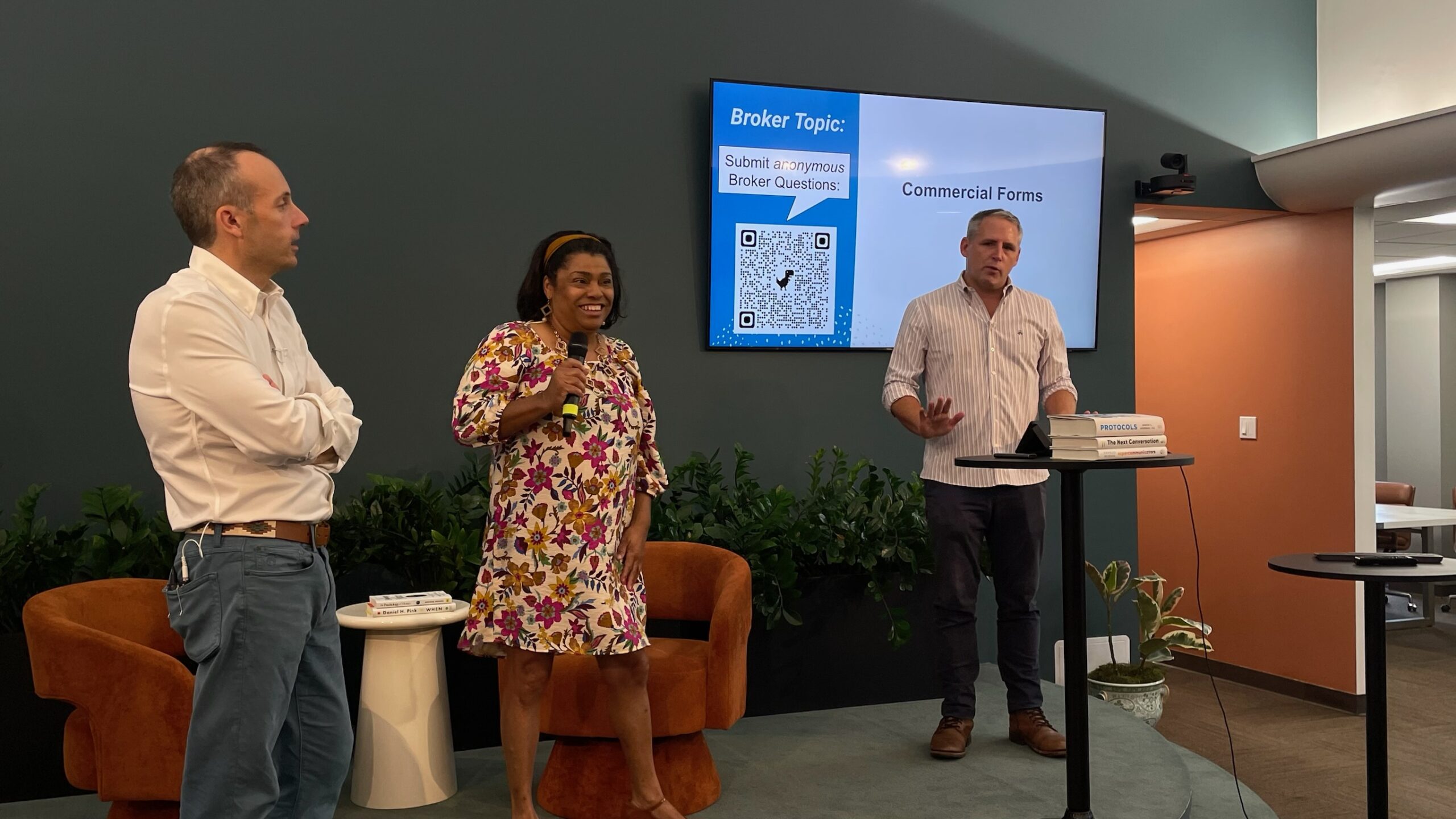
Nichole Donald, Jeffrey Doussan, and Cody Caudill of KW New Orleans on why Louisiana has no state-prescribed commercial contract, what a Letter of Intent actually does, when to use the residential purchase agreement, and how agents can break into commercial deals without getting burned.
Louisiana has no state-prescribed commercial real estate contract: the Louisiana Real Estate Commission’s mandatory purchase agreement is required only for residential property of one to four units. In the KW New Orleans team’s practice, commercial deals start with a Letter of Intent that is usually non-binding, then move to a purchase agreement that a real estate attorney drafts or reviews for the specific deal. Buyers and sellers should consult a Louisiana attorney before signing.
Why It Matters
Every Louisiana agent eventually faces a commercial opportunity, and the first question is almost always the same: where do I find the contract? The answer is uncomfortable. There is no fill-in-the-blank form waiting for you. What exists instead is a process that depends heavily on attorneys, on a well-constructed Letter of Intent, and on knowing exactly when the document you already know (the residential purchase agreement) is good enough and when it absolutely is not.
During a September 2026 session at KW New Orleans, Nichole Donald (Coach and Co-Broker), Jeffrey Doussan (Operating Principal), and Cody Caudill (Team Leader) walked agents through the practical reality of commercial transactions in Louisiana: the LOI, the attorney’s role, disclosure obligations, commercial leases, and the fastest path to building competency in this space.
The State of Play
Here is the commercial real estate picture for Louisiana agents in plain terms: the tools and protections that exist in residential transactions do not automatically carry over, and the stakes on a misstep are higher at every level.
If you think you’re smart enough as a real estate agent to be reading somebody’s insurance policy, which generally we don’t even get given to us, right, and to be making a lease that’s smart enough to cover these terrible like one-off cases, well then maybe we send you to SpaceX to work for them because you’re smarter than everybody.
Jeffrey Doussan, Operating Principal, KW New Orleans
The Letter of Intent: What It Is and What It Is Not
An LOI is a pre-contract alignment document. Doussan described it as a meeting of the minds on the broad terms while the parties are “not in contract yet.” It lays out the broad strokes: price, general terms, key conditions. If the parties cannot agree on a two-or-three-page LOI, he said, there is no point moving toward a formal contract.
Doussan said an LOI is usually non-binding and typically carries no deposit. Whether a particular letter binds anyone depends on how it is written, so it should state plainly which terms are and are not binding, and the parties should have a Louisiana attorney review it. Its value is in surfacing disagreement early, before anyone has spent real money. Caudill said that even after a verbal agreement, putting the terms in writing can bring surprise pushback, and he ends up saying, “We just talked about that.” In his words, “It happens every time.”
KW New Orleans has Word templates for LOIs, and Doussan said the team also has a commercial document written by “a very good real estate attorney” that it will share with agents who come talk to leadership. He was quick to warn that an editable Word file is also an easy way to get into trouble. The team’s first move, he said, is to get the client to use their own attorney, who will probably want to write the document.
Attorney Involvement: When and Why
In the team’s view, the answer to “do I need an attorney for this commercial deal?” is almost always yes, and the need grows with the size of the deal. As Doussan put it, “you’re getting riskier and riskier the more and more expensive you get.”
For a simpler deal, Caudill said, a big title company may have a commercial attorney on staff who can handle the work, and he named Crescent Title as one example. It depends on where that attorney’s specialty lies, though. For a specialized asset type, a large dollar figure, or a lease with complex insurance and damage provisions, he would tell the client to find an attorney who works in that field, and each side benefits from its own counsel.
When a client declines to hire an attorney, the team’s guidance is to put the recommendation in writing and keep the record. Responding to an agent who had advised clients in writing, more than once, to have an attorney review a document, Doussan said to upload that email to KW Command as a PDF. “You say it twice,” he said, and Caudill finished the line: “you write it twice.” That paper trail can help if a deal goes sideways and a client later says they were not warned.
AI is no shortcut here either. Caudill put the question directly: “I can’t just ChatGPT my entire contract off my LOI.” Donald’s reply was that she “wouldn’t advise that.”
Doing a commercial purchase agreement, you can do that. Doing a commercial lease, that’s more than like a very very simple thing. You need to tell your client they have to, they need to get an attorney.
Jeffrey Doussan, Operating Principal, KW New Orleans
When the Residential Purchase Agreement Works (and When It Does Not)
One of the most practical takeaways from the session is that, in the team’s view, Louisiana agents do not always need a custom commercial document. The Louisiana Residential Agreement to Buy or Sell, the commission’s mandatory form for residential property of one to four units, is a document agents already know well, and for the right kind of deal beyond that, the team says it holds up.
Donald said agents can use the residential purchase agreement for a basic deal to buy a building, such as a five-unit apartment building. Doussan went further: “I’d use it on a 10. It’s a great document.” He acknowledged that an experienced commercial agent on the other side of the deal, someone at a dedicated commercial brokerage, might raise an eyebrow. In his view, using a document you know well to serve the client matters more than appearances.
The team’s hard limit is the moment an occupational license enters the picture. “We’re talking literally the building only, not the business or the business function,” Caudill said. Once the sale includes a business, the residential agreement is no longer the right tool, and the deal needs counsel and a document built for what it actually is.
Disclosure on Commercial Property: Louisiana’s Two Rules
Doussan, who was quick to say he is not a lawyer, framed disclosure as two rules. The first: Louisiana’s property disclosure requirement stops at residential property. With limited exceptions, sellers of residential real property must complete a property disclosure document in the form the Louisiana Real Estate Commission prescribes (La. R.S. 9:3196 et seq.; LAC 46:LXVII.3601), and commercial sellers are not required to complete that form. But that is only half the picture.
The second rule sits underneath it. Under Louisiana’s redhibition articles, a seller who knows the thing sold has a defect but omits to declare it is liable to the buyer for return of the price with interest, reasonable expenses, damages, and reasonable attorney fees (La. Civ. Code art. 2545). That article applies to sales generally, so a commercial seller who knows about a hidden hole in the roof and says nothing is not protected by the absence of a mandatory disclosure form. Agents carry their own duty: failing to disclose to a buyer a known material defect is grounds for discipline under the license law (La. R.S. 37:1455(A)(27)). Asked what it means if you have knowledge, Doussan answered simply: “Then you’ve got to disclose.”
Caudill’s personal approach is to ask commercial sellers to fill out a disclosure form anyway, even when it is not required. It creates a record. It prompts the seller to think through what they know. And if something surfaces later, the agent has documentation that the question was at least asked. What a particular seller must disclose is a question for a Louisiana attorney.
Agency Disclosure and Command: The Compliance Gaps to Know
KW Command, the Keller Williams platform where agents submit transaction documents, is geared toward residential deals, and Doussan warned there are “going to be some holes” on commercial. Agents need to know which compliance requirements still apply and which forms do not translate.
Before COVID, I cut out this act of God sort of the market falls off the planet. I literally deleted out of one of them because I was trying to like condense, condense, condense because I was scaring away like the seller. Luckily, we didn’t sign it literally the weekend before COVID.
Cody Caudill, Team Leader, KW New Orleans
Getting Started in Commercial: A Realistic On-Ramp
The team’s message on getting started was encouraging. Commercial real estate is not a closed door, and the on-ramp is specific, affordable, and open to any licensed Louisiana agent who wants to try.
Donald’s recommended first step is to take an introductory commercial class to see whether commercial is something you want to focus on. You do not have to join CID (the Commercial Investment Division of the New Orleans Metropolitan Association of REALTORS, or NOMAR) to take it, but she noted that CID members do not pay for the class. NOMAR lists CID dues at $70 a year for REALTOR members, and membership also brings discounted access to LACDB (the Louisiana Commercial Database), a separate paid subscription that Doussan called “the largest kind of MLS for commercial.”
From there, Doussan pointed agents to the introductory classes that start the CCIM Institute path, such as an introduction to real estate finance and an introductory commercial finance class. “I’m not saying go get a CCIM,” he said, but after the first two or three CCIM classes, “you’ll learn more than most.”
For agents who simply want to browse commercial listings first, Caudill offered a quick tip: inside RPR (Realtors Property Resource), which agents can reach through the MLS, a widget shows LACDB properties. It does not include all the back-end data, he noted, but it lets an agent get a feel for what is out there before paying for an LACDB subscription.
The team’s standing offer to KW New Orleans agents is straightforward: if you are looking at a commercial deal, bring it to the leadership team before you go too far alone. The LOI templates and the attorney-written commercial document are available to agents who ask. Caudill said leadership does not want agents to be afraid of commercial work; the idea is to “hold hands and go through these things together” so the deal serves the client and protects the agent’s license. You can explore the full range of resources available at KW New Orleans’ Learning Center.
Common Questions
There is no commercial contract template waiting to save you, and the closest thing to a safety net is an attorney who knows the asset class. Jeffrey Doussan’s family came close to a six-figure gap between lease and insurance after Hurricane Ida; Cody Caudill’s condensed agreement, stripped of its force majeure clause, luckily went unsigned the weekend before COVID. In the team’s view, the residential purchase agreement can work for simple building-only sales, but the moment a business license or a complex lease enters the picture, the document needs a lawyer’s hands. For agents who want to build toward commercial work, the path is clear: join CID ($70 a year for REALTOR members), take the introductory classes, consider an LACDB subscription, and bring deals to the KW New Orleans leadership team before going it alone. Buyers and sellers should consult a Louisiana attorney before signing. The resources and the experienced hands are there; use both.
About this series. KW New Orleans hosts regular conversations with the leaders shaping our city: developers, architects, investors, and operators building the New Orleans of tomorrow. These are the conversations that happen in the rooms most people don’t get invited into.
KW New Orleans brings together the sharpest minds in real estate, development, and hospitality. If you’re ready to work alongside people building the city’s future, we’d love to talk.