
KW New Orleans leaders on binding homeowners insurance before a storm shuts the market, what Louisiana’s purchase agreement says about moving a closing date, and how buyers and sellers protect a deal in hurricane season.
Bind the buyer’s homeowners insurance as soon as a storm threatens: insurers suspend new policies when a hurricane approaches, and lenders generally require proof of coverage to close. The Louisiana Real Estate Commission’s 2026 Residential Agreement to Buy or Sell has no act of God clause, so moving the Act of Sale takes a written agreement signed by buyer and seller, either at the time or in an addendum they signed with the contract.
Why It Matters
Hurricane season changes the math on every Louisiana closing. The contract can be clean, the loan approved, and the title clear, and the deal can still stall on one document: proof that the buyer’s new homeowners policy is in force.
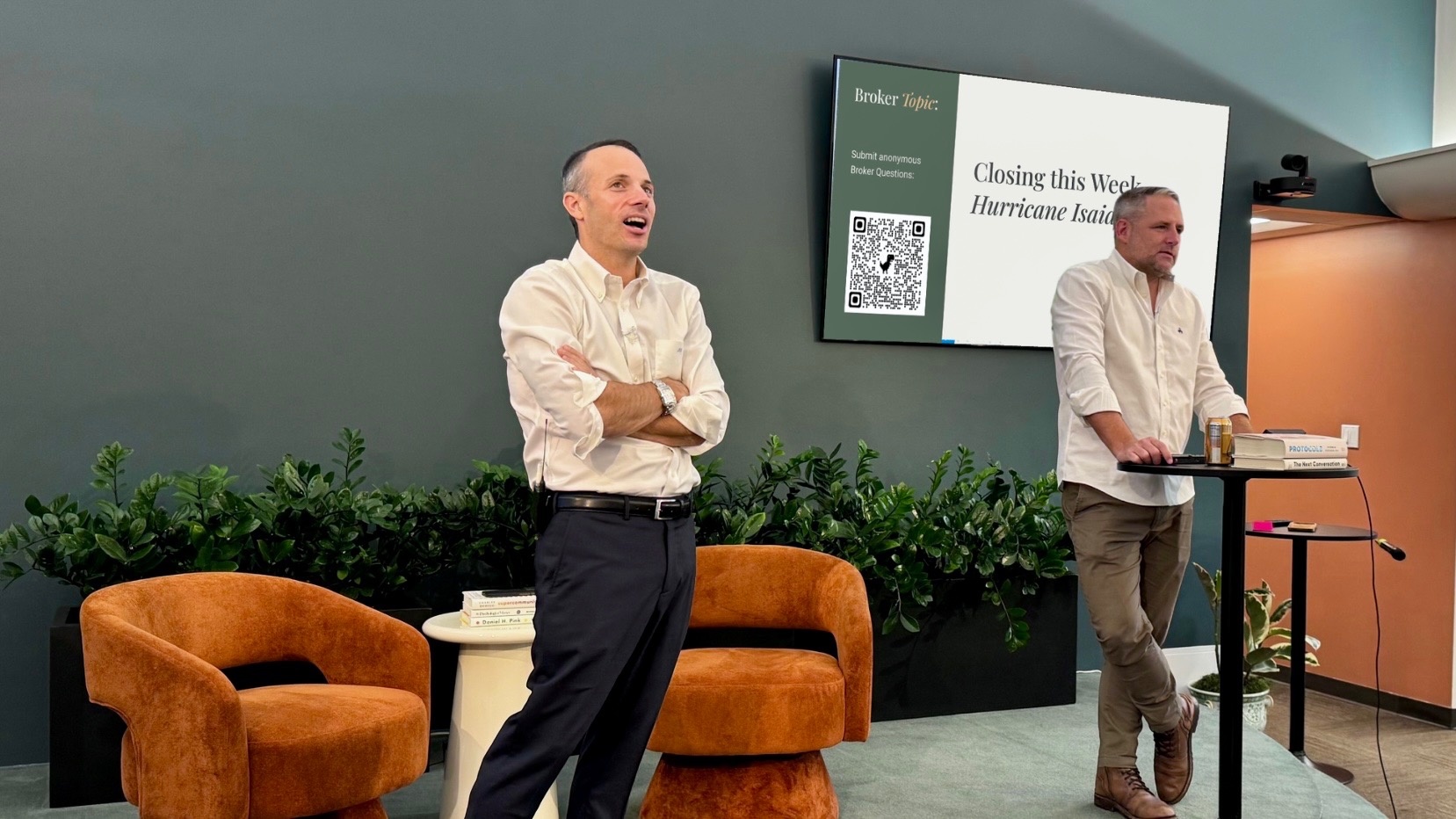
On Oct. 7, with Hurricane Isaias in the Gulf and a stack of KW New Orleans closings on the calendar, Nichole Donald, Coach and Co-Broker, used the weekly broker topic for one message: call the insurance agent now. Cody Caudill, Team Leader, followed with the contract question. The answers below come from that session, checked against the 2026 Residential Agreement to Buy or Sell itself.
You have to bind your insurance, and if it’s not, you won’t close.
Nichole Donald, Coach and Co-Broker, KW New Orleans
Bind Insurance Before the Market Closes
Insurers stop selling new coverage when a storm gets close. When a hurricane threatens, carriers declare a binding suspension: no new policies and no coverage increases until the suspension lifts. Each company sets its own trigger. Citizens Property Insurance Corporation, Florida’s insurer of last resort, stops binding statewide once the National Weather Service issues a tropical storm or hurricane watch or warning for any part of Florida.
That window can close in hours. Jeffrey Doussan, Operating Principal, told the room that agents had texted insurance contacts during the team’s morning huddle, and the answer was the same everywhere: policies could still be written, but carriers expected the word to stop at any minute.
They were expecting by noon that most companies will be shut down. All markets, all of them shut down.
Nichole Donald, Coach and Co-Broker, KW New Orleans
No policy, no loan. The Consumer Financial Protection Bureau notes that lenders generally require proof of homeowners insurance, because the house is their collateral. Donald’s advice reached past that week: even a closing set for the following Monday needed coverage bound right away, because no one knew how long the market would stay shut.
Flood coverage runs on different rules. Under the National Flood Insurance Program, a new policy normally takes effect 30 days after the application, but when it is bought in connection with a mortgage and applied for and paid at or before closing, coverage starts at the loan closing (44 CFR 61.11). Buyers in a flood zone still need the application and premium in before the Act of Sale.
What the Purchase Agreement Says About Storms
Then came the contract question. If a storm shuts the insurance market or the settlement agent’s office, what happens to a closing date both parties already signed?
What does the act of God do for us in this moment?
Cody Caudill, Team Leader, KW New Orleans
The answer is in the form, and it surprises people. The 2026 Residential Agreement to Buy or Sell, one of the commission’s mandatory forms, contains no act of God, force majeure, or natural disaster paragraph. The Act of Sale is signed before a settlement agent or notary the buyer chooses (more on who picks your title company), and the form says any change of that date “must be mutually agreed upon in writing and signed by the SELLER and the BUYER.” Its deadlines section adds that “TIME IS OF THE ESSENCE, and all deadlines are final” unless a change is made in writing and signed by all parties.
So a storm does not move a closing by itself. Buyer and seller sign an extension, usually as an addendum, and the new date holds. If the parties signed a storm, act of God, or force majeure addendum with the original contract, that document controls: read how long it extends deadlines, what event triggers it, and what notice it requires.
One storm-related extension is built into the form. During the due diligence period, the inspection window “will be extended by the same number of days that the BUYER is not granted immediate access to the Property or all utilities are not provided by the SELLER.” After a storm, days without access or power can stretch that window.
Louisiana law offers a backstop, though not one to plan around. Under Civil Code article 1873, a party is not liable for failing to perform when a fortuitous event makes performance impossible. Legal guidance that Louisiana REALTORS® published in September 2020 notes that the residential form has no fortuitous event paragraph and that, without a specific provision, deadlines generally continue to run. Whether a storm excuses a missed date is a question for a Louisiana real estate attorney. A signed extension keeps it from becoming one.
After the Storm, Look Again
A closing that survives the storm still needs a second look at the house. The form requires the seller to keep the property in substantially the same or better condition as when the agreement was signed, and it gives the buyer the right to re-inspect within five calendar days before the Act of Sale.
Donald made the same point in the meeting: extra time gives everyone a chance to view the property and make sure there is no damage. If the walk-through finds some, buyer and seller are back at the table on repairs, price, or timing, and the seller’s insurance claim becomes part of that conversation.
A Storm-Week Checklist
For any closing inside a storm’s forecast window, four moves protect the deal.
Common Questions
Isaias put two clocks on every closing at once. The insurance market’s clock was expected to run out by noon on Oct. 7, and Donald’s answer was to bind coverage before it did. The contract’s clock never stops on its own, because Louisiana’s form has no act of God pause. The next storm will reward the agents who make both moves early: the call to the insurance agent and the extension signed by both sides.
About this advisory. KW New Orleans shares guidance from its weekly agent meetings when it can help buyers and sellers. This post is general information, not legal advice. For questions about a specific contract, talk with your agent and a Louisiana real estate attorney.
Our agents close deals through every hurricane season. If you’re buying or selling in New Orleans, we’ll help you plan around insurance deadlines, contract dates, and the final walk-through.