
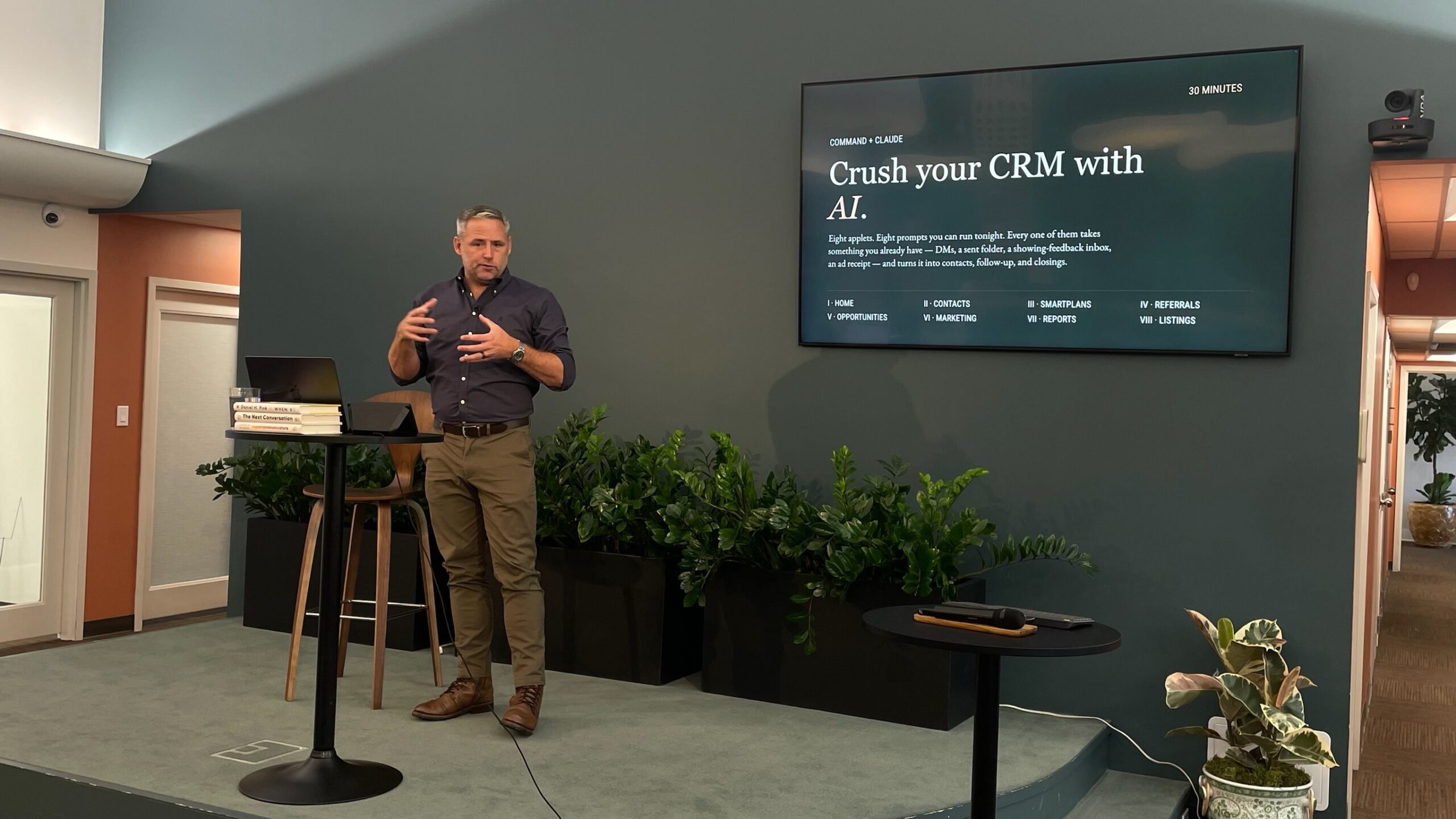
Cody Caudill, Team Leader at KW New Orleans, on using AI to clean your database, build personalized smart plans, write golden letters at scale, and finally make your CRM do something.
Most real estate agents already have hundreds of warm leads sitting idle in their phones and social inboxes; the problem is not lead generation, it is the absence of a system to act on what they already have. KW Command, combined with AI tools like Claude, lets agents automatically tag contacts, generate personalized drip sequences, and produce targeted direct-mail lists in minutes, work that used to take hours and rarely got done at all.
Why It Matters
Your database is either working for you or slowly costing you deals. According to the National Association of Realtors, repeat clients and personal referrals together account for 41% of total Realtor business (20% from repeat clients, 21% from referrals), and Caudill notes that for agents who have built a mature, well-tended database, that share can climb to 65% or beyond. The gap between those two numbers is not talent. It is follow-up, tagging, and consistency.
In July 2026, KW New Orleans held a follow-up session to its Accelerate AI training program. The topic: your CRM. Specifically, the fact that most agents have thousands of contacts sitting in a database with no tags, no smart plans, and no system, and that a new generation of AI tools makes fixing that faster than anyone expected. Cody Caudill, Team Leader at KW New Orleans, led the session with a live walkthrough, honest self-assessment, and a handful of immediately actionable moves.
The State of Play
When Caudill asked the room how many agents were actively using smart plans in Command and had tagged their database to their satisfaction, a handful of hands went up. The rest of the room was quiet. That moment framed everything that followed.
You already have a lot of these leads. You’re just not doing something with them potentially, right? Or you haven’t thought about how to get the data into command and turn this into a system.
Cody Caudill, Team Leader, KW New Orleans
Building Your VIP List With AI
The first move Caudill walked through was not importing a cold list; it was surfacing the warm one already hiding in plain sight. His method: ask an AI tool to scan wherever you actually communicate with people and pull out every name.
For his own demo, he pulled three months of Instagram direct messages, 161 conversations with people he was already in contact with. He is clear that Instagram is just one example; the same logic applies to Gmail threads, phone text messages, or any platform where real conversations happen. The point is not the source, it is the principle: the people you have messaged recently are your actual sphere of influence, not everyone you have ever met.
Once that list exists, even as a plain text file of names, the next step is getting it into Command. With the Claude desktop app and its Chrome browser extension installed, you give Claude the list, tell it to search each contact in Command, and tag them as VIP. If the tag does not exist, you tell it to create one first. For 150 names, Claude handles what would otherwise be an hour of clicking in minutes, while you make calls or do anything else. The practical ceiling on this workflow is staying logged into Command; like most platforms, it times out, and Caudill calls the occasional re-login “babysitting.”
For agents who want a more structured starting point, Caudill references the VIP 200 list, a focused set of roughly 200 relationships to work intentionally, expanded to 400 in a slower market. This is not everyone in your phone; it is the people you would call if you needed a favor. AI just makes it faster to figure out who that actually is.
Golden Letters at Scale
A golden letter is a targeted direct-mail piece that tells a specific property owner you have a ready and willing buyer for their type of home. Unlike a generic “I’m your neighborhood agent” mailer, a golden letter names the specific need (unit type, building, or neighborhood), which is why its response rate outperforms mass mail. Caudill estimates roughly one strong response per 100 letters sent, which sounds low until you do the math on the cost of a stamp versus a closed commission.
The workflow he demonstrated: pull owner mailing addresses from the Orleans Parish Assessor’s Office public records, or Realtors Property Resource (RPR), which draws from the same public data, for a specific building or radius. Hand that list to Claude and ask it to generate individual letters for each owner, referencing their specific unit type. Pull MLS data on bedrooms and square footage to make each letter even more precise. Then ask Claude to format mailing labels in the Avery template of your choice. What used to take three-plus hours of mail merge frustration takes minutes.
The legal piece matters here. Public records data does not give you permission to email or text those owners. Under the CAN-SPAM Act and the Telephone Consumer Protection Act (TCPA), unsolicited commercial messages require prior consent. Physical mail (USPS, FedEx, or a letter tucked into a door frame (not the mailbox, which is a federal violation)) is the compliant path. Paid digital ads are the other: running a hyper-targeted campaign to the same address list creates a permission-based touchpoint without the compliance risk.
The Mid-City corridor and other dense residential neighborhoods around New Orleans are natural candidates for this approach: tight blocks of owner-occupied properties where a buyer with specific criteria and a specific budget is a genuine value proposition, not a cold pitch.
Something that would have taken you probably three hours plus is going to be done in seconds, right?
Cody Caudill, Team Leader, KW New Orleans
Smart Plans That Actually Sound Like You
KW Command’s smart plan library exists, and by most accounts in the room, it is not very useful. The pre-built sequences are generic, impersonal, and obviously templated. Caudill’s fix is to stop using them and build custom ones with AI instead.
The process: take your own website (agent bio, neighborhood descriptions, client reviews, tone) and paste the URL into Claude. Ask it to write an 18-month drip campaign for a specific lead type (cold Facebook leads, sphere of influence contacts, investors, buyers, sellers). Tell it to use Command’s merge fields, the contact.first_name syntax, so every message personalizes automatically. Then ask Claude to open Command, create a new smart plan, and enter each step. A sequence that would take hours to build manually gets done while you are in a showing.
The key variable is which lead type you are building for. A drip for a cold Facebook lead is long: Caudill describes 18 months of persistent, somewhat blunt contact for leads that cost money and have low engagement. A drip for someone in your sphere is shorter, warmer, and reads nothing like a marketing template. Building both is not twice the work when AI is writing them; it is just two prompts.
On the email side, Command includes up to 5,000 emails per month at no additional cost, which Caudill points out can replace paid subscriptions to tools like Mailchimp or Constant Contact for agents who are not sending at high volume. The catch: Command’s email design templates are dated. His workaround is to have Claude generate clean, basic HTML (no JavaScript, no images), export it as a standalone HTML file, and import it directly into Command’s email builder. The result looks far better than anything in the default template library.
Referral Networks and the Gulf States
One lead source that consistently gets under-worked: the KW referral network. Keller Williams organizes agents into affinity communities (luxury, military, sports, and others) whose primary value is cross-market referrals. The agent Caudill described who leads one of these communities generates $380,000 in GCI annually from referrals alone, through a simple rhythm of quarterly postcards, monthly emails, and occasional calls.
The mechanism is straightforward: an agent in Scottsdale has a client relocating to New Orleans. Who gets that referral? The agent who stayed top of mind. Nichell Thompson, an agent at KW New Orleans, described reorienting her newsletter around New Orleans (what the city offers, why people move here, what makes it distinct) and beginning to receive referral business as a direct result. The newsletter was not about real estate. It was about the city. That distinction matters.
Building a Gulf States referral network specifically makes geographic sense for New Orleans agents. Buyers from Biloxi, Gulfport, and the Mississippi Gulf Coast represent a real, recurring pool of people who want a second home or primary residence in New Orleans. Caudill walked through how Claude can pull agents from the KW map by military base or region, compile them into a spreadsheet, and feed that list directly into a referral-specific smart plan. What used to require a full afternoon of manual clicking becomes a single session.
I found that I was like, I’m not doing anything to be top of mind with these other referral potential referral partners, and I’ve started getting business from it.
Nichell Thompson, Agent, KW New Orleans
Tracking Ad ROI Without Trusting the Platform
Caudill has a specific frustration with digital advertising dashboards: platforms like Meta and Google Ads report metrics that favor the platform. Impressions, reach, clicks: none of these tell you whether the ad paid for itself.
His solution was to build a custom ROI dashboard using Claude. He set up the relevant Google accounts (Google Ads, Google Analytics, Google Search Console, Google Tag Manager) and then gave Claude a detailed prompt: track every lead that enters from a paid source, calculate the cost per lead, and update the dashboard weekly. The threshold he cares about is not an absolute number; it is whether the cost per lead is lower than what he would pay a booking platform like Booking.com at 15% commission. If the ad is cheaper than the alternative, it is worth running. If not, it is not.
For real estate agents, the same logic applies. You need to know the value of an actual converting lead (not a click, not an impression) before you can evaluate whether any paid channel is worth the spend. That number takes time to learn. But without tracking it from the start, you are guessing. AI does not eliminate the guesswork on the strategy side; it eliminates the hours of spreadsheet work that used to prevent agents from tracking it at all. Agents interested in pairing this with a stronger listing presence can also explore how properties are surfaced through the KW New Orleans property search as one part of a broader digital strategy.
Common Questions
Cody Caudill’s core argument is not that AI replaces prospecting; it is that AI eliminates the friction that keeps agents from doing prospecting they already know they should be doing. Tagging 150 contacts takes an afternoon manually and never happens; it takes fifteen minutes with Claude and actually gets done. Writing 100 personalized golden letters to condo owners at one specific building takes three hours with a mail merge and produces inconsistent results; it takes one prompt and produces letters specific enough to name the unit type. Building an 18-month drip campaign from scratch takes a full day and almost never happens; it takes one conversation with an AI that has read your website. The agents who close more referrals, more sphere deals, and more golden-letter listings over the next two years will not necessarily be better at real estate. They will be the ones who stopped letting the setup cost keep them from running the system.
About this series. KW New Orleans hosts regular training sessions, guest conversations, and workshops for agents at every stage, from first year to top producer. Sessions are recorded and available for review. If you missed one, you did not miss it permanently.
KW New Orleans runs training, community, and real-estate conversations worth showing up for. If you want to work alongside agents who are actually building systems, we’d love to talk.