
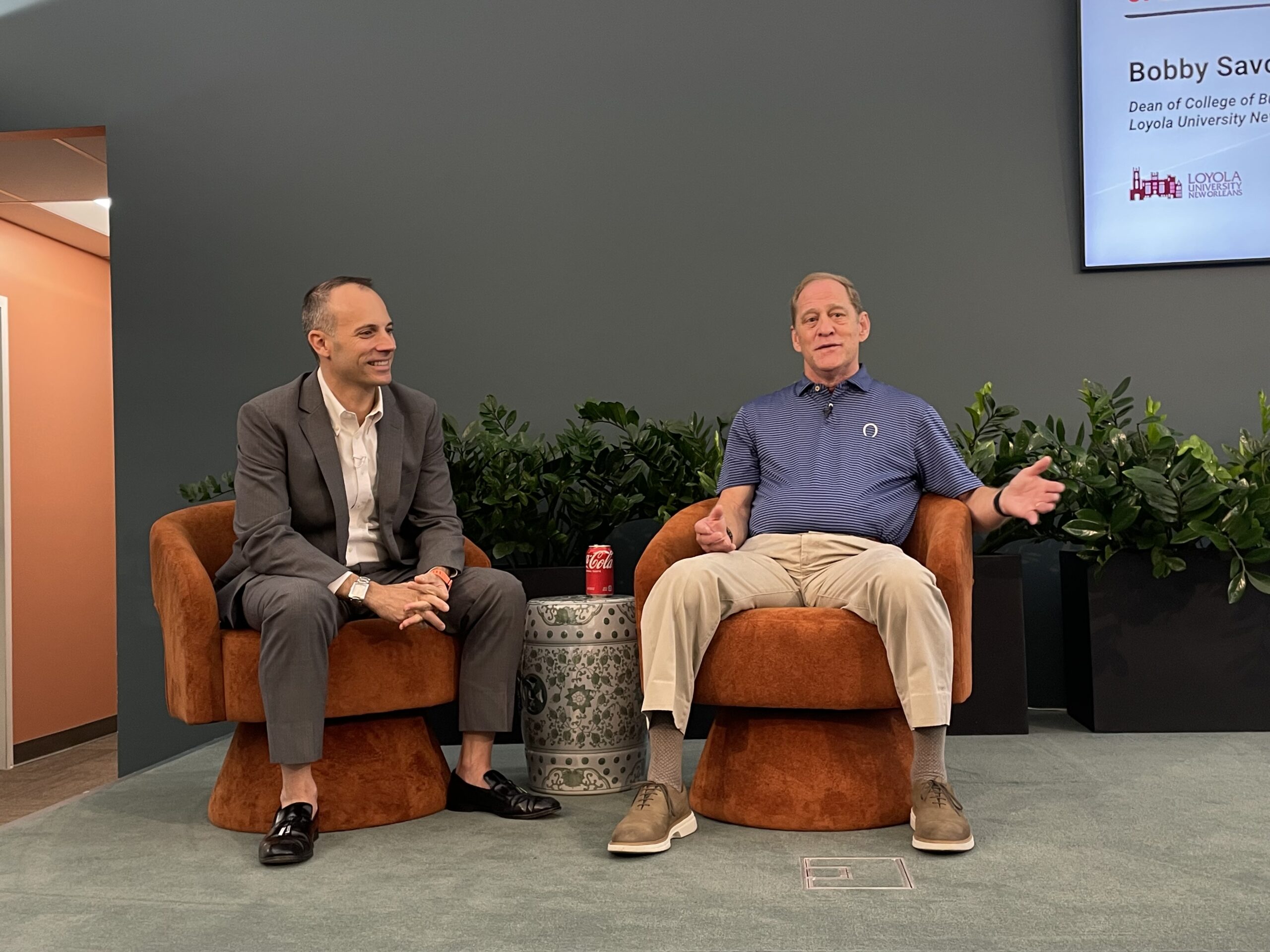
Bobby Savoie, Dean of the College of Business at Loyola University New Orleans, on building companies from nothing, why AI will fire the people who misuse it, and whether New Orleans is finally on the right trajectory.
The question of who shapes the next generation of New Orleans business leaders doesn’t get asked often enough. The answer, right now, involves a sugarcane farmer’s son who helped design a rocket, turned around a university budget crisis, and walked into retirement only to take on one of the most consequential jobs in local higher education.
Bobby Savoie sat down with KW New Orleans Operating Principal Jeffrey Doussan for a wide-ranging conversation that moved from federal contracting and employee ownership to AI literacy, critical thinking, and the long arc of Louisiana’s economic potential. What emerged was a masterclass in staying the course, and knowing exactly when to change course.
Savoie’s vantage point is unusual: he sits at the intersection of entrepreneurship, higher education, and a city in the middle of a slow but real reinvention. Here’s where things stand across the dimensions he knows best.
For the same effort I can get a $5,000 contract with the City of New Orleans, or a $50,000 contract with the State of Louisiana, or a $50 million contract with the federal government. It’s just a matter of knowing how to do it.
Bobby Savoie, Dean of the College of Business, Loyola University New Orleans
Savoie’s first federal contract, a $25,000 purchase order from the U.S. Department of Energy, took two years to win and likely cost his firm four times that in effort to deliver. That single relationship eventually produced $70 million in work with the same customer. The lesson he draws isn’t about federal contracting specifically. It’s about what patience in a single lane actually builds.
The parallel to real estate is direct. Any agent who has fought to land a listing, managed a transaction through a dozen near-collapses, finally reached the closing table, and then looked up to find a completely empty pipeline knows exactly the dynamic Savoie is describing. His answer to it, earned over years of sacrifice and employee ownership across four companies, was to shorten, then close, that feast-or-famine window by growing more than one relationship at a time. Not by abandoning what was working for something that looked easier.
Employee ownership was central to how he kept the people who made that growth possible. Across all four exits, employees shared in more than $100 million from company sales, a figure Savoie attributes directly to the decision to treat staff with the same intentionality as customers. Many of those employees followed him from one company to the next, bringing client relationships with them.
The debate in most institutions frames AI as a cheating problem. Savoie frames it as a firing problem: specifically, the risk that the students who use AI to avoid learning will one day be replaced by the colleagues who used AI to learn faster.
He isn’t dismissing the cheating concern. He personally proctored an economics exam, phones collected at the front of the room. But his larger argument is that an institution which only polices AI misses the mandate: preparing students to apply it effectively in professional environments where their employers will expect exactly that. The College of Business now requires freshman-year AI instruction, and several professors who described themselves as AI agnostics have since redesigned their syllabi around it.
The cautionary example he offers is not hypothetical. Attorneys representing a nonprofit Savoie is involved with submitted a federal court brief generated entirely by AI, without reading it. The brief cited case law that did not exist. The opposing counsel flagged it. The attorneys were sanctioned, the nonprofit lost the case, and litigation against the attorneys followed. The failure was not AI’s. It was the decision to outsource judgment to a tool that, by Savoie’s own accounting, produces errors a meaningful portion of the time.
The people who learn how… you’re going to get hired, and then you’re going to end up getting fired by the person who used AI to learn how to do your job better using AI through it. They don’t need you anymore, and you’re not going to be the one that’s kept around.
Bobby Savoie, Dean of the College of Business, Loyola University New Orleans
When Jeffrey Doussan pressed on whether adults are doing enough to maintain their own critical thinking skills, not just students, Savoie’s answer was disarmingly simple: the process is the same regardless of the stakes. Evaluating a house, structuring a pitch, diagnosing a customer relationship, designing a component for a space launch system: all of it runs on the same underlying skill.
The prescription for keeping that skill sharp, in his view, is sustained engagement with hard problems. His engineering background gave him decades of practice working through situations where the full shape of the problem wasn’t visible yet. The habit of working toward a solution before you have complete information, then stress-testing what you’ve produced, is what makes AI a multiplier rather than a replacement. The tool accelerates the middle of the research process. It doesn’t substitute for knowing what question to ask or whether the answer makes sense.
Savoie is an optimist about New Orleans and Louisiana, but a specific kind of optimist, the kind who can name what has gone wrong and still believe the arc bends forward.
His diagnosis of the region’s stagnation is structural: the Baton Rouge–New Orleans corridor has never cohered into the economic super-region it could be. He points to how rail investment along the Washington, D.C. Beltway transformed undeveloped land into dense employment centers as the kind of catalytic infrastructure Louisiana passed on. The missed light rail connection between the two cities (a project offered at the federal level and declined over operating cost concerns) is, in his view, the kind of decision that compounds quietly over decades.
What gives him confidence is the entrepreneurial ecosystem that has taken shape despite those structural gaps. Organizations like GNO Inc. have built the connective tissue between sectors and stakeholders that used to be missing. The profile events like New Orleans Entrepreneur Week now draw suggest that the city’s identity as a place to build something is genuinely strengthening. He is careful to note he could be wrong. But the trajectory, in his read, is positive.
I think the ecosystem we’ve built for entrepreneurship and for other companies to come in and build good things, I think we have a great ecosystem, and so I think it’s going to be positive.
Bobby Savoie, Dean of the College of Business, Loyola University New Orleans
Bobby Savoie built four companies, helped design a rocket, turned around a $20 million university budget deficit, and walked into what was supposed to be retirement. His through-line is not ambition. It’s obligation: to employees, to customers, to students who don’t yet know what they don’t know about AI. The College of Business at Loyola is now the institution producing the next wave of New Orleans entrepreneurs, and Savoie is reshaping it around a single conviction: the people who learn to use AI as a thinking tool will absorb the jobs of the people who use it as a shortcut. For anyone building a business or a career in this city, that is the competitive reality to plan around, and the next decade, he argues, will reward those who build networks and stay in their lane long enough to see the compounding begin.
About this series. KW New Orleans hosts regular conversations with the leaders shaping our city: developers, architects, investors, and operators building the New Orleans of tomorrow. These are the conversations that happen in the rooms most people don’t get invited into.
Be in the Room Where It Happens
KW New Orleans brings together the sharpest minds in real estate, development, and hospitality. If you’re ready to work alongside people building the city’s future, we’d love to talk.