
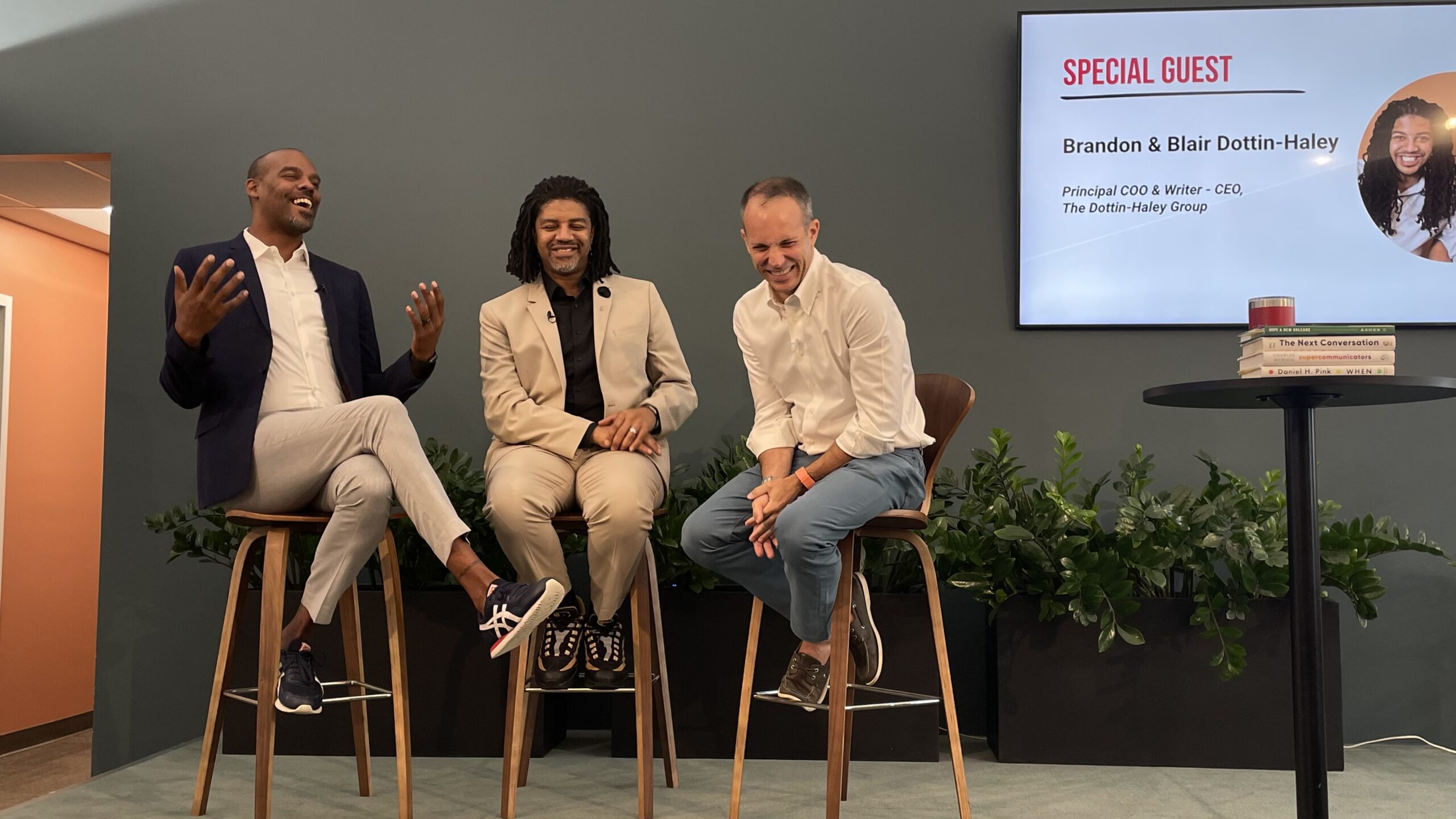
Brandon & Blair Dottin-Haley, the married co-founders of The Dottin-Haley Group, on civil rights lineage, documentary filmmaking, building community across silos, and what it actually takes to bet on yourself in a city as complicated and beloved as New Orleans.
Why It Matters
New Orleans has always produced people who do more than one thing: musicians who paint, attorneys who cook, activists who build institutions. Brandon and Blair Dottin-Haley fit squarely inside that tradition, except they also hold a Smithsonian acquisition, a BET documentary credit, 10 awards for a pandemic-era talk show, and a clothing brand whose John Lewis tribute collection caught the attention of the National Museum of African American History and Culture. Not bad for two people who started their first episode with a lamp, no shade, and a stack of books propping up a phone.
The Dottin-Haleys joined KW New Orleans Operating Principal Jeffrey Doussan for a conversation about legacy, place, the grind of entrepreneurship, and what it means to come home (or move to someone else’s home) and invest in it anyway. Blair’s grandmother, civil rights icon Oretha Castle Haley, loomed large over the room. So did the question every New Orleanian eventually faces: is this city worth the fight?
The State of Play
The Dottin-Haley Group’s reach across media, education, community development, and consumer goods makes it genuinely difficult to categorize. Here’s where they actually stand:
Life will bring you what’s supposed to come to you, and you have to be open, willing to take a chance on yourself and be willing to bet on yourself to win, even if it’s something that you’ve never done before.
Blair Dottin-Haley, CEO, The Dottin-Haley Group
The Weight of a Name
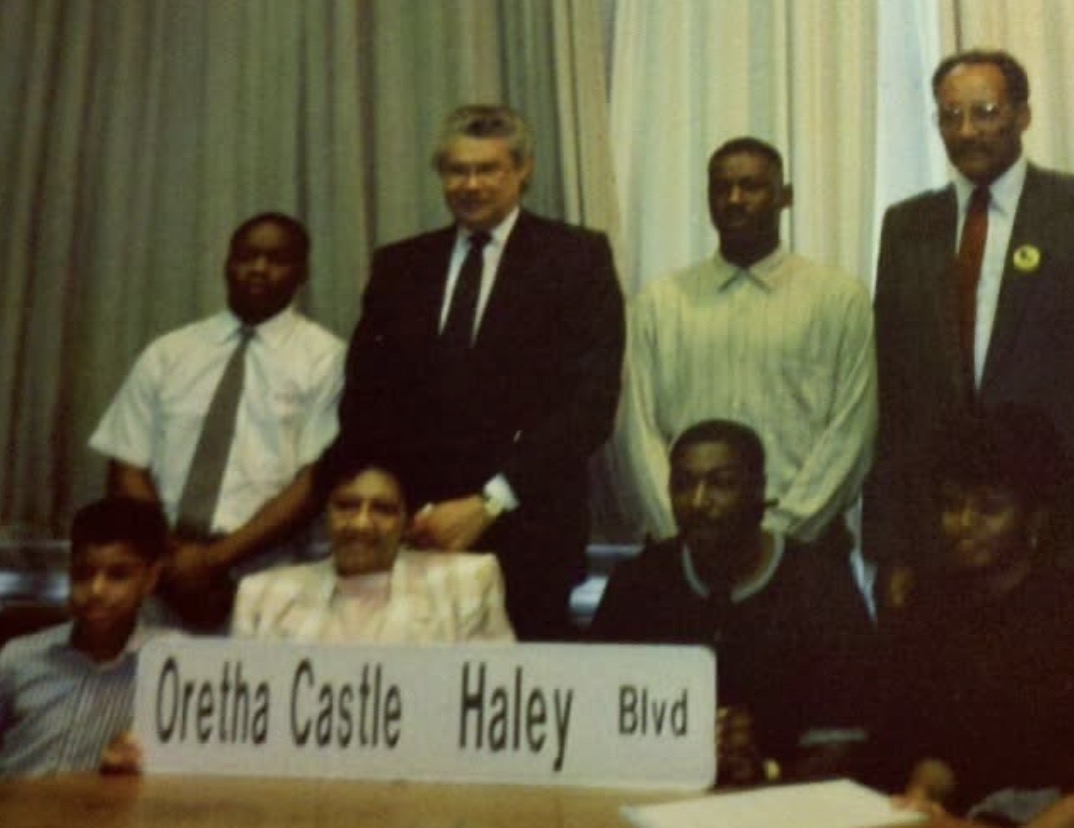
On the evening of September 17, 1960, a 20-year-old woman named Oretha Castle Haley walked into the McCreery Five and Ten Cent Store at 1005 Canal Street with three others and sat at a lunch counter. What followed (arrests, a circuit of appeals, a U.S. Supreme Court ruling in Lombard v. Louisiana) helped dismantle segregated service in restaurants across six states. Blair Dottin-Haley is her grandson.
He didn’t learn the full scope of her work from a history book. He was sitting in a school assembly at Audubon Montessori watching a civil rights documentary narrated by James Earl Jones (A House Divided, produced by Xavier University, the Amistad Research Center, and PBS) when he realized that the people on screen, the ones talking about marching and organizing, were his grandmother, his great-grandmother, and his grandfather. People he had seen the day before. People he was going to see later that day.
Oretha Castle Haley died at 48. She had integrated and then led Charity Hospital as its first Black female director, co-founded the Sickle Cell Anemia Foundation in New Orleans, served as director of minority recruitment for LSU Medical, and run campaigns for trailblazing politicians including Dorothy Mae Taylor, the first Black woman elected to New Orleans City Council at large. Blair was in the elevator at the Hilton Riverside, seven years old, going down to Taylor’s victory party, trying not to trip her in her heels. The Dottin-Haleys’ great-grandmother, Virgie Castle, worked the bar at Dooky Chase Restaurant for 40 years, and as Blair later learned directly from Leah Chase herself at a Smithsonian talk, that family connection is how Dooky Chase became a gathering place for civil rights workers. Freedom House, where Oretha Castle Haley brought the Freedom Riders, sits two blocks away.
Blair says he always felt the weight of that lineage as a responsibility to do something of substance. What’s striking is how literal he’s been about it. He is now among the people scheduled to be involved in the Louisiana Children’s Museum’s 40th anniversary, an institution his grandmother helped found. In June 2026, he was teaching a brand-led photography workshop for the museum’s Teen Catalyst program.
What It Actually Takes to Build Here
Before moving back to New Orleans in late 2023, Blair had lived through the city’s most brutal stress test as an outsider. He returned from Austin to New Orleans on August 1 or 2, 2005, three weeks before Hurricane Katrina. He was not fully unpacked when the storm hit. Everything in storage was gone.
He spent three years in Atlanta afterward, then moved to Washington, D.C., where he and Brandon met. The decision to come back wasn’t nostalgia: it was a cluster of opportunities that required being physically present. They put in the New Orleans offer two weeks after their Baltimore housewarming. When the bank said yes, they figured the rest out later.
Brandon, who isn’t from New Orleans, came in without the insider map that Blair’s upbringing provided. His read on the city is sharp for that reason. He’s observed what Blair describes as a half-degree-of-separation culture (tighter than anywhere else either of them has lived), and he’s watched how that proximity shapes professional relationships in ways that require a different kind of care. Relationship management here, Brandon notes plainly, is why he lets Blair handle it.
What keeps them is harder to pin down than opportunity. Brandon talks about New Orleans East (where they currently live) with the urgency of someone who sees unrealized potential clearly. Blair talks about wanting the city to get back to even what it was before Katrina, while refusing to romanticize what that was. “Some of these challenges,” he said, “are decades and decades old”, not products of any one mayor or legislature, but compounding like interest on a principal debt. That framing, borrowed from finance, is also a pretty good description of how New Orleans works for anyone trying to build something real in the city’s real estate landscape.
New Orleans is not a sixth degree of separation city, it’s a half a degree of separation city, and it makes for relationship management to be such a different beast than it is in other places.
Blair Dottin-Haley, CEO, The Dottin-Haley Group
On Making Something You’ve Never Made Before
The first episode of the Savage Chat Series had a lamp without a shade, a stack of books, and a phone. Erica Alexander (guest number two) apparently warranted a ring light. Blair made the case. Brandon wasn’t convinced. They got the ring light.
That origin story matters because it’s structural, not anecdotal. Neither of them had produced a talk show. Neither had produced a documentary when they made the short film about the Guardians of the Garden mural along I-10. Brandon was fielding calls with Johnson & Johnson during a respiratory health startup pivot while simultaneously co-hosting live episodes from the same laptop. The through-line isn’t talent: it’s the willingness to do the thing before you know how to do it, then get better fast.
Brandon’s poetry collection First Flight, released in October 2025, fits the same pattern. He describes himself as a page poet, someone who writes to process, rarely shares it, and treats it as private. Publishing a book of what he calls “soulful senryu” required him to release something he never intended for anyone else. He called it a vulnerable experience. He’s also clearly proud of it in a way that’s different from the awards and the Smithsonian piece (more personal, less easily categorized). The book is available at major retailers and through The Blairisms, their brand’s website. Agents and entrepreneurs serious about building in New Orleans might recognize the posture: betting on yourself before the outcome is guaranteed is not a strategy unique to documentary filmmaking.
As black queer male married entrepreneurs, been able to be successful and survive 10 years in the making. I mean, survive the pandemic, survive what is happening in the world right now.
Blair Dottin-Haley, CEO, The Dottin-Haley Group
Community as Infrastructure
Brandon’s vision for New Orleans East is specific and practical. He wants the neighborhood’s potential fully realized, not as an abstraction, but as something he intends to be part of making happen. Coming to the city from outside, without the inherited networks, he’s watched what works and what doesn’t, and his frustration is less with the scale of the city’s problems than with the basics that remain undone: lights on, potholes filled, recycling running.
The Dottin-Haleys’ community work runs through Junior Achievement, Arts New Orleans, the Young Artist Movement, and the Ashé Cultural Arts Center. Their Delgado Community College and Apple partnership has already put hardware in the hands of youth-serving organizations. These aren’t charitable gestures sitting alongside their “real” work: they are the work, woven into the same professional identity as the documentaries and the clothing brand. For anyone thinking about what genuine investment in New Orleans neighborhoods looks like from the outside in, Brandon and Blair are instructive: you move here, you buy a house, you identify where the gap is, and you get in the room.
Blair’s grandmother organized marches. His great-grandmother kept the bar at Dooky Chase, so the Freedom Riders had somewhere to gather. He teaches photography to teenagers at the Louisiana Children’s Museum. The continuity is not incidental. It’s the point.
Brandon and Blair Dottin-Haley are doing something specific in New Orleans: closing silos. They move between civil rights legacy and brand activism, documentary production and Apple hardware deployments, poetry publishing and New Orleans East neighborhood investment, not because they lack focus, but because they understand that the city’s challenges are interlocking. Blair carries a family history that spans Lombard v. Louisiana, the integration of Charity Hospital, and the founding of the Sickle Cell Anemia Foundation; Brandon brings the outside perspective of someone who chose this city without inheriting it. Together, they argue, by example, that betting on New Orleans requires doing the unglamorous thing first: show up, build real relationships, get the basics right, and stay even when it’s hard. The Smithsonian didn’t call until the work was already in the world. The same logic applies to every block in New Orleans East that still needs the lights turned on.
About this series. KW New Orleans hosts regular conversations with the leaders shaping our city: developers, architects, investors, and operators building the New Orleans of tomorrow. These are the conversations that happen in the rooms most people don’t get invited into.
KW New Orleans brings together the sharpest minds in real estate, development, and community building. If you’re ready to work alongside people investing in the city’s future. We’d love to talk.