
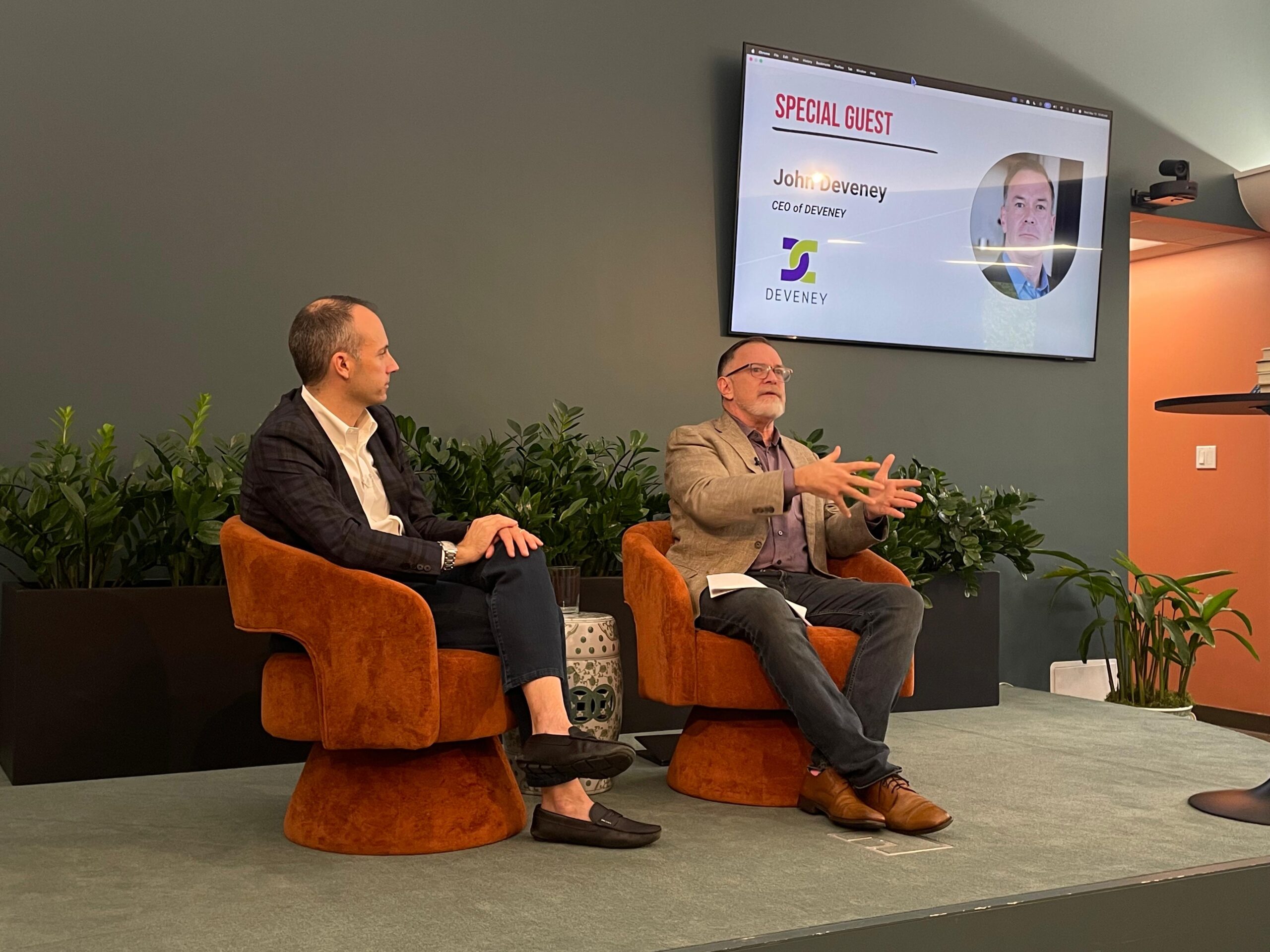
John Deveney, CEO of DEVENEY, on why AI is flooding every channel with content, and why the agents who double down on humanity are about to become the most valuable people in any transaction.
Why It Matters
Every industry is asking the same anxious question right now: what does AI leave for us? The honest answer, according to one of New Orleans’ most seasoned communications strategists, is that the question itself is backward. AI doesn’t eliminate the premium on human connection; it creates one.
John Deveney, CEO of DEVENEY, has spent decades managing crisis communications for publicly traded corporations and local institutions alike, helping rebuild Louisiana’s image after Hurricane Katrina, and training executives to command a room. He sat down with KW New Orleans Operating Principal Jeffrey Doussan to talk about what the AI disruption actually means, and why real estate professionals may be better positioned than almost anyone else to come out ahead.
The State of Play
The communications landscape has shifted faster in the past three years than in the previous three decades. Deveney laid out exactly which tools are being damaged, and which human qualities are quietly appreciating in value.
Success is not going to be the most content, the loudest voice. It’s really going to be who doesn’t communicate most, because everyone can generate and every machine can generate. It’s who can communicate most meaningfully.
John Deveney, CEO, DEVENEY
From Message to Meaning
Deveney draws a sharp line between what AI can do and what it cannot. Generating a message is a mechanical act. Creating meaning is a human one, and that distinction is about to matter more than any content calendar.
He pointed to the Galatoire’s experience as a useful frame. By most objective measures, it is not the finest table in New Orleans. The floors are hard, the lights are up, the room is loud. And yet people love it, return to it, and recommend it, because being there, among other people, is the experience itself. A ghost-concept restaurant that texts you a locker combination delivers the same product and none of the point.
The same logic applies to every industry being reshuffled by automation. Deveney described his visceral frustration with AI phone systems, not because they are incompetent, but because the moment a human being is removed from a transaction, something real is lost. The clients who call KW New Orleans agents are not trying to access information. They are trying to trust someone with one of the most significant decisions of their lives.
Why Real Estate Holds the Advantage
Deveney was direct: real estate is not in the crosshairs the way other industries are, because humanity was never optional in a home sale. It was always the main ingredient.
He contrasted real estate with restaurants moving toward ghost concepts, customer service moving toward automated phone trees, and content industries where AI can now generate an entire marketing campaign overnight. In each of those cases, the human element was added on top of a transaction that could theoretically happen without it. In real estate, the relationship is the transaction. You have walked through the house with your client. You know what they want before they do. You showed up with the right coffee order before a showing. That is not a feature that can be automated away; it is the product.
Doussan shared a moment that crystallized the point: a client flying in for a weekend visit, a colleague out of town, and a simple question sent the night before, what’s your coffee order? The coffees were waiting in a clean car at 9 a.m. It cost less than ten dollars. It punched well above its weight.
People buy from other people… that humanity is the main ingredient of every sale that you do. You know every one of your clients, you’ve walked through the house with them a couple times… that’s what we want. Other industries are being more disruptive because the humanity, that’s going to be the premium.
John Deveney, CEO, DEVENEY
Executive Voice and the Art of Being Heard
Deveney’s firm has been doing executive speaker training for years; it’s actually how he and Doussan first met. But the program has been rebuilt from the ground up into something called Executive Voice, designed specifically for a world where generating words is free and being believed is everything.
The program runs eight modules, covering how the room works, how the body communicates, how the voice carries authority, and ultimately how to construct and deliver a story that moves people. It is conducted in person, deliberately so. The format is flexible, built around the schedules of the cohort going through it. Deveney described the first class wrapping up with four three-hour sessions, a structure the participants themselves shaped.
The case for investing in this kind of training right now is counterintuitive but airtight. Public speaking has historically ranked as the top fear for most people, ahead of almost everything else. That fear has kept it underutilized as a business tool even as its practitioners consistently outperformed. Now, with AI leveling every other communication channel, the executive who can walk into a room and make people feel something has a durable advantage that no language model can replicate.
He made the point with a simple image: a parent making a baby laugh. You don’t issue an instruction. You giggle first. There is a shared nonverbal language between human beings that we are born reading, and that is precisely what AI cannot fake, and what audiences are already sniffing out when it tries.
AI as Tool, Not Threat
For all his emphasis on the limits of AI, Deveney is not arguing against using it. His firm uses it. His policy is simply that nothing leaves the building without a human author taking ownership of it.
He told a story about a client’s assistant who became convinced that the president of her organization was publishing AI-generated content. Her sole piece of evidence: the writing listed things in groups of three. Deveney, who wrote all of that content himself, was genuinely rattled, went back and ran it through an AI detection system, and confirmed it was well within human ranges. The episode stuck with him not because the accusation was serious, but because of what it revealed: the presumption that AI-generated equals bad. That presumption is spreading. It changes the calculus for anyone communicating professionally.
His framework is practical: treat AI the way you treat a photocopier. Nothing inherently wrong with it. You would not hand a client something straight off the machine without reading it first. You use it, you review it, you own the output. The tool does not replace the professional judgment; it just handles some of the labor. KW New Orleans’ own shift to an AI phone system follows the same logic: the agents get their time back, callers get connected faster, and the human relationship is preserved where it actually matters.
AI is like your photocopy machine. There’s nothing inherently evil with using the photocopy machine… you’d want to take it off the machine, look at it, decide this is what’s good for the client, change what needs to be changed, and give it to them.
John Deveney, CEO, DEVENEY
Post-Katrina Lessons That Still Apply
Deveney’s work after Hurricane Katrina was, in many ways, the ultimate test of everything he now teaches. The challenge was not generating content; the national media was generating plenty. The challenge was changing the meaning of New Orleans in the minds of people watching from thousands of miles away.
Working from simultaneous crisis communications centers in Baton Rouge and New Orleans, his team used the tools available at the time (satellite trucks, local and national news coordination) to push recovery coverage into the national feed and eventually persuade outlets like CNN to retire the rooftop rescue footage that had been on loop for months. The mechanics of that work are largely obsolete now. The principle behind it, that meaning requires a deliberate human hand guiding the narrative, has never been more relevant.
John Deveney draws a line that most AI conversations miss: content is already a commodity, and the agents who treat volume as their strategy are competing on the wrong terrain. What appreciates in value as AI floods every channel is exactly what real estate has always been built on: presence, sincerity, credibility, and the kind of emotional intelligence that makes a client trust you with a decision that will shape the next chapter of their life. Deveney’s prescription is not to resist AI, but to stop letting it near the moments that matter. Use it for the labor. Show up, fully, for the relationship. The coffee in the car. The walk through the house. The closing you chose to attend. Those are not soft gestures; in the era he is describing, they are the differentiator.
About this series. KW New Orleans hosts regular conversations with the leaders shaping our city: developers, architects, investors, and operators building the New Orleans of tomorrow. These are the conversations that happen in the rooms most people don’t get invited into.
Be in the Room Where It Happens
KW New Orleans brings together the sharpest minds in real estate, development, and business. If you’re ready to work alongside people building the city’s future, we’d love to talk.