
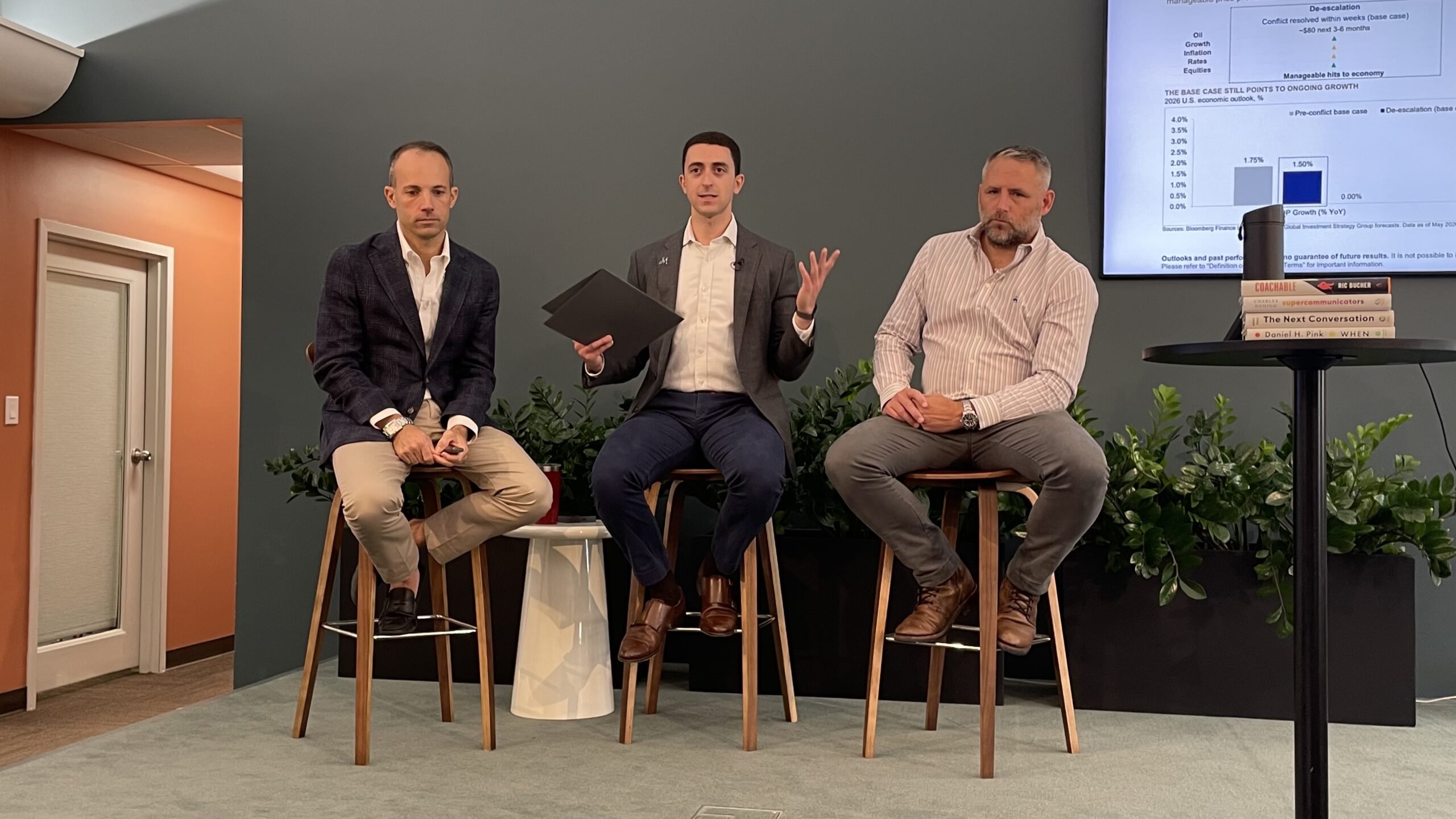
Antonio Carbone, banker at J.P. Morgan Private Bank, on the 2026 midyear outlook for rates, inflation, AI’s grip on the market, and why New Orleans is one of the few housing markets that’s actually moving.
JP Morgan’s 2026 midyear outlook calls for the Federal Reserve to hold rates steady through the end of the year, with GDP growth settling around 1.5% and inflation cooling from a recent 4.2% CPI print toward the 2.9–3.1% range as energy prices normalize. For New Orleans real estate agents, the takeaway is concrete: the local housing market is among a small group of U.S. markets that began thawing in May–June 2026, and the case for adjustable-rate mortgages has rarely been stronger.
Why It Matters
Every real estate conversation in 2026 eventually runs into the same wall: what are rates going to do? The honest answer is that even the biggest bank in the world is watching a Fed committee split exactly down the middle. Eight members think rates go up, eight think they come down. Understanding where we actually stand, rather than where cable news says we stand, is the difference between an agent who can talk to a buyer with confidence and one who shrugs.
Antonio Carbone visits KW New Orleans more than almost any other guest, and there’s a reason for that: he leaves the room feeling more useful than when he walked in. A banker with J.P. Morgan Private Bank, Carbone gives the KW New Orleans team what amounts to a private briefing on where one of the largest financial institutions in the world is placing its bets: on rates, equities, energy, AI, and the housing market specifically.
The State of Play
JP Morgan’s midyear framework organizes the current economic moment around three forces: global fragmentation, inflation, and artificial intelligence. Each one is pulling the economy in a different direction at the same time, which is why the outlook feels so contradictory: strong corporate margins alongside squeezed consumers, record equity levels alongside frozen payrolls.
The companies that are using AI more have higher net margins, they make more money than the ones that are sticking to their guns and refusing to adopt AI.
Antonio Carbone, Banker, J.P. Morgan Private Bank
Rates: On Pause, Not Pivoting
The most recent Federal Reserve meeting ended in something close to a deadlock. The Fed’s rate-setting committee has 19 policymakers, only 12 of whom hold a vote at any given meeting. That meeting itself produced a rate hold, but the committee’s own projections showed officials split almost down the middle on where rates go next, divided between those expecting no change, those anticipating cuts, and a plurality leaning toward hikes. Kevin Warsh, the current Fed chair, declined to signal his own position. JP Morgan’s read: the Fed goes nowhere for the rest of 2026.
That doesn’t mean rates are comfortable. JP Morgan’s forecast puts the 10-year Treasury yield finishing the year around 4.5–4.6%, slightly above where it sits today. That ceiling on the 10-year keeps 30-year fixed mortgage rates elevated: JP Morgan’s own 30-year jumbo product was sitting at 6.25% for borrowers with $25 million or more in assets at the time of this conversation, and 6.875% for borrowers in the $3–10 million range. Those aren’t rates that move inventory on their own.
The more actionable number is what JP Morgan was offering on shorter-duration loans. A 3-, 5-, or 7-year adjustable-rate mortgage (ARM), a loan product where the rate is fixed for the initial term and then adjusts annually, was pricing in the mid-to-high fives for that same $3–10 million borrower. The spread between a 3-year ARM and a 30-year fixed at JP Morgan was more than a full percentage point. For a buyer who realistically plans to sell or refinance within seven years, that spread represents a meaningful reduction in monthly carrying cost. Carbone’s message to agents: make sure buyers run the ARM scenarios, not just the 30-year fixed, before deciding the market doesn’t work for them. You can explore current listings and financing conversations with our team on the KW New Orleans property search.
The New Orleans Housing Market in 2026
JP Morgan published a midyear report in May 2026 titled “Is the Housing Market Thaw Happening?” The answer, as Carbone framed it to the room: it depends entirely on where you live. Markets in the Northeast, Southern California, and Chicago are still locked. New Orleans showed up in the “light green” category: markets beginning to move in the May–June window.
Part of what insulates New Orleans from the rate-lock problem that has frozen other markets is the city’s unusually high share of cash buyers. When roughly half of all transactions don’t involve a mortgage, rate anxiety loses some of its grip. That dynamic, combined with the second cohort of buyers who entered the market in recent years with rates already in the 5.5–6.5% range, means agents can no longer assume every potential seller is anchored to a 2.5% pandemic-era mortgage. According to JP Morgan’s analysis, approximately 25% of current mortgage holders carry rates between four and six percent, a group with far less psychological resistance to moving.
For those buyers and sellers, working with an agent who understands the full financing picture, including what JP Morgan Private Bank can do for jumbo borrowers, is a real competitive advantage. Browse the KW New Orleans agent roster to connect with someone who knows these conversations.
Be happier. A realtor in New Orleans and not in the Northeast or Southern California, Chicago, because we’re Chicago, because those markets are not seeing the same movement that you guys are.
Antonio Carbone, Banker, J.P. Morgan Private Bank
AI, Energy, and the Capital Spending Surge
The electricity demand story is one of the stranger subplots of the current economy. From 2000 to 2025, total U.S. electricity demand was essentially flat; population grew, but efficiency gains offset it. AI data centers have snapped that trend. Utility stocks are rising because, for the first time in a generation, power companies have room to grow revenue.
Entergy is partnering with Meta on a data center project in Louisiana that involves three new natural gas turbines built specifically to power the facility. That’s one data center. Amazon, Microsoft, Google, and Meta collectively are projecting capital expenditure of roughly $800 billion on data center infrastructure across 2026, 2027, and 2028, figures Carbone cited directly from JP Morgan’s analysis. The question of where that electricity comes from (natural gas, nuclear, solar, or some combination) is still being answered in real time.
South Louisiana is already in the middle of that answer. Natural gas export terminals are being built across the region, driven partly by Europe’s need to replace supply that had previously come from Russia and Qatar. That export demand raises domestic natural gas prices, but it also positions Louisiana as a critical node in the new global energy supply chain.
SpaceX went public in the months before this conversation at a valuation exceeding $2 trillion, putting it in the company of Apple and Microsoft by market cap. One driver of investor enthusiasm: the possibility of building data centers in space, where solar power is continuous and cooling is unnecessary. Carbone was direct about the timeline: there is no scientific proof of concept yet, and SpaceX has not yet demonstrated four consecutive quarters of profitability, the threshold required for S&P 500 inclusion. (SpaceX has been added to indices including the Russell 1000, but not the S&P 500.) Investors with S&P 500 index funds should verify what is and isn’t in their fund. The AI buildout is also benefiting Nvidia and, increasingly, Micron Technology, both central to the semiconductor supply chain that powers these data centers.
Tax-Aware Borrowing & the Jumbo Mortgage Opportunity
For agents working with high-net-worth buyers, the JP Morgan Private Bank relationship is worth understanding in detail. The bank handles jumbo mortgages at $750,000 and above, with pricing tiers at $3–10 million, $10–25 million, and $25 million-plus. Rates improve at each tier. At $25 million and above, borrowers receive an additional eighth of a point reduction off the already-discounted rate.
The more interesting product for clients with existing liquidity is what Carbone calls tax-aware borrowing: using a cash position or line of credit to close quickly on a purchase, then refinancing into a mortgage after closing. This approach lets buyers move at the speed of a cash offer while capturing the mortgage interest deduction on the back end. JP Morgan also continues to offer HELOCs (home equity lines of credit, a revolving credit product secured by home equity) in the private bank when many lenders have pulled back. At the time of this interview, HELOC pricing for qualified borrowers was sitting at Wall Street Journal Prime minus a quarter to minus a half point for larger relationships, with standard pricing around the low-to-mid sixes.
Agents who want to look like a resource to a luxury client can simply email Carbone for a current rate chart. If the client is willing to have a broader banking relationship with JP Morgan, the pricing adjusts accordingly. It’s one of the more concrete partnership opportunities discussed in this series. Our KW New Orleans learning center has additional resources on working with jumbo buyers and financing structures.
If you refer a client to me, we can help them execute quickly on the purchase using cash or line of credit, and then refinance that out with a mortgage.
Antonio Carbone, Banker, J.P. Morgan Private Bank
Common Questions
Antonio Carbone came in with a specific message for New Orleans agents: stop waiting for the 30-year fixed rate to save you, and start getting fluent in ARM products. JP Morgan sees the 10-year Treasury finishing the year at 4.5–4.6%, which means long-duration rates stay elevated. The opportunity is in the spread (more than a full point between a 3-year ARM and a 30-year fixed) and in the fact that New Orleans is one of a shrinking list of U.S. markets where deals are actually closing. The cash-buyer base here acts as a buffer that most markets don’t have, and a 25% cohort of existing mortgage holders with rates already in the 4–6% range has far less psychological resistance to moving than the pandemic-era lock-in crowd. The agents who figure out how to talk about ARM structures, tax-aware borrowing, and jumbo relationships, and who can point clients toward partners like JP Morgan Private Bank, are going to out-earn the ones still waiting for rates to hit three percent again. They won’t.
About this series. KW New Orleans hosts regular conversations with the leaders shaping our city: developers, architects, investors, and operators building the New Orleans of tomorrow. These are the conversations that happen in the rooms most people don’t get invited into.
KW New Orleans brings together the sharpest minds in real estate, finance, and development. If you’re ready to work alongside people building the city’s future, we’d love to talk.