
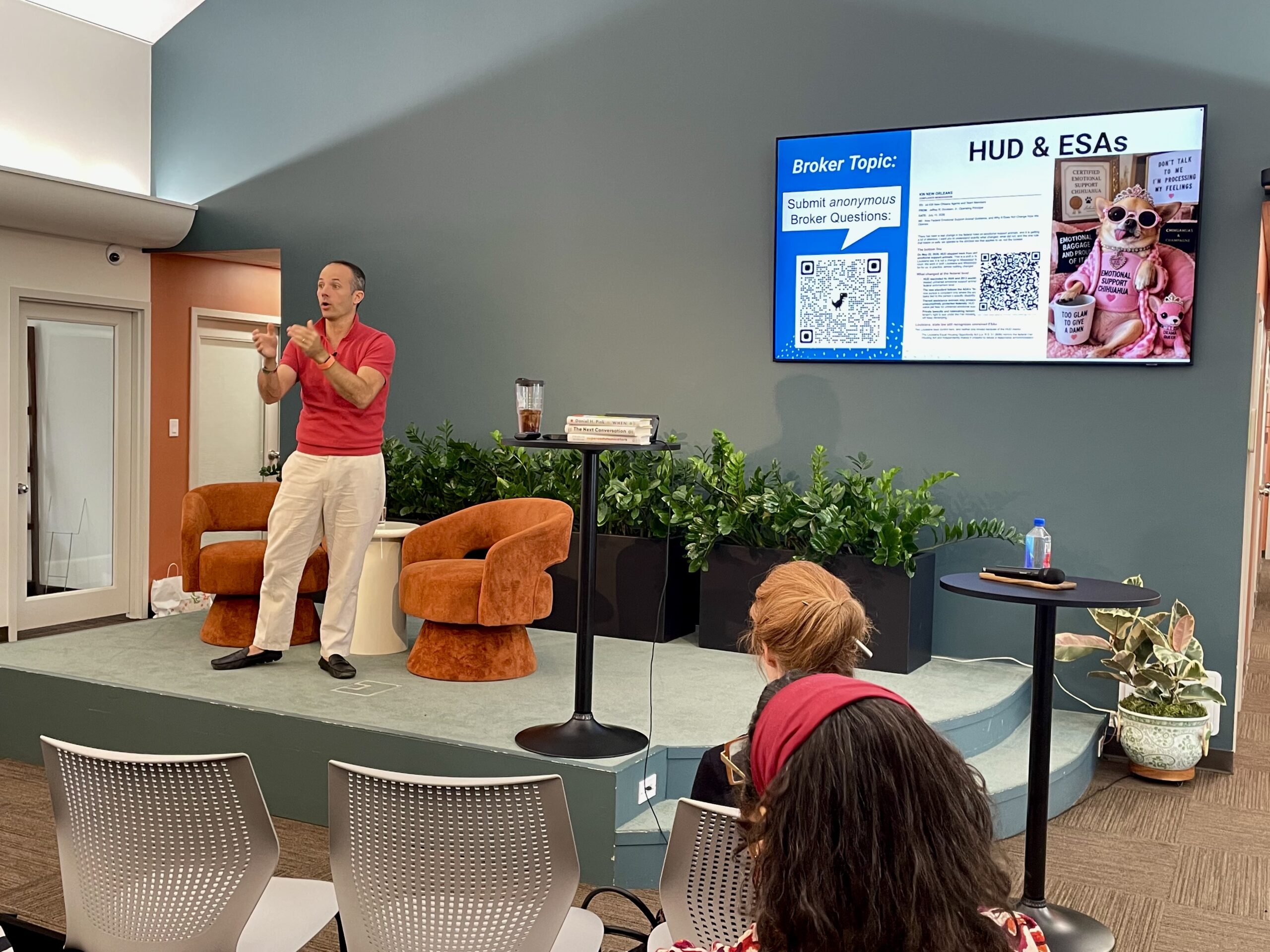
Nichole Donald, Coach/Co-Broker at KW New Orleans, on what the HUD emotional support animal policy change actually means for Louisiana agents and landlords, and why the answer isn’t what most people think.
Between September 2025 and May 2026, the U.S. Department of Housing and Urban Development withdrew its longstanding assistance-animal guidance and announced it will pursue pet-policy accommodation complaints only where the animal is individually trained to perform disability-related tasks. The Fair Housing Act itself has not changed, and neither has Louisiana’s independent protection: the state’s 2024 Support and Service Animal Integrity Act still recognizes emotional support animals while setting strict documentation standards, and the Louisiana Equal Housing Opportunity Act still requires reasonable accommodations. Landlords and agents in Louisiana cannot treat the HUD shift as a green light, and in Mississippi, which has no state ESA housing law, the federal change carries the most weight.
Why It Matters
When a major federal agency rewrites the rules, the news travels fast, and clients hear the headlines before they hear the details. The HUD announcement on emotional support animals landed exactly that way: bold, broadly shared, and widely misunderstood by landlords who assumed they could immediately start charging pet fees, demanding paperwork, and turning away tenants with support animals. In Louisiana, the reality is more complicated, and getting it wrong cuts both ways.
Nichole Donald, Coach/Co-Broker at KW New Orleans, brought this issue to the brokerage floor in July 2026 alongside co-broker Jeffrey Doussan specifically because the gap between federal news and state reality was already creating confusion, and potential fair housing liability, for agents caught in the middle.
The State of Play
Two sets of rules now govern emotional support animals in the markets where KW New Orleans operates, and they point in opposite directions. Here is where each jurisdiction stands as of July 2026.
It went from one extreme to the other, and so they’ve gotten so many cases that went to the Fed level, and they just decided to rescind that particular extension of allowing for emotional support.
Nichole Donald, Coach/Co-Broker, KW New Orleans
What Louisiana Law Still Requires
This is where agents need to be precise, because the gap between the headline and the reality is exactly where fair housing violations happen. Under current Louisiana law, the following remain prohibited regardless of the federal change.
Charging pet fees, deposits, or pet rent for a legitimately documented assistance animal remains a fair housing risk. Louisiana law expressly bars extra charges for trained service dogs (La. R.S. 46:1954), and refusing a reasonable accommodation, including waiving pet charges for a documented emotional support animal, can still violate the Louisiana Equal Housing Opportunity Act and the federal Fair Housing Act. A landlord who wants to change policy based on the HUD news should talk to an attorney first.
Documentation is where Louisiana law actually changed. When a disability-related need is not apparent, a landlord may request reliable supporting documentation, and the 2024 Support and Service Animal Integrity Act defines what counts: a letter from a Louisiana-licensed (or licensure-compact) health care provider qualified to evaluate the condition, based on a therapeutic relationship of at least 30 days, at least two sessions, and a clinical evaluation within the prior 30 days, with the provider’s license information on the document (La. R.S. 46:1974). Instant online ESA certificates do not meet that standard, and misrepresenting an animal as a service animal carries fines of up to $2,500 (La. R.S. 46:1975, 46:1977).
There is still no species limitation in Louisiana’s framework: the statute defines a support animal as any animal other than a service dog that provides assistance or therapeutic emotional support (La. R.S. 46:1973). That breadth is part of why documentation standards tightened: the Legislature chose to police paperwork quality rather than narrow which animals qualify.
The Agent’s Role When Conflict Arises
The practical problem isn’t just knowing the rule; it’s knowing what to do when a landlord and a tenant are on opposite sides of it, and you’re the agent holding both relationships.
The situation Donald and Doussan flagged is one agents encounter regularly: a ready, willing, and able tenant has an emotional support animal; the landlord has a policy, or an insurance carrier, that pushes back. The agent’s job in that moment is not to adjudicate the dispute or to give legal opinions. It is to disclose clearly what the law says, let both parties know this is a legal question that requires an attorney, and then step back. Agents who reach for an answer beyond their license are not helping clients; they are taking on liability that belongs to counsel.
Insurance is a genuine complication. Some carriers restrict coverage based on animal breed or type, which creates a real tension between a landlord’s legal obligation to accommodate and their practical ability to insure the property. That tension does not disappear because the law says the landlord must accommodate; it becomes a problem the landlord and their attorney have to solve. The agent’s role is to present the parties, make the disclosure, and stay out of the middle.
There’s no rule in this game that says we have to have all the answers for every situation for clients.
Jeffrey Doussan, Co-Broker & Operating Principal, KW New Orleans
How to Talk to Clients About This Right Now
Clients on both sides of the transaction, landlords and tenants, are reading headlines that do not match Louisiana’s current legal reality. The agent who gets ahead of this earns trust. The one who says “yeah, the rules changed” without knowing the state-level details creates problems.
For landlord clients: the federal change is real, and Louisiana may well follow. But as of today, Louisiana landlords who deny housing to, or refuse to accommodate, a properly documented emotional support animal are exposed to state fair housing liability, and the documentation standards are now set by state statute, not by the landlord. The advice to any landlord asking about this is simple: consult your attorney before changing any policy based on what you saw in the news.
For tenant clients: Louisiana law still protects emotional support animals, but tenants should expect to provide documentation that meets the Support and Service Animal Integrity Act’s standards. A tenant with compliant documentation who is denied housing or charged pet fees may have a state-level claim even though HUD’s administrative pathway has narrowed.
For agents uncertain about any specific situation, the guidance from the KW New Orleans broker team is direct: if the answer could be multiple things depending on how you read it, you punt. You refer the client to their own attorney and you do not warranty someone else’s legal interpretation. That is not a cop-out; it is the correct professional boundary. You can explore more resources for agents through the KW New Orleans Learning Center or connect with our agent team for guidance on navigating complex transactions.
I brought a ready, willing, and able lessee. You’re a lessor. You all have to bring this together, and this is a legal decision that you have to make with your lawyer and your god.
Jeffrey Doussan, Co-Broker & Operating Principal, KW New Orleans
Common Questions
The HUD announcement created a two-speed legal reality that is already generating confusion in the field. Louisiana landlords who read the federal headlines as a green light (denying documented assistance animals outright or bolting pet fees onto them) are taking on state fair housing risk right now: HUD stepped back, but Louisiana had already modernized its own rules with the 2024 Support and Service Animal Integrity Act, which keeps support animals protected while demanding real documentation from real Louisiana providers. Nichole Donald’s read on where this goes: the Louisiana Legislature will likely move to align with the federal standard, but “likely” and “soon” are not the same as “today.” Until the statute changes, every agent in Louisiana needs to hold the line on the current rules and keep a referral to qualified legal counsel ready for every landlord-tenant conflict involving a support animal. In Mississippi, the federal standard applies immediately. Watch for Louisiana legislative action; when the statute changes, the rules will shift quickly.
About this series. KW New Orleans hosts regular conversations with the leaders shaping our city: developers, architects, investors, and operators building the New Orleans of tomorrow. These are the conversations that happen in the rooms most people don’t get invited into.
KW New Orleans brings together the sharpest minds in real estate, compliance, and market strategy. If you’re ready to work alongside people who stay ahead of the rules, and ahead of the news, we’d love to talk.