
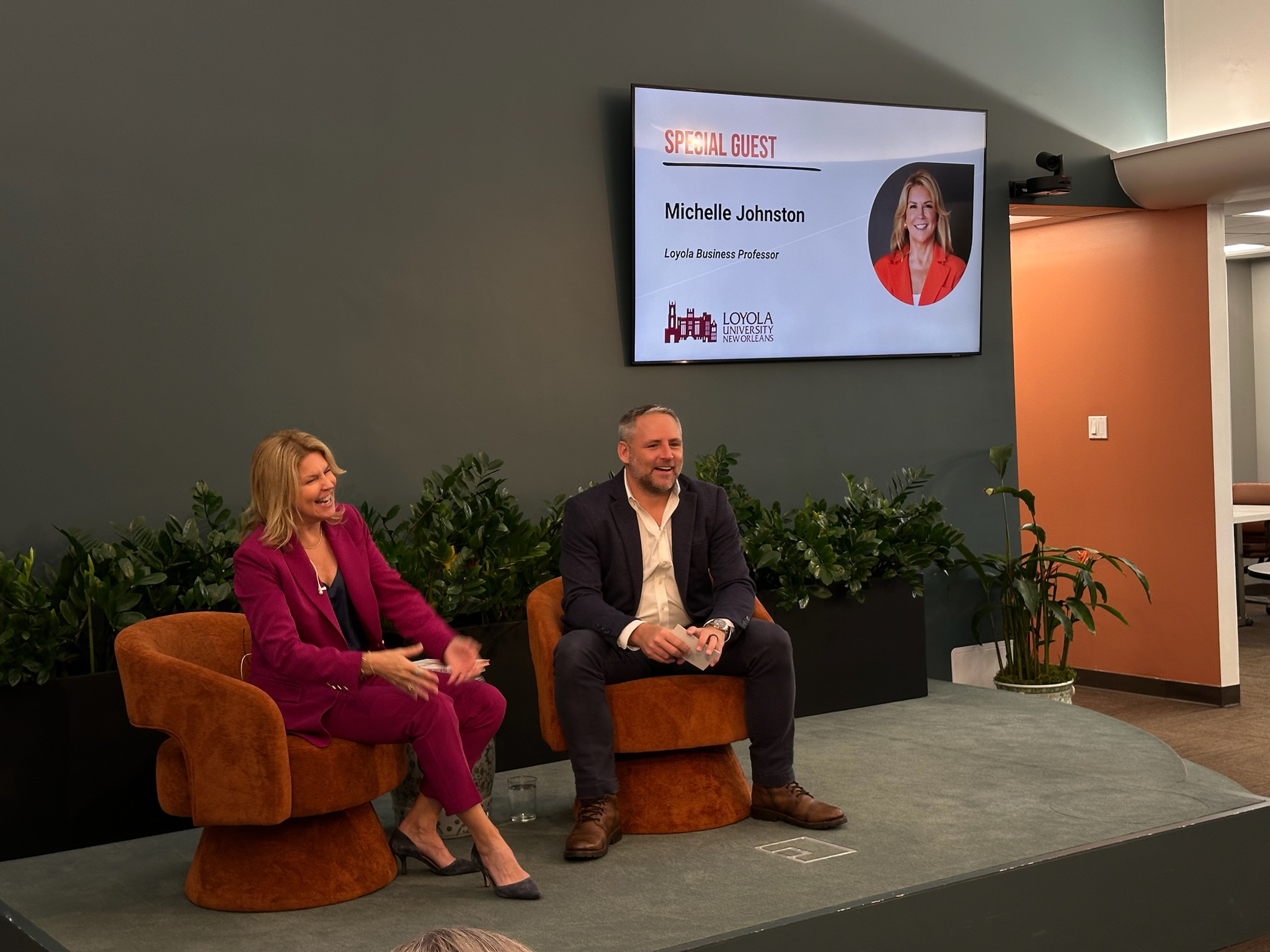
Michelle Johnston, distinguished Loyola professor and connection expert, on why leaders must shift from tasks to relationships and how New Orleans gets it right.
The loneliness epidemic is literally killing American workers, and most leaders are responding with the wrong medicine. While organizations double down on productivity metrics and remote mandates, employees are withering from disconnection at rates that rival smoking addiction.
Michelle Johnston has spent years studying what separates thriving teams from failing ones, and her research points to a counter-intuitive truth: the path to better performance runs through deeper human connection, not more efficient systems.
Watch the Conversation
Johnston’s latest research reveals a workplace crisis hiding in plain sight. Organizations are optimizing for efficiency while employees suffer from isolation that has measurable health consequences.
One of the biggest failures that I’ve seen is, believe it or not, they’re focused on results, results, results, agenda, agenda, agenda, and they’re not lifting their head up to even say hello.
Michelle Johnston, Distinguished Professor, Loyola University
Johnston and Marshall Goldsmith identified seven fundamental changes leaders must make to create connection in an increasingly disconnected world. The shifts move from mechanical management to human-centered leadership.
The framework begins with perspective: shifting from “what” tasks need completion to “who” you get to work with each day. This seemingly simple change transforms how leaders approach their calendars, meetings, and energy allocation.
Johnston tested this with a Finnish CEO overseeing $100 million in port terminal construction near New Orleans. His breakthrough came when he stopped waking up focused on task lists and started seeing his calendar as opportunities to influence and connect with specific people.
Johnston’s most uncomfortable insight centers on a simple truth: show me your calendar, and I’ll show you your priorities. Most leaders discover their most important relationships never appear on their schedules.
This revelation earned Johnston two appearances on NBC News with Kate Snow, who admitted on live television that her most important people weren’t reflected in her daily schedule. The moment illustrated a widespread leadership blind spot.
Johnston learned this lesson painfully when her college daughter confronted her during Christmas break, pointing out that the connection expert had barely seen her own child in two weeks. The incident forced a fundamental rethinking of how intentional scheduling drives relationship outcomes.
Show me your calendar, and I will show you your priorities, and it might make you really uncomfortable.
Michelle Johnston, Distinguished Professor, Loyola University
Johnston argues that New Orleans creates natural connection opportunities that other cities systematically eliminate through suburban sprawl and highway-dependent design.
The city’s front porch culture, festival calendar, and walkable neighborhoods provide built-in relationship infrastructure. Johnston’s daughter, graduating from the University of Georgia, chose to return to New Orleans over Atlanta, Nashville, or Austin specifically because of these connection advantages.
This cultural foundation gives local organizations and real estate professionals distinct advantages in building the relationship-driven teams that Johnston’s research shows drive superior financial performance.
The business world has shifted away from polished perfection toward authentic leadership, but many professionals still struggle to integrate their full selves into their work identity.
Johnston spent years trying to conform to academic expectations, suppressing her naturally enthusiastic teaching style in favor of rigid lecture formats. Her teaching evaluations suffered until she embraced authenticity, leading to improved student engagement and professional satisfaction.
The lesson extends beyond academia: employees and clients increasingly expect leaders to show up as complete humans rather than corporate personas. This shift requires vulnerability that many executives find uncomfortable but necessary.
The days of this is my professional self, my professional life and my professional calendar. And this is the real me and my real priorities and my real calendar. And they’re separate. Those days are over.
Michelle Johnston, Distinguished Professor, Loyola University
For real estate professionals, Johnston’s framework translates into shifting perspective from transaction completion to life transformation. Instead of focusing on listing presentations and CMAs, agents can reframe their work around who they get to help reach their next life chapter.
This approach aligns with New Orleans’ natural advantages in storytelling and architectural history. Agents who connect properties to neighborhood narratives and architectural significance create emotional bonds that purely transactional approaches cannot match.
The connection extends to team dynamics within brokerages. Johnston observed that KW New Orleans morning meetings demonstrate effective relationship-building through shared energy, authentic interaction, and collaborative celebration rather than purely business-focused announcements.
Johnston’s research reveals that connection isn’t a soft skill add-on; it’s the foundation that enables trust, innovation, and financial performance. Leaders who continue prioritizing tasks over relationships will watch their teams wither while competitors in cities like New Orleans leverage natural connection advantages to build thriving, profitable organizations. The choice is simple: evolve toward human-centered leadership or lose talent to leaders who understand that people, not processes, drive results.
About this series. KW New Orleans hosts regular conversations with the leaders shaping our city: developers, architects, investors, and operators building the New Orleans of tomorrow. These are the conversations that happen in the rooms most people don’t get invited into.
Be in the Room Where It Happens
KW New Orleans brings together the sharpest minds in real estate, development, and hospitality. If you’re ready to work alongside people building the city’s future, we’d love to talk.