
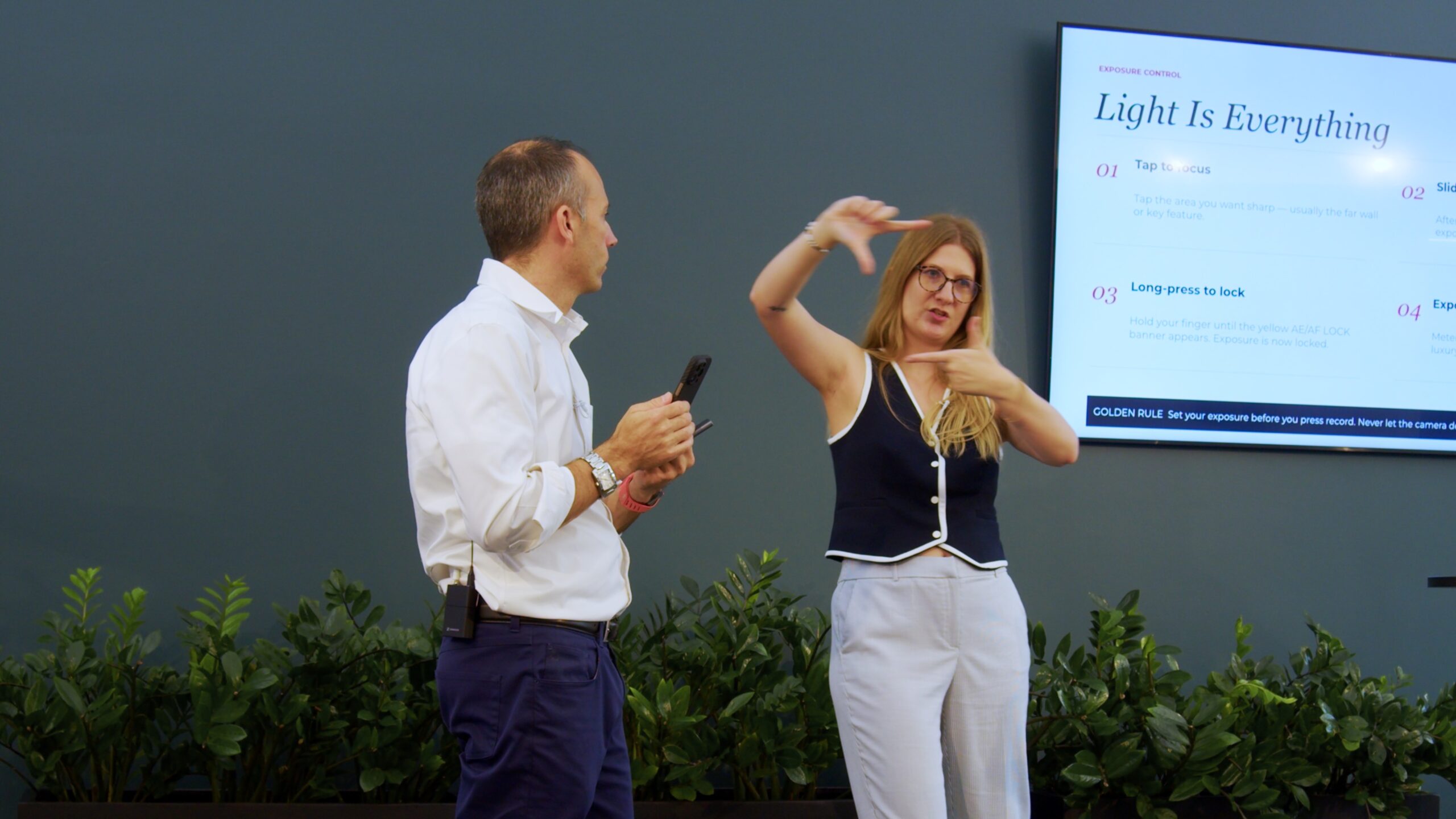
Samantha Morse, Content Specialist at KW New Orleans, on why the camera in your pocket already beats most professional gear, and the handful of settings that separate amateur footage from content that builds trust.
Every agent knows they should be posting video. Most don’t, because they think they need equipment they can’t afford or skills they haven’t learned. That assumption is wrong, and it’s costing them deals.
Samantha Morse came to real estate content from a background in film production, which gives her a perspective most marketing coaches don’t have: she’s worked on sets where getting it wrong is expensive, so she knows exactly which professional rules translate to a phone camera and which ones don’t. What she taught the KW New Orleans team in this session is a masterclass in doing more with less, and doing it right the first time.
Watch the Conversation
Most agents overcomplicate video. The settings that make the biggest difference are already inside your phone; they just need to be unlocked and understood before you hit record.
You could have a cinema camera and still do a bad job. You can have a camcorder from the 80s and make something award-winning.
Samantha Morse, Content Specialist, KW New Orleans
Lighting is the single variable that separates footage that looks professional from footage that looks like it was shot in a hurry. And unlike resolution or frame rate, you can’t fix bad lighting after the fact.
The core rule: always err toward slightly underexposed rather than overexposed. If a portion of the frame blows out to pure white, that data is gone from the file permanently. There’s no recovering it in editing. Dark footage, on the other hand, can often be brightened in post. On an iPhone, tapping the screen brings up the exposure slider. Pull the sun icon down just a few percent before locking your settings. That single habit will immediately upgrade the quality of everything you shoot indoors.
For real estate specifically, natural light is always the most flattering. Open windows, switch on soft lamps, and avoid harsh overhead fixtures. If a space looks good to your eye when you walk in, it will look good on camera. If it doesn’t, no camera setting will save it.
Modern smartphones have three lenses on the back, each covering a different focal length. Knowing which one to use, and which one to avoid, makes a direct difference in how your listings look on screen.
For interior real estate shots, shoot on the standard 1x lens: the one your phone opens to automatically. The ultra-wide 0.5x option might feel appealing because it shows more of a room, but it actively distorts space, making rooms appear smaller and colder, and warping the proportions of anyone in the frame. For detail shots, the 2x lens is the right call. The guiding principle is simple: zoom with your feet, not the camera. Walking closer preserves image quality; pinching to digital zoom degrades it.
If you take nothing else from today, take that.
Samantha Morse, Content Specialist, KW New Orleans
Once your settings are locked and your light is right, the craft of the shot comes down to composition and camera movement, two areas where film industry instincts translate directly to social media content.
The rule of thirds is the foundational composition principle: turn on your camera’s grid overlay and it divides the frame into nine equal sections. Place key elements (a horizon line, a person’s face) along those grid lines rather than dead center. For a room shot, align the floor with the bottom horizontal line. For a person, place their face at an intersection point. These are rules to internalize before you break them intentionally.
For movement, Morse offers a principle that reframes how most agents think about shooting: if your subject is still, you move; if your subject is moving, you stay still. For real estate, where almost everything in frame is stationary, that means the camera operator is responsible for creating visual interest through deliberate, slow movement: heel-to-toe walking with elbows tucked into the body for stabilization, or a simple weight-shift side to side for social clips. The goal is constant, subtle motion that keeps a social media audience engaged without a gimbal or any additional equipment.
One often-overlooked detail: clean your lens before every shoot. A phone that lives in a pocket picks up oil from calls and daily handling, and a smudged lens softens the entire image in a way no setting can correct.
The most expensive lesson in film production, and the one most directly applicable to real estate video, is that editing cannot rescue a bad shoot.
Morse’s background on professional sets gave her a hard rule: anything you can solve in camera, solve in camera. Removing a reflection, correcting blown-out exposure, stabilizing a shaky clip: these are all things that sound fixable in post-production but require significant technical skill and time to execute well. For an agent shooting a listing walk-through between appointments, that’s not a realistic option. The better habit is simply avoiding the problem: duck out of reflective surfaces, lock your exposure before rolling, and move slowly enough that stabilization isn’t an issue.
Audio follows the same logic. The iPhone’s built-in microphone is serviceable for most on-site recording, but it’s located at the bottom of the phone, so blocking it with your hand eliminates it entirely. For noisy outdoor environments, an external microphone with a windscreen is worth adding. For quiet interior shoots, a single AirPod used as a wireless mic can outperform clip-on external hardware for ease and audio quality.
The actual saying is, fix it in pre. Anything you can fix in camera, do it, because editing is a nightmare.
Samantha Morse, Content Specialist, KW New Orleans
There is no universal format for real estate video, and shooting in the wrong orientation for your intended platform is a mistake you cannot fix without cropping out content.
The rule is straightforward: decide where the video will live before you press record. YouTube and long-form content calls for landscape orientation. Instagram Reels and vertical social formats call for portrait. If you need both, shoot twice. Trying to reframe a landscape shot for a vertical feed means losing significant portions of the image on either side.
Jeffrey Doussan closed the session with a point worth taking seriously: closing videos are among the most underleveraged content opportunities in real estate. Every closed transaction is real, verifiable social proof, the kind of specific, local data that both prospective clients and AI-powered search tools increasingly use to evaluate who to trust and recommend. Flooding YouTube with consistent closing content is not just a marketing exercise; it’s a long-term credibility signal in an environment where demonstrated results matter more than polished branding.
Samantha Morse makes a case that is harder to dismiss than most video advice: the gap between amateur and professional real estate content has almost nothing to do with equipment and everything to do with four controllable variables: exposure, lens selection, camera movement, and light. Lock your exposure before rolling, shoot on the 1x lens, move slowly with your body rather than your thumb, and open every window in the room. Those four habits, applied consistently, produce content that reads as professional without a single additional dollar spent on gear. The next step is volume: closing videos posted to YouTube build the kind of specific, verifiable track record that earns trust from both human clients and the AI tools increasingly shaping how people find their next agent.
About this series. KW New Orleans hosts regular conversations with the leaders shaping our city: developers, architects, investors, and operators building the New Orleans of tomorrow. These are the conversations that happen in the rooms most people don’t get invited into.
Be in the Room Where It Happens
KW New Orleans brings together the sharpest minds in real estate, development, and hospitality. If you’re ready to work alongside people building the city’s future, we’d love to talk.