
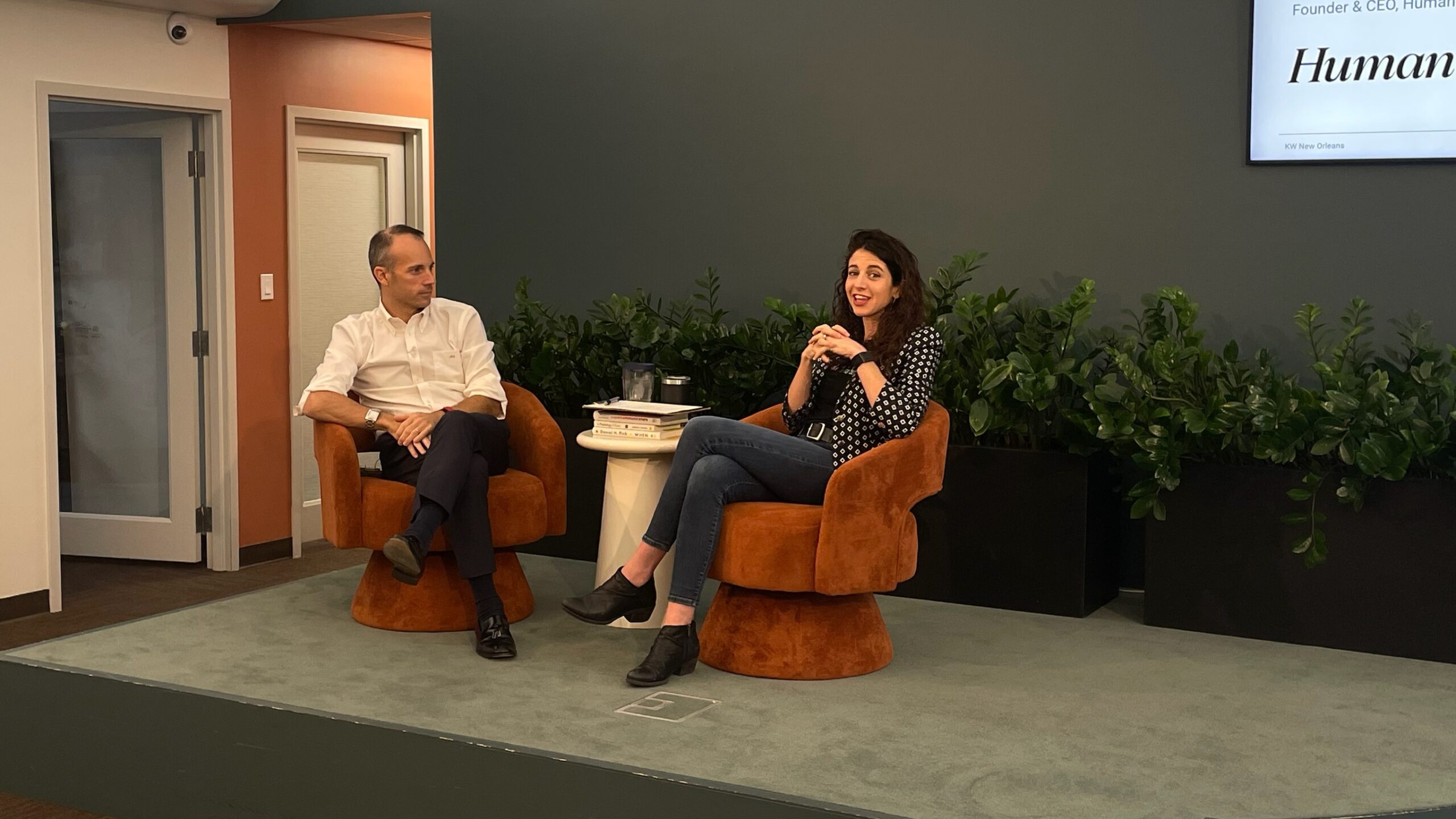
Katie Greenman, Founder and CEO of HumanSide, on the five human strengths AI is quietly eroding, why real estate listing copy already sounds the same, and what it takes to get your brain back.
Artificial intelligence can write your emails, confirm your appointments, and generate a listing description in seconds. What it cannot do is walk into a room and know something is wrong, weigh what actually matters to a specific family, or take responsibility when it gets it wrong. HumanSide Founder and CEO Katie Greenman has identified five human strengths (judgment, intuition, accountability, imagination, and belonging) that AI will not replace, and she is tracking the ways our over-reliance on these tools is slowly eroding each one.
Why It Matters
Every week, someone in real estate declares that AI is either going to save the industry or end it. Both takes miss the more uncomfortable truth: the technology is already changing how agents think, write, and show up, and most of them haven’t noticed yet.
That’s the conversation Katie Greenman brought to a recent KW New Orleans session in October 2026. Greenman runs HumanSide, an experiential culture-building and leadership development firm she founded about 13 years ago out of a simple obsession: what does it actually mean for our species to thrive? For most of that time, HumanSide worked with corporations on alignment, retreats, and training (including building a training academy for Google). Then AI arrived at scale, and suddenly the question she had been asking in conference rooms became urgent everywhere at once.
The State of Play
When Greenman asks a room what risks they associate with AI, she gets the full list fast: job loss, extinction, energy costs, data centers, the end of humanity. Those are real conversations. The risk she focuses on is quieter and already underway.
Our incredible brain that you’ve spent decades developing, all the wisdom that you have, all the creativity that you have, all the opinions that you have and have learned, now all of a sudden we’ve got this sexy little toy that we’re playing with really fast, and it’s eroding some of the stuff that took you decades to develop in yourself.
Katie Greenman, Founder and CEO, HumanSide
The Five Irreplaceable Strengths
Greenman calls herself a fan of AI. Her argument is narrower: some skills can be traded away and you still thrive (the calculator took arithmetic, GPS took our sense of direction), but five human strengths are foundational, and those are the ones that erode when people stop exercising them.
The first is judgment. AI can flag plenty of things that might be important. Only you can decide what actually is. You know the values, needs, desires, and families of the people you serve. A system does not.
The second is intuition. This one is learned through experience: open houses, client calls, difficult conversations. An agent who hears a buyer say they love a house and senses a blocker the buyer has not named has learned that skill. There is no shortcut to it, which is also why Greenman worries about younger professionals who are not getting the same reps.
The third is accountability. AI has no stakes. It is not sitting in the room. The stakes are human, and they are yours: your name is on everything you do and everything you build, including whatever AI helped you draft.
The fourth is imagination. This is where Greenman gets genuinely excited about what AI could do for agents specifically. If the administrative work comes off an agent’s plate, what happens to the hours that used to disappear into it? She described agents from her own home search who made the experience unforgettable. Their communications had a theme, and when she showed up they had set up a toy corner because they knew some people were bringing kids. They made house hunting creative in a way she had not experienced before. The question is what agents do when AI clears that time.
The fifth, and the one Greenman calls the foundation for all the others, is belonging. Why are you doing this? Who are you doing it for? Without a clear answer, the efficiency gains from AI just feed a faster version of the same grind. None of the other strengths function well without a sense of purpose and connection underneath them.
You take away my judgment, my intuition, my accountability, my imagination. I become a less healthy person, a less capable being.
Katie Greenman, Founder and CEO, HumanSide
The Dopamine Problem (and the Digital Spa)
Greenman is blunt about phones, and she frames the problem in terms of brain chemistry. Our brains have limited energy, she says, and dopamine, one of the chemicals that affects how you focus and how you tire, is a limited reserve that social media and AI both draw down with quick hits.
She puts the pull in the same family as chocolate, coffee, and slot machines. Somebody built AI to sell it, she points out, and like social media, a product that makes money from your attention is designed to keep it. Greenman, a fan of the free market, has no quarrel with that. Her warning is that a tool built to keep you engaged will also exhaust you, which helps explain why disconnecting is harder than it sounds.
There is also a second layer. As AI absorbs the small tasks that used to fill a workday (sending that email, checking that box), people spend more of their working hours on high-intensity creative and strategic thinking. Greenman describes ending a day of heavy creative work and not being able to account for where her brain went. Those trivial tasks, she realized, had been giving her small dopamine hits, because each one felt like a win. Remove them, and the workday becomes an unbroken stretch of the hardest kind of thinking. Her conclusion: at that intensity, a 20-hour work week might make more sense, because nobody can think that hard for 40.
Her practical advice is blunter: no one is coming to save you, so be disciplined. Put the phone in a box or leave it in the car; hers stays behind on her Thursday date nights with her husband. Jeffrey Doussan described his own version. The three to five minutes he used to spend on Instagram before his morning workout became an assignment from his coach: 30 seconds of thinking about how he wants to show up that day, then two minutes of breathing and moving. The goal is simply to get through three minutes without touching the phone.
For workshops and retreats, HumanSide goes further with what Greenman calls a “digital spa,” a concept she credits to an executive coach and says HumanSide has evolved. In sessions that teach presence, communication, and mindfulness, participants park their phones in a themed diorama: a campfire scene, a beach setup, a yoga mat with a sunset. The phones get a vacation, and the joke makes it easier to let go. She also has a simpler version at her own dinner table: a box that says “your presence is the present.” Phones go in. Dinner happens. Her mom, she admits, is the biggest culprit.
One Use Case at a Time
Greenman left the room with a challenge that is harder than it sounds: stop trying to do everything at once.
Two weeks before the session, she was at an event for chief transformation officers, enterprise leaders rolling out a huge transformation for 50,000 people. One of the biggest takeaways in that room was about pace. “The hype and the noise is way louder than the reality,” she said. “It’s slower than this.” The feeling of being behind, she added, is itself causing missteps.
Her prescription for individuals is simpler. Identify the one thing in your workflow that costs you the most emotional or logistical energy. Build one AI solution for that thing. Prototype it. Iterate privately. Don’t talk about it until it works. Then pick the next one. When someone tells her they built 50 agents instead of four really good ones, Greenman does not count it as a win. Her first question is how present that person was that week.
She offered a concrete example: a partner, an engineer she rates an 11 out of 10 on AI fluency, who built an agent he calls “mise” (after mise en place, the culinary practice of having everything in its place). Every day, mise sends him a grounding quote aligned with his spiritual beliefs. At 10 o’clock, it reminds him of everything he said he would do and lays out drafts ready for his approval. With the administrative work handled, he spends most of his time on the streets, talking to people and listening.
For agents at KW New Orleans, Jeffrey Doussan sees a version of this taking shape through new agentic AI tools that need no technical setup, the subject of a well-attended KW New Orleans class the day before: appointments confirmed automatically, emails that go out in the morning, routine client requests answered without a person touching every step. The unlock, he argued, is months if not weeks away for a typical agent in the office. More of the office’s AI conversations are collected in the Learning Center. Greenman’s answer: the tools are there for anyone with the capacity to play with them, but the time they free up is only worth something if you know what it is for.
Time is only a gift if you know what you’re going to use it for.
Katie Greenman, Founder and CEO, HumanSide
What This Means for Real Estate Agents
Greenman does not work in real estate. She prepared for this conversation the night before by asking Claude how her framework might apply to agents. That honesty made her point land harder.
From the outside, she sees agents solving a problem she calls “so beautiful and personal”: helping people understand what a home means, and why a home means something so different now. Her suggestion is to spend the time AI frees up with people, talking, listening, and working out new ways to explain the value of the work, the part only an agent can do. John Deveney made a related case in May 2026 about why human connection wins in the AI era.
The agents who will be hardest to replace, in her read, are the ones who use AI to clear administrative drag and then spend that recovered time doing things the system cannot. Sitting with a client who is weighing a neighborhood they have never lived in. Designing an open house that visitors remember. Making the house hunt creative, the way the agents in Greenman’s own search did. That imaginative layer is genuinely irreplaceable, but only if someone is investing in it. If the time AI saves goes straight back into more screen time and more AI use, the irreplaceable thing never gets exercised. If you’re looking at properties in areas like Uptown or the Garden District, the agents who know those streets and those stories will always have something no listing description can carry.
The agents on our team page are building that kind of depth right now. If you want to work with people who are thinking seriously about both the technology and what it means to stay human inside it, that’s where to start.
Common Questions
Katie Greenman wants agents to use AI and to watch what it takes from them. The efficiency gains are real, and so is the erosion. Judgment built across years of client relationships, intuition sharpened by open houses and hard conversations, accountability backed by a name and a license, imagination freed by offloading the grunt work, and the sense of belonging that makes any of it worth doing. Those five things are yours. They atrophy the same way any skill atrophies: through disuse. The agents who come out of this moment strongest will be the ones who used AI to buy back time and then spent that time doing the irreplaceable things. The ones who handed AI everything and waited will have a harder answer when a client asks why they need an agent at all. Join the conversation about how KW New Orleans is building that kind of team.
About this series. KW New Orleans hosts regular conversations with the leaders shaping our city: developers, architects, investors, and operators building the New Orleans of tomorrow. These are the conversations that happen in the rooms most people don’t get invited into.
KW New Orleans brings together sharp thinkers in real estate, technology, and community development. If you’re ready to work alongside people building the city’s future, we’d love to talk.